
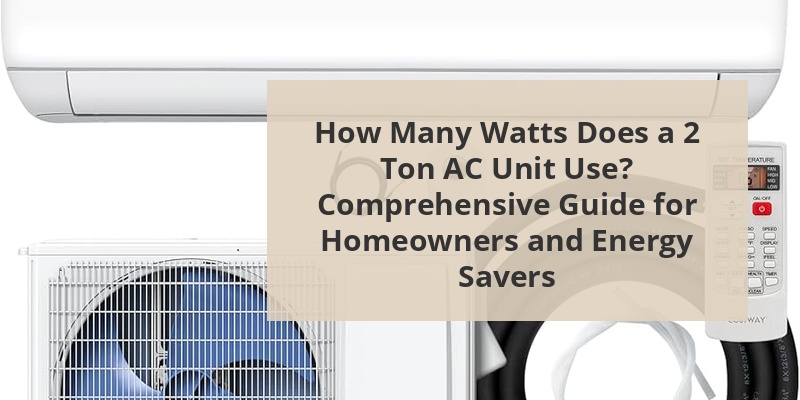
Understanding the energy consumption of a 2 ton air conditioning unit is crucial for homeowners looking to optimize their energy bills or size a backup generator. This article breaks down how many watts a 2 ton AC unit uses, explores the key factors that affect its power draw, and provides practical tips to enhance efficiency. Whether you’re new to HVAC systems or an energy-conscious consumer, gain valuable insights into wattage, efficiency ratings, and more.
| AC Unit Spec | Typical Wattage (Running) | Starting Wattage | Estimated Monthly kWh Use* |
|---|---|---|---|
| 2 Ton (24,000 BTU/h) | 2,000 – 2,800 Watts | 5,000 – 7,800 Watts | 300 – 600 kWh |
*Based on 5-8 hours daily use; efficiency affects actual consumption.
Content Navigation
- What Does “2 Ton AC Unit” Mean?
- How Many Watts Does A 2 Ton AC Unit Use?
- Breaking Down The Math: Calculating Wattage From BTU And SEER
- Wattage Differences By AC Type
- How Start-Up Watts Differ From Running Watts
- Monthly And Yearly Energy Use Estimates
- Factors Affecting 2 Ton AC Power Usage
- How To Measure Your AC’s Actual Power Usage
- 2 Ton AC And Generator Sizing
- Comparing Power Usage: Other Home Appliances Vs. 2 Ton AC
- Ways To Reduce Your AC’s Electricity Usage
- Frequently Asked Questions (FAQs)
- Key Takeaways For Homeowners
What Does “2 Ton AC Unit” Mean?
A 2 ton AC unit refers to the cooling capacity of the air conditioner, not its weight. One “ton” equals 12,000 BTUs (British Thermal Units) per hour. Thus, a 2 ton unit has a cooling output of 24,000 BTU/h. Sizing is critical for home comfort and energy use.
The right tonnage ensures your unit efficiently cools the chosen space without wasting electricity or struggling to perform.
How Many Watts Does A 2 Ton AC Unit Use?
Most modern 2 ton central air conditioners use between 2,000 and 2,800 running watts. However, the initial start-up wattage surges much higher—often between 5,000 and 7,800 watts for a few seconds, especially with standard compressor technology.
The exact wattage depends on several factors, including the SEER rating, brand, age of the unit, and whether it operates as a central, window, or split-system AC.
Call 888-896-7031 for Free Local HVAC Quotes – Compare and Save Today!
Breaking Down The Math: Calculating Wattage From BTU And SEER
Understanding SEER Ratings
The Seasonal Energy Efficiency Ratio (SEER) indicates how efficiently an AC unit operates. The higher the SEER, the less energy (watts) it uses for a set cooling output.
- Formula: Watts = BTU/h ÷ SEER Rating
For a 2 ton (24,000 BTU/h) unit:
- SEER 10: 24,000 BTU ÷ 10 = 2,400 watts/hour
- SEER 16: 24,000 BTU ÷ 16 = 1,500 watts/hour
- SEER 20: 24,000 BTU ÷ 20 = 1,200 watts/hour
Newer units with high SEER ratings use considerably less power than older, less efficient systems.
Wattage Differences By AC Type
- Central Air Conditioner (Standard) – 2,000 to 2,800 running watts
- Ductless Mini-Split (High-Efficiency Inverter) – 1,200 to 2,200 watts
- Window 2 Ton AC (Rare, Larger Window Units) – 2,000 to 2,500 watts
Inverter and variable-speed compressor units can draw less power on partial load, making them more energy efficient throughout variable weather conditions.
How Start-Up Watts Differ From Running Watts
Start-up or surge wattage is the brief spike when the compressor and fan first turn on. For a 2 ton AC, this can exceed 5,000 to 7,800 watts, but usually lasts just a few seconds.
When sizing backup generators, always base calculations on the higher starting wattage to avoid risks of tripping breakers or damaging equipment.
Call 888-896-7031 for Free Local HVAC Quotes – Compare and Save Today!
Monthly And Yearly Energy Use Estimates
The amount of energy a 2 ton AC unit consumes depends on how many hours it runs daily and its actual operating wattage.
| Daily Usage (Hours) | SEER 10 (kWh/Month) | SEER 16 (kWh/Month) | SEER 20 (kWh/Month) |
|---|---|---|---|
| 4 | 288 | 180 | 144 |
| 8 | 576 | 360 | 288 |
Multiply monthly kWh by your utility rate (usually $0.13–$0.25 per kWh) for estimated cost. Higher SEER units save hundreds of dollars per cooling season.
Factors Affecting 2 Ton AC Power Usage
- Efficiency rating (SEER/EER)
- Unit age and condition
- Climate and average temperatures
- Home insulation quality
- Thermostat settings and control habits
- Regular maintenance or clogged filters
These factors can cause wide variations in actual energy draw, even for units of the same size.
How To Measure Your AC’s Actual Power Usage
If you want to know exactly how many watts your 2 ton AC uses, you can:
- Check the manufacturer’s label for amps and volts (W = V x A)
- Use a whole-home electricity monitor (like Sense or Emporia)
- Consult your utility bill for kWh usage spikes during cooling season
Measuring real-time energy consumption can reveal inefficiencies and inform upgrades or repairs.
2 Ton AC And Generator Sizing
If you’d like to run a 2 ton AC unit on a backup generator, choose a generator with at least 8,000 to 10,000 watts of starting capacity, especially if you plan to power other appliances.
Undersizing a generator can lead to voltage drops and damage your AC’s compressor.
Comparing Power Usage: Other Home Appliances Vs. 2 Ton AC
| Appliance | Typical Running Watts |
|---|---|
| 2 Ton AC Unit | 2,000–2,800 |
| Refrigerator (Full Size) | 120–250 |
| Electric Oven | 2,000–5,000 |
| Dishwasher | 1,200–1,500 |
| Vacuum Cleaner | 500–1,200 |
This illustrates that a 2 ton AC unit is one of the largest power draws in most American homes.
Ways To Reduce Your AC’s Electricity Usage
- Upgrade to a higher SEER unit for major efficiency gains
- Install a programmable or smart thermostat to optimize run times
- Seal leaks and add insulation to reduce load on your AC
- Maintain filters and coils regularly
- Use ceiling fans to help distribute cooled air
Simple steps can trim hundreds off your summer cooling bills annually.
Frequently Asked Questions (FAQs)
Can A 2 Ton AC Unit Be Run On Solar Power?
Yes, but requires a robust solar system (typically 2.5–4 kW) with proper battery storage to handle both running and high start-up demands.
What Size Room Is Best For A 2 Ton AC?
Generally, a 2 ton AC is suitable for spaces between 1,000–1,200 square feet, depending on insulation quality and sunlight exposure.
How Does Age Affect Power Use?
Older AC units (10 years+) often use significantly more watts than modern high-SEER systems, sometimes as much as 30–40% more for the same cooling output.
Key Takeaways For Homeowners
- A typical 2 ton AC uses between 2,000–2,800 watts while running, with much higher start-up spikes.
- Actual energy use varies based on SEER, maintenance, usage patterns, and home efficiency upgrades.
- Understanding your unit’s real power draw is essential for accurate energy budgeting and generator planning.
Smart upgrades and habits can dramatically lower your cooling costs and carbon footprint.
Tips for Getting the Best HVAC Prices
- Prioritize Quality Over Cost
The most critical factor in any HVAC project is the quality of the installation. Don’t compromise on contractor expertise just to save money. - Check for Rebates
Always research current rebates and incentives — they can significantly reduce your overall cost. - Compare Multiple Quotes
Request at least three estimates before making your choice. You can click here to get three free quotes from local professionals. These quotes include available rebates and tax credits and automatically exclude unqualified contractors. - Negotiate Smartly
Once you've chosen a contractor, use the proven strategies from our guide — How Homeowners Can Negotiate with HVAC Dealers — to get the best possible final price.