
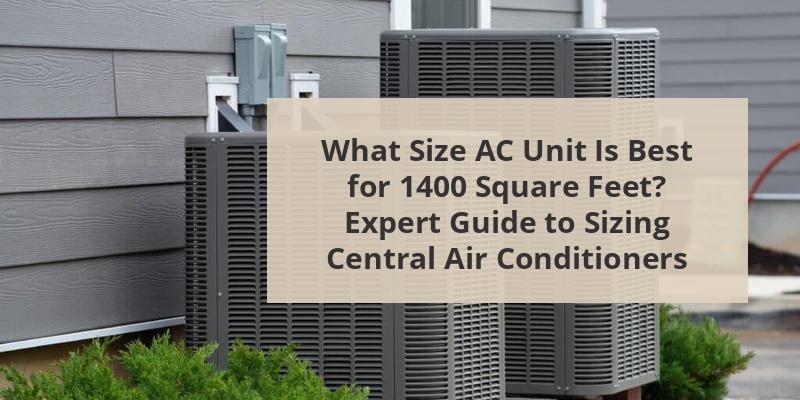
Choosing the right AC unit size for a 1400-square-foot home is essential for comfort, energy efficiency, and cost savings. Oversized or undersized air conditioners can lead to higher bills, uneven cooling, and premature equipment failure. This comprehensive guide details the factors affecting AC sizing, general guidelines, expert tips, and top options, ensuring American homeowners find the best fit for their needs.
| Factor | Typical Recommendation | Notes |
|---|---|---|
| Home Size | 1400 sq ft | Standard Single-Family Home |
| Recommended AC Size | 2.5 tons (30,000 BTUs) | Ranges from 2-3 tons for most 1400 sq ft homes |
| Climate Zone | Varies | Hotter climates may require more BTUs |
| Insulation & Windows | Impacts Sizing | Poor insulation may need larger units |
| Unit Types | Central, Split, Mini-Split | Choice depends on home layout |
Content Navigation
- Why AC Unit Size Matters For 1400 Sq Ft Homes
- How To Calculate The Right AC Size For 1400 Sq Ft
- Rule Of Thumb: AC Sizing Chart For 1400 Sq Ft
- How To Use Climate Zones In Your Calculation
- Factoring Insulation, Windows, And Ceiling Height
- Central AC Versus Other Unit Types For 1400 Sq Ft
- How Many BTUs Do You Need? Step-By-Step Example
- Portable And Window Unit Options For 1400 Sq Ft
- Top Central AC Brands And Models For 1400 Sq Ft Homes
- Common Mistakes When Sizing AC Units
- What Is A Manual J Calculation?
- How SEER Ratings Impact Sizing And Energy Use
- Installation Considerations For AC In A 1400 Sq Ft Home
- Estimated Costs For AC Installation By Unit Size
- How Smart Thermostats And Zoning Can Improve Efficiency
- When To Replace Versus Repair Your AC Unit
- Key Steps For Selecting The Right AC Size
Why AC Unit Size Matters For 1400 Sq Ft Homes
Choosing the correct AC unit size is critical to avoid common problems: Oversized units cycle on and off too quickly, never fully dehumidifying the air. Undersized units run constantly but can’t cool the home, driving up energy use and causing wear. Sizing ensures comfort, efficiency, and long equipment life.
How To Calculate The Right AC Size For 1400 Sq Ft
HVAC professionals use several methods to determine the proper unit size. The most common is by calculating total cooling demand in BTUs (British Thermal Units) per hour. The process involves:
- Square Footage: Begin with the area of the home (1400 sq ft).
- Base BTU Estimate: Industry standards suggest 20-25 BTUs per square foot.
- Adjust For Climate: Warmer regions require more cooling power, colder regions less.
- Insulation Quality: Newer, well-insulated homes may use AC units at the lower end of the BTU range, while older, drafty homes may need more.
- Ceiling Height: Higher-than-average ceilings increase the air volume to be cooled.
- Sun Exposure: More sunlight exposure or large windows increases cooling needs.
- Occupancy & Appliances: More people or heat-producing appliances add to demand.
This individualized approach is more accurate than one-size-fits-all estimates.
Rule Of Thumb: AC Sizing Chart For 1400 Sq Ft
Most experts recommend 2.0 to 2.5 tons (24,000 to 30,000 BTUs) for a 1400-square-foot area, assuming 8-foot ceilings and average insulation. However, the actual required tonnage varies by region and home specifics.
| Square Feet | BTUs Needed | Tons Needed |
|---|---|---|
| 1000 – 1200 | 24,000 | 2.0 |
| 1300 – 1500 | 30,000 | 2.5 |
| 1500 – 1800 | 36,000 | 3.0 |
How To Use Climate Zones In Your Calculation
Climate has a significant impact on how much cooling power you need. In warmer southern states, increase the base BTU by 10-20%; in cooler northern regions, decrease by 10-15%.
Call 888-896-7031 for Free Local HVAC Quotes – Compare and Save Today!
| Region | BTUs per Sq Ft | AC Size (for 1400 sq ft) |
|---|---|---|
| Cool (North) | 18 | 25,200 |
| Average (Midwest) | 22 | 30,800 |
| Hot (South) | 25 | 35,000 |
For exact local adjustments, consult the ACCA Manual J load calculation or an HVAC professional.
Factoring Insulation, Windows, And Ceiling Height
Homes with modern insulation and few windows will require less power than older or leaky buildings. Every additional foot of ceiling height (beyond 8 feet) increases the cubic footage to be cooled—add about 10% BTUs per foot. Large or south-facing windows may require a 10–20% increase.
Central AC Versus Other Unit Types For 1400 Sq Ft
The most common AC systems for a 1400-square-foot property include:
- Central AC—Best for whole-home cooling, offers even distribution, and is highly effective when paired with ductwork.
- Ductless Mini-Split—Good for homes without existing ducts, allows for zoned cooling and high efficiency.
- Split-System (Heat Pump)—Provides both heating and cooling, often recommended for moderate climates.
The sizing principle remains similar, but some ductless options are modular and scale up or down by room.
How Many BTUs Do You Need? Step-By-Step Example
Here’s a practical example for a 1400-square-foot home in a temperate U.S. climate, with moderate insulation, and standard 8-foot ceilings:
- Calculate the base: 1400 sq ft × 22 BTUs = 30,800 BTUs needed.
- Add for modest sun exposure: 5% increase; 30,800 × 1.05 = 32,340 BTUs.
- Adjustment for two adults: typical, no change needed.
- Ceiling height at standard, no adjustment needed.
- Final estimate: 2.5 tons (generally, one ton = 12,000 BTUs, so 32,340 ÷ 12,000 ≈ 2.7 tons).
Selecting a 2.5 or 3.0 ton unit (30,000–36,000 BTUs) would be appropriate for most American homes of this size and description.
Call 888-896-7031 for Free Local HVAC Quotes – Compare and Save Today!
Portable And Window Unit Options For 1400 Sq Ft
If central air is not feasible, multiple window or portable AC units can provide localized cooling. Each room typically needs a separate unit sized for its area:
- Living Room (400 sq ft): 9,000–10,000 BTUs
- Bedrooms (150 sq ft each): 5,000–6,000 BTUs per unit
- Total similar to a whole-home system but distributed by space
Note: This is less efficient and doesn’t provide balanced whole-house comfort.
Top Central AC Brands And Models For 1400 Sq Ft Homes
The following are popular, well-reviewed central AC units suitable for homes around 1400 square feet:
- Carrier Infinity 16: High SEER efficiency and quiet operation
- Trane XR14: Reliable, cost-effective for mid-size homes
- Lennox Elite Series XC14: Excellent warranty, strong efficiency
- Goodman GSX16: Budget-friendly, easy maintenance
- American Standard Silver 16: Durable and consistently high-rated
Ensure the selected model and tonnage match your climate and home features.
Common Mistakes When Sizing AC Units
Errors in sizing can compromise comfort and efficiency:
- Choosing the largest affordable unit “just to be safe”
- Ignoring climate or insulation factors
- Not accounting for ceiling height or sun exposure
- Forgetting to include significant heat sources (e.g., kitchen, lots of electronics)
- Skipping a Manual J or professional assessment
Each home is unique—avoid these mistakes for the best results.
What Is A Manual J Calculation?
Manual J is the industry standard method for calculating residential heating and cooling loads. It includes every variable—dimension, insulation, windows, climate, occupancy, ductwork, and more. Reputable HVAC contractors always conduct this before recommending unit size. This process maximizes comfort and energy savings.
Most Americans can estimate their AC size using basic guidelines, but for best results, hire a certified professional to perform a Manual J assessment.
How SEER Ratings Impact Sizing And Energy Use
AC units have SEER (Seasonal Energy Efficiency Ratio) ratings. Higher SEER = greater efficiency, though the tonnage needed for your square footage stays similar. A high-SEER (16+) unit delivers the same cooling as a lower-SEER unit but uses less electricity. Upfront cost may be higher, but long-term energy bills will be lower.
Installation Considerations For AC In A 1400 Sq Ft Home
Proper installation is crucial to maximize a new AC system’s benefits:
- Ductwork: Must be properly sized, insulated, and leak-free
- Location: Outdoor condenser placement impacts efficiency and noise
- Airflow: Good return and supply air pathways ensure even cooling
- Thermostat: Smart thermostats improve energy savings
- Permits: Local codes may require inspections
These factors are as important as selecting the right size AC unit.
Estimated Costs For AC Installation By Unit Size
The following table provides a general cost estimate for central AC systems in 1400 sq ft American homes (as of early 2025):
| Size (Tons) | BTUs | Installed Price Range |
|---|---|---|
| 2.0 | 24,000 | $4,000 – $6,000 |
| 2.5 | 30,000 | $4,200 – $6,500 |
| 3.0 | 36,000 | $4,500 – $7,000 |
These figures include equipment, installation, and basic ductwork repairs or modifications.
How Smart Thermostats And Zoning Can Improve Efficiency
Pairing a properly sized AC with a smart thermostat can boost energy savings by 10-15% annually. Zone controls or ductless mini-splits allow targeted cooling, which can lower utility bills by reducing cooling in unused spaces. These upgrades maximize the benefits of correct sizing.
When To Replace Versus Repair Your AC Unit
If your system is over 12-15 years old, faces frequent breakdowns, or struggles to maintain comfort, replacing with a properly sized, energy-efficient unit is likely more cost-effective than repeated repairs. Modern ACs provide better comfort control and lower monthly costs, adding value to your home.
Key Steps For Selecting The Right AC Size
- Calculate your exact square footage.
- Assess insulation, windows, sun exposure, and ceiling height.
- Locate your home within the appropriate climate zone.
- Consult a trusted local HVAC professional for a Manual J calculation.
- Choose reputable brands and consider long-term operating costs (SEER rating).
Correct sizing is the foundation for comfort, savings, and peace of mind in your 1400-square-foot home.
Tips for Getting the Best HVAC Prices
- Prioritize Quality Over Cost
The most critical factor in any HVAC project is the quality of the installation. Don’t compromise on contractor expertise just to save money. - Check for Rebates
Always research current rebates and incentives — they can significantly reduce your overall cost. - Compare Multiple Quotes
Request at least three estimates before making your choice. You can click here to get three free quotes from local professionals. These quotes include available rebates and tax credits and automatically exclude unqualified contractors. - Negotiate Smartly
Once you've chosen a contractor, use the proven strategies from our guide — How Homeowners Can Negotiate with HVAC Dealers — to get the best possible final price.