
Finding the Best Inside Wall Heater means balancing size, installation, energy use, and safety. Below is a concise comparison of five well-regarded wall heater options selected for indoor use, including smart, electric panel, and built-in thermostat models ideal for bedrooms, offices, and additions.
| Product | Type / Key Feature | Brand |
|---|---|---|
| Heat Storm HS-1500-PHX-WIFI Infrared Heater | Wi‑Fi Wall Mounted Infrared, Touchscreen | Heat Storm |
| ENVI Plug-in Electric Panel Wall Heater | Low‑wattage Fan‑less Convection, 24/7 Safe Operation | ENVI |
| Dreo Smart Wall Heater WH719S | Oscillating Smart Electric Heater, App/Alexa | Dreo |
| Cadet Com‑Pak Electric Wall Heater CSC151TW | Complete Unit With Thermostat, 1500W | Cadet |
| Cadet Energy Plus Wall Heater CEC163TW | Digital Thermostat, Multi‑Voltage | Cadet |
Content Navigation
- Heat Storm HS-1500-PHX-WIFI Infrared Heater, Wifi Wall Mounted
- Envi Plug-in Electric Panel Wall Heaters For Indoor Use
- Dreo Smart Wall Heater WH719S Electric Space Heater
- Cadet Com-Pak Electric Wall Heater CSC151TW With Thermostat
- Cadet Energy Plus Wall Heater CEC163TW With Digital Thermostat
- Buying Guide: How To Choose An Inside Wall Heater
Heat Storm HS-1500-PHX-WIFI Infrared Heater, Wifi Wall Mounted

The Heat Storm HS-1500-PHX-WIFI is a wall-mounted infrared heater designed to save floor space while offering smart controls. It includes a Wi‑Fi connection for remote thermostat control via smartphone and a touch screen with a built-in digital thermostat. A remote control is included for local adjustments.
Safety features include tip‑over shutoff, and the unit is intended as a wall-mounted solution for bedrooms, kitchens, and offices. The infrared heating method delivers targeted radiant warmth rather than forced-air circulation, which can be preferable for allergy concerns or quiet rooms.
Key considerations: infrared heating warms objects and people directly, so placement relative to seating areas matters. The smart features allow scheduling and remote access, useful for zone heating and energy management.
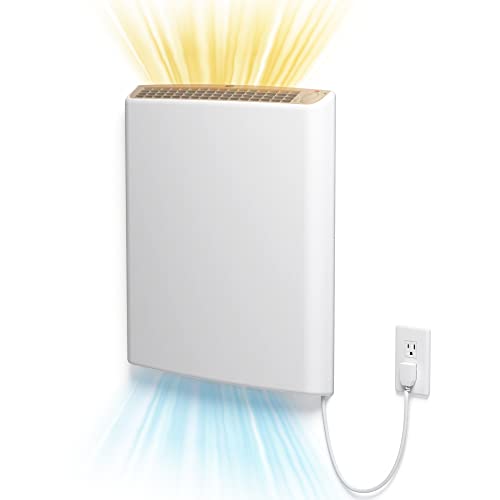
Envi Plug-in Electric Panel Wall Heaters For Indoor Use
Call 888-896-7031 for Free Local HVAC Quotes – Compare and Save Today!
The ENVI Plug-in Electric Panel Wall Heater emphasizes energy efficiency and silent operation. Its patented fan‑less, “stack convection” design provides gentle warmth without blowing dust or allergens, making it appropriate for bedrooms and allergy‑sensitive environments.
This model is engineered for continuous 24/7 operation at a low radiant surface temperature (~90°F) and includes a wall-sense safety sensor that cuts power if removed from the wall. The auto-dimming power light reduces nighttime disturbance.
Because the panel runs quietly and at low heat, it is positioned as a supplemental or primary zone heater for maintaining a stable room temperature with minimal energy waste. Installation is simple, and the design targets users who prioritize steady, non-forced heat distribution.
Dreo Smart Wall Heater WH719S Electric Space Heater

The Dreo WH719S combines smart home integration with vertical oscillation to distribute heat across a room. It offers 120° oscillation for wider coverage than fixed wall units and uses a PTC ceramic heating element for quick temperature response.
Smart features include app control, scheduling, and compatibility with Alexa and Google Home. The thermostat range is broad (about 41°F to 95°F) with 1°F accuracy, and a 24‑hour timer supports automated routines.
Call 888-896-7031 for Free Local HVAC Quotes – Compare and Save Today!
For rooms where even distribution is critical, the oscillation mechanism helps reduce cold spots. The smart controls are useful for preheating schedules or remote management, but network setup and ongoing app use are considerations for some buyers.
Cadet Com-Pak Electric Wall Heater CSC151TW With Thermostat

The Cadet Com‑Pak CSC151TW is a classic complete wall heater unit that includes a built‑in thermostat and 1500W output. It provides reliable electric heating suitable for small to medium rooms and installs in a standard wall can.
This unit focuses on straightforward operation and durable performance. The integrated thermostat helps maintain setpoint temperature without external controls, and the design supports quick heat-up for occupied spaces.
Consider this model when you want a simple, proven hardwired solution that replaces older wall heaters or integrates into existing wiring with minimal changes. Electric units like this are commonly used where central heating is inadequate or for room-by-room zone control.
Cadet Energy Plus Wall Heater CEC163TW With Digital Thermostat

The Cadet Energy Plus CEC163TW adds a digital interface to Cadet’s wall heater line. It features an onboard digital thermostat with push-button controls and a clear display for easy temperature management.
Safety features include thermal safeguard protection that shuts the unit off if internal temperatures exceed safe limits. The unit is compatible with the same wall can as other Cadet Com‑Pak series models, which simplifies upgrades and replacement.
This model is suitable when you want the reliability of a hardwired electric wall heater with added convenience from a digital thermostat. It supports multi-voltage configurations and is useful for tighter temperature control and retrofits.
Buying Guide: How To Choose An Inside Wall Heater
Selecting an inside wall heater requires evaluating room size, installation constraints, energy source, and safety features. Below are key considerations and comparison perspectives to help match a heater to your needs.
Heating Type And Coverage
- Infrared / Radiant: Heats people and objects directly; efficient for targeted zones and avoids circulating dust. Good for seating areas and small rooms.
- Convection / Panel: Warms air gently and evenly; fanless panels provide quiet, allergen‑friendly heating and steady background warmth.
- Forced-Air / Fan-Assisted: Speeds distribution but can move dust; useful where rapid warm‑up is needed.
- Fuel Type: Electric is common indoors for ease of installation and clean operation. Propane/vent-free models deliver high BTU output but require venting considerations and adherence to indoor combustion safety codes.
Power And Room Size
- Match wattage/BTU to the space: higher wattage or BTU for larger rooms. A 1500W electric unit is typical for small rooms; larger spaces may need multiple units or a higher BTU fuel heater.
- Consider insulation, ceiling height, and windows—poor insulation increases required capacity.
Controls And Automation
- Manual Thermostat: Simple and reliable for basic control.
- Digital Thermostat: Offers more precise setpoints and display clarity.
- Smart/Wi‑Fi: Remote control, scheduling, and voice integration can improve convenience and energy management, but require network setup and may have ongoing app dependency.
Installation And Retrofit
- Hardwired units require electrical work and proper wall can mounting. Check voltage compatibility (120V vs. 240V).
- Plug‑in panel heaters simplify installation but need an appropriate outlet and clearance.
- When replacing an existing unit, choose models compatible with the existing wall can to avoid drywall repair and simplify swap‑outs.
Safety Features
- Auto Shutoff / Thermal Safeguard: Prevents overheating and reduces fire risk.
- Tip‑Over Protection: Important for portable or low‑mounted units that could be dislodged.
- Oxygen Depletion Sensor (ODS): Required for indoor combustion heaters; it shuts the unit off if oxygen levels fall.
- Wall‑Sense Sensor: Ensures panel heaters are properly mounted before operation.
Noise, Allergens, And Comfort
- Fanless designs provide silent operation and reduce allergen circulation; desirable for bedrooms and offices.
- Oscillating or fan-assisted units can improve distribution but may increase noise and dust movement.
Energy Efficiency And Operating Cost
- Electric resistance heaters convert nearly all input power to heat but costs vary with local electricity rates.
- Low‑wattage or smart scheduling reduces runtime and can lower operating costs when used for zone heating rather than whole‑home reliance.
- Compare thermostat accuracy and control options to avoid overheating or wasted runtime.
Installation Location And Clearance
- Follow manufacturer clearances to walls, furniture, and drapery. Maintain recommended height and unobstructed airflow for convection units.
- Consider mounting height: higher mounts allow heat to sink into the room; lower mounts provide direct warmth to seated occupants.
Maintenance And Longevity
- Fanless units require little upkeep beyond dusting. Fan‑assisted heaters need occasional cleaning to remove accumulated dust from the blower area.
- Hardwired elements and thermostats can be serviced, but verify parts availability and warranty terms.
Comparison Perspectives
- For Silent, Allergen‑Friendly Heat: Choose a fanless panel heater like the ENVI panel.
- For Smart Control And Scheduling: Consider the Heat Storm or Dreo with Wi‑Fi/app support.
- For Simple, Durable Hardwired Heat: Cadet Com‑Pak and Cadet Energy Plus offer proven performance and easy retrofit options.
- For Even Distribution: An oscillating wall heater such as the Dreo model improves coverage in taller rooms or wide layouts.
Use the above considerations to weigh installation complexity, ongoing operating costs, and the level of automation or safety required for your living space. Review manufacturer installation instructions and local electrical or fuel codes before purchase and installation.
Tips for Getting the Best HVAC Prices
- Prioritize Quality Over Cost
The most critical factor in any HVAC project is the quality of the installation. Don’t compromise on contractor expertise just to save money. - Check for Rebates
Always research current rebates and incentives — they can significantly reduce your overall cost. - Compare Multiple Quotes
Request at least three estimates before making your choice. You can click here to get three free quotes from local professionals. These quotes include available rebates and tax credits and automatically exclude unqualified contractors. - Negotiate Smartly
Once you've chosen a contractor, use the proven strategies from our guide — How Homeowners Can Negotiate with HVAC Dealers — to get the best possible final price.