
Finding the right natural gas shop heater means balancing BTU output, installation type, efficiency, and clearance requirements. This guide highlights top-rated natural gas heaters suited to garages, workshops, and small commercial spaces, and provides a concise comparison to help narrow your choices.
| Product | Type | BTU Rating | Primary Use |
|---|---|---|---|
| Mr. Heater Big Maxx MHU80NG | Unit Heater (Ceiling/Wall) | 80,000 BTU | Large shop / 2,000 sq ft |
| Reznor UDXC-60 | Ceiling Mount Forced Air | 60,000 BTU (two levels) | Garage / Workshop |
| Reznor UDXC-150 | Ceiling Mount Forced Air | 150,000 BTU (two levels) | Large warehouse / commercial |
| Modine Hot Dawg HD45 | Unit Heater (Low Profile) | 45,000 BTU | Residential/commercial garage |
| Mr. Heater MH40NG 40,000 BTU | Infrared Unit Heater | 40,000 BTU | Shops with 12–15 ft ceilings |
Content Navigation
Mr. Heater Big Maxx 80,000 BTU
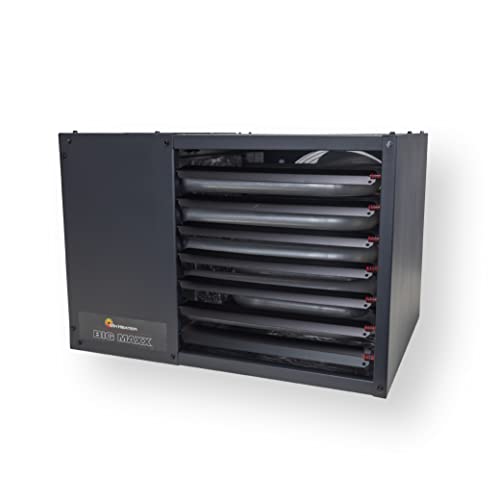
The Mr. Heater Big Maxx MHU80NG is a natural gas unit heater designed for larger garages and shops. The unit delivers 80,000 BTU and lists coverage for up to 2,000 sq. ft.. Installation requires attention to venting category and clearances; the product description notes Category 1 vertical or Category 3 horizontal venting and a minimum 8 ft clearance from the floor to the base of the unit.
Included items from the listing are two angle brackets and a propane conversion kit (thermostat, hose, and regulator are not included). The heater operates on 120 V, 2.3 amps and measures approximately 29.33” L x 15.50” W x 26.37” H. This unit is positioned as a ceiling- or wall-mounted option for heavier-duty shop heating needs.
Reznor UDXC-60 Natural Gas Heater

The Reznor UDXC-60 is a ceiling-mounted forced-air natural gas heater suited for garages and light commercial spaces. The unit provides two effective output settings, with a low-fire output around 34,860 BTU and a high-fire output up to 49,800 BTU, and the model is rated for an 83% thermal efficiency.
Call 888-896-7031 for Free Local HVAC Quotes – Compare and Save Today!
Designed for indoor use, the UDXC-60 includes threaded-nut retainers at four suspension points to support ceiling mounting. The listing emphasizes the heater’s application for garages, workshops, and small warehouses. Because mounting hardware may be sold separately, confirm installation accessories and local venting codes when planning installation.
Reznor UDXC-150 Commercial Heater
The Reznor UDXC-150 targets larger commercial environments with a two-stage output and high thermal efficiency. It delivers low-fire 87,150 BTU and high-fire 124,500 BTU settings per the listing, with an overall 83% thermal efficiency rating.
Like the smaller UDXC model, this unit is engineered for ceiling suspension using the included suspension points. The product listing specifies suitability for warehouses, factories, and large shops; mounting hardware may be required separately. Horizontal Category 1 B-vent options are noted for venting configuration depending on site requirements.
Modine Hot Dawg 45,000 BTU
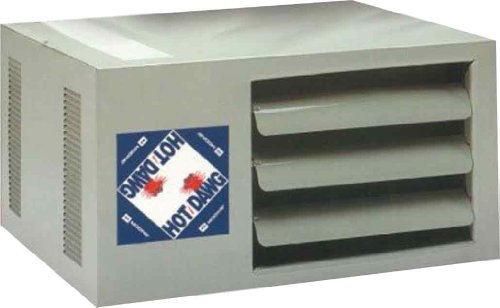
The Modine Hot Dawg HD45 is a compact natural gas unit heater commonly used in residential and commercial garages. The unit provides 45,000 BTU with an 80% efficiency specification listed by the brand. Its low-profile design and neutral color help it blend into workshop ceilings and walls.
Call 888-896-7031 for Free Local HVAC Quotes – Compare and Save Today!
Key listing notes include certified use for residential, commercial, and industrial settings and quiet operation. The compact form factor is intended for spaces where a less obtrusive heater is desired, and the unit’s classification supports general garage and small-shop heating duties.
Mr. Heater MH40NG 40,000 BTU

The Mr. Heater MH40NG is an infrared-style natural gas heater delivering 40,000 BTU, marketed for buildings with 12 to 15 ft ceilings. The unit uses infrared heat to warm objects and people directly rather than relying solely on air temperature.
Features from the listing include efficient infrared heating and specified clearance requirements: Top 36″, Sides & Back 30″, and Below 68″. This unit suits shops where directed radiant heat is preferred and where ceiling height and clearance requirements can be met.
Buying Guide: Choosing The Right Natural Gas Shop Heater
Selecting a natural gas shop heater requires weighing safety, performance, installation, and operating cost considerations. Below are key factors to evaluate before purchase.
Heat Output And Space Size
- BTU Capacity: Match the heater’s BTU output to the volume and insulation level of the space. Larger, poorly insulated shops need higher BTU ratings; compact, insulated garages require less output.
- Coverage Estimates: Manufacturers often provide square-foot coverage estimates—use these as a starting point and adjust for insulation, ceiling height, and open bays.
Heater Type And Heat Distribution
- Unit Heaters (Forced Air): Good for general ambient heating; ceiling- or wall-mounted forced-air units distribute warmed air through fans and ducts.
- Infrared/Radiant Heaters: Heat objects and people directly, useful for spot heating and for areas with high ceilings where air heating is inefficient.
- Portable Forced-Air Heaters: Provide temporary or construction-site heat and are often direct-fired; verify indoor use ratings and ventilation needs.
Efficiency And Operating Costs
- Thermal Efficiency: Higher efficiency ratings mean more of the fuel is converted into usable heat. Compare efficiency percentages where provided.
- Fuel Conversion Kits: Some models include conversion kits but confirm compatibility and installation requirements if switching fuels.
Venting, Clearances, And Safety
- Venting Category: Confirm whether the unit requires Category 1 vertical, Category 3 horizontal, or dedicated B-vent systems and ensure local code compliance.
- Clearance Requirements: Note manufacturer-specified clearances from floors, walls, and obstructions before choosing a mounting location.
- Indoor/Outdoor Rating: Verify the heater’s certification for indoor use if installing inside a garage or shop.
- Combustion Air & Ventilation: Ensure adequate combustion air and follow guidelines for carbon monoxide and exhaust management.
Mounting, Installation, And Accessories
- Mounting Options: Some models include suspension points or brackets, others require separate mounting hardware. Plan for ceiling joist locations and structural supports.
- Thermostat And Controls: Decide between integrated thermostats, separate wall thermostats, or remote controls for zoning and efficiency.
- Electrical Requirements: Confirm voltage and amperage for blower motors or ignition systems; some units need a 120 V supply or dedicated circuits.
Maintenance And Durability
- Service Access: Choose models with straightforward access to burners and electrical components for seasonal maintenance.
- Construction Quality: For harsh environments, look for heavier gauge materials and protective coatings to resist corrosion and wear.
Comparison Perspectives
- Small Workshop vs Large Shop: For small, insulated garages, 30,000–50,000 BTU radiant or unit heaters are often sufficient. For large or poorly insulated spaces, consider 80,000 BTU and above units or multiple units for even coverage.
- Radiant vs Forced Air: Use radiant for spot heating and high ceilings; choose forced-air for whole-space air temperature control and faster warm-up times.
- Permanent vs Portable: Permanent ceiling/wall units provide consistent, code-compliant installations, while portable forced-air heaters work for temporary or jobsite heating where venting is manageable.
Before purchase and installation, consult local building and fuel-gas codes, and consider professional installation for venting and gas line connections. Properly sizing and locating the heater will optimize performance and safety for your shop or garage.
Tips for Getting the Best HVAC Prices
- Prioritize Quality Over Cost
The most critical factor in any HVAC project is the quality of the installation. Don’t compromise on contractor expertise just to save money. - Check for Rebates
Always research current rebates and incentives — they can significantly reduce your overall cost. - Compare Multiple Quotes
Request at least three estimates before making your choice. You can click here to get three free quotes from local professionals. These quotes include available rebates and tax credits and automatically exclude unqualified contractors. - Negotiate Smartly
Once you've chosen a contractor, use the proven strategies from our guide — How Homeowners Can Negotiate with HVAC Dealers — to get the best possible final price.