
Finding The Right Hanging Natural Gas Garage Heater — This guide compares five well-known natural gas heaters suited for garages, workshops, and light industrial spaces. Below is a quick comparison table to help you scan capacity, mounting type, and primary features before diving into detailed reviews.
| Product | BTU / Coverage | Mounting | Key Feature |
|---|---|---|---|
 Reznor UDXC-60 |
60,000 BTU | Ceiling Mount / Hanging | Two heat output levels, 83% efficiency |
Reznor UDXC-225 |
225,000 BTU | Ceiling Mount / Hanging | High-capacity commercial output, 83% efficiency |
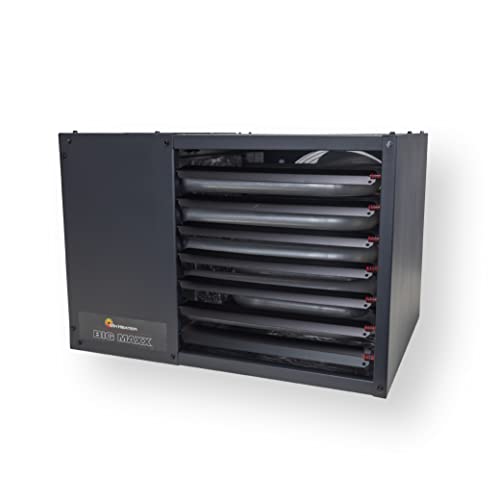 Mr. Heater Big Maxx MHU80NG |
80,000 BTU | Hanging / Bracket Mount | Includes mounting brackets, multiple venting options |
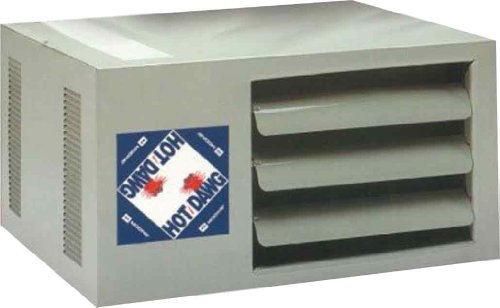 Modine Hot Dawg HD45 |
45,000 BTU | Ceiling/Hanging Low Profile | Quiet operation, certified for residential & commercial |
 Dyna-Glo IR30NMDG-1 |
30,000 BTU (Infrared) | Wall Mount (radiant) | Infrared radiant heat warms objects directly |
Reznor 60,000 BTU Unit Natural Gas Heater UDXC-60
The Reznor UDXC-60 is designed for indoor commercial or residential spaces such as garages and workshops. It is a ceiling-mount hanging heater with four threaded-nut retainers for suspension points, allowing flexible installation with compatible brackets.
Key listed features include a rated 60,000 BTU output with two selectable heat levels (low fire 34,860 BTU; high fire 49,800 BTU) and an 83% thermal efficiency. The unit uses a quiet forced-air, low-static propeller fan intended to move warm air across the workspace. The product targets spaces that need consistent warm air distribution rather than direct radiant heating.
Installation note: mounting hardware is sold separately; confirm ceiling structure and clearances. The design suits suspended mounting where overhead space and ducting or louvers let you direct airflow toward work areas.
Reznor 225,000 BTU Commercial Natural Gas Heater UDXC-225
Call 888-896-7031 for Free Local HVAC Quotes – Compare and Save Today!
The Reznor UDXC-225 is a high-capacity hanging natural gas heater for larger garages, warehouses, or commercial shops. It provides significant output for big spaces while retaining the UDXC series’ 83% thermal efficiency.
Features include 225,000 BTU maximum capacity with dual heat output levels (low fire 130,725 BTU; high fire 186,750 BTU). The indoor unit uses a quiet forced-air low-static fan to push heated air. It includes threaded suspension points for ceiling mounting; brackets are not included.
Consider this model when heating high-volume spaces where forced-air distribution and high BTU are necessary. Ensure gas supply capacity and ceiling structural support meet the unit specifications and local code for commercial gas appliances.
Mr. Heater Big Maxx MHU80NG Natural Gas Unit Heater
The Mr. Heater Big Maxx MHU80NG delivers an 80,000 BTU output intended to cover large garage areas up to several thousand square feet. The package lists include two angle brackets and a liquid propane conversion kit (for those switching fuels), with thermostat and regulator sold separately.
Notable product specs include a compact footprint (approx. 29.33” L x 15.50” W x 26.37” H), category 1 vertical and category 3 horizontal venting options, and manufacturer guidance on minimum clearances (for example, an 8 ft. minimum clearance from the floor to the base of the unit). The unit requires standard 120 V power for controls and fan operation.
Call 888-896-7031 for Free Local HVAC Quotes – Compare and Save Today!
Mounting flexibility and included brackets can simplify hanging installation. Verify your garage’s ventilation plan, gas line capacity, and required clearances before selection to meet safety codes and optimal airflow distribution.
Modine HD45AS0111 Natural Gas Hot Dawg 45,000 BTU
The Modine Hot Dawg HD45 is a 45,000 BTU natural gas unit heater with an emphasis on quiet operation and a low-profile design that suits residential garages and small commercial shops. It is certified for residential, commercial, and industrial use.
Listed features highlight quiet operation, a compact neutral appearance, and suitability for ceiling or hanging installations. The Hot Dawg line typically uses a direct forced-air design for evenly distributing warmed air. The model is often chosen for installations where noise and visual profile matter.
Confirm compatibility with room size and insulation levels. For garages with moderate square footage and average heat loss, this unit can be a balanced option between oversized commercial units and small wall heaters.
Dyna-Glo IR30NMDG-1 30,000 BTU Natural Gas Infrared Wall Heater
The Dyna-Glo IR30NMDG-1 is a 30,000 BTU natural gas infrared heater designed primarily for wall mounting. It uses infrared radiant technology that warms objects and people directly rather than heating the entire air volume rapidly.
Key listed features: Natural gas ready (no conversion permitted), infrared heating that radiates to surfaces first, and coverage claims up to 1,000 sq. ft. Radiant heaters excel when localized warm spots are desired or in spaces with high ventilation where convective systems lose heat quickly.
Note that this model is not a hanging ceiling unit but is included for users considering radiant vs. forced-air solutions. Radiant units often provide immediate perceived warmth for occupants and machinery while using different installation clearances and airflow considerations.
Buying Guide: How To Choose A Hanging Natural Gas Garage Heater
Selecting the appropriate hanging natural gas heater requires balancing heat output, distribution method, installation requirements, efficiency, and safety features. Below are the key factors and comparative perspectives to help narrow options.
1. Determine Required BTU Output
Estimate heat load by considering garage volume (square footage x ceiling height), insulation quality, number of exterior doors, and local outdoor design temperature. As a rule of thumb, small garages may need 20,000–45,000 BTU, medium to large garages 45,000–100,000 BTU, and commercial spaces may require 100,000+ BTU. Oversizing wastes energy; undersizing reduces comfort.
2. Forced-Air Versus Radiant (Infrared)
Forced-air hanging heaters (Reznor, Mr. Heater, Modine) move heated air to distribute warmth across the space. They are effective for whole-space heating and can be mounted centrally. Radiant infrared units (Dyna-Glo) warm objects and people directly, offering faster perceived warmth in zones and lower heat loss in drafty spaces. Choose by use-case: whole-space comfort vs. targeted spot warmth.
3. Mounting And Clearance Requirements
Hanging heaters require adequate ceiling support and specified clearances from combustibles and the floor. Some units supply suspension points but do not include brackets. Confirm structural capacity, mounting hardware needs, and local code for minimum clearances and venting pathways.
4. Venting And Combustion Air
Natural gas heaters can be category 1 (indoor vent), category 3, or direct/indirect vented. Verify venting type: vertical or horizontal venting capability, and whether fresh combustion air is required. Proper venting ensures safe operation and compliance with building codes.
5. Efficiency And Operational Costs
Thermal efficiency indicates how much of the gas BTU becomes useful heat. Higher efficiency reduces gas consumption. However, installation, local gas pricing, and control strategies (thermostats, zoning) also influence operating cost. Compare efficiency ratings like the Reznor units’ 83% figure where available.
6. Noise, Fan Type, And Air Distribution
Consider fan noise for attached garages or workshops. Low-static propeller fans provide quieter operation and broader airflow, while high-velocity fans move air farther. Radiant units have minimal fan noise since they don’t rely on forced air.
7. Safety Features And Certifications
Look for sealed combustion or direct venting where possible, pilot safety valves, pressure regulators, and certification for residential or commercial use. Ensure units meet local codes, and plan for CO detectors and proper clearance to combustibles.
8. Controls, Thermostat Compatibility, And Zoning
Decide whether you need a built-in thermostat interface, remote control, or compatibility with wall-mounted thermostats. Zoning (separating the heated area) helps manage energy usage by heating only occupied sections.
9. Installation Complexity And Professional Requirements
Natural gas installations commonly require licensed professionals for gas line work, venting, and combustion air compliance. Factor in installation time, trades required, and permits. Some units offer easier bracket-based hanging; others need custom support or vent systems.
10. Comparative Perspective: Small Garage Versus Large Commercial Bay
- Small Residential Garage: Consider Modine Hot Dawg or a lower-BTU forced-air unit for quiet operation and easier mounting.
- Medium Workshop/Two-Car Garage: Units in the 45,000–80,000 BTU range like Modine or Mr. Heater provide balanced coverage.
- Large Commercial Spaces: High-BTU ceiling-hung units such as the Reznor UDXC-225 provide the capacity to heat high-volume spaces; confirm gas supply and structural support.
- Spot Heating Or Drafty Spaces: Infrared heaters (Dyna-Glo) deliver direct perceived warmth for workstations or partially open bays.
Final selection should weigh required BTU, distribution method (forced-air vs. radiant), venting and clearance needs, efficiency, and installation logistics. Always consult local codes and a licensed HVAC professional for gas appliance installations and safety verification.
Tips for Getting the Best HVAC Prices
- Prioritize Quality Over Cost
The most critical factor in any HVAC project is the quality of the installation. Don’t compromise on contractor expertise just to save money. - Check for Rebates
Always research current rebates and incentives — they can significantly reduce your overall cost. - Compare Multiple Quotes
Request at least three estimates before making your choice. You can click here to get three free quotes from local professionals. These quotes include available rebates and tax credits and automatically exclude unqualified contractors. - Negotiate Smartly
Once you've chosen a contractor, use the proven strategies from our guide — How Homeowners Can Negotiate with HVAC Dealers — to get the best possible final price.