
Choosing A Gas Heater depends on whether you need whole-house hot water, central space heating, or supplemental room heat. The table below summarizes the five selected gas heaters from Amazon to help compare core features at a glance.
| Product | Type | Key Output / Flow | Primary Use |
|---|---|---|---|
| Rinnai V75IN Tankless Hot Water Heater | Indoor Tankless Water Heater | 7.5 GPM | Whole-house hot water |
| ThermoMate 102,000 BTU Tankless Water Heater | Indoor Tankless Water Heater | 4.7 GPM, 102,000 BTU | Multi-point hot water, whole-house |
| Orbek 100,000 BTU Tankless Water Heater | Indoor Tankless Water Heater | Up To 4.3 GPM, 100,000 BTU | On-demand hot water |
| Rheem RTG-95DVLN-3 Tankless Natural Gas Water Heater | Indoor Tankless Water Heater | 9.5 GPM | High-capacity whole-house hot water |
| Mr. Heater MHVFRD20NGT Vent Free Radiant 20,000 BTU | Vent-Free Radiant Space Heater | 20,000 BTU | Supplemental room heating |
Content Navigation
- Rinnai V75IN Tankless Hot Water Heater
- ThermoMate 102,000 BTU 4.7 GPM Tankless Water Heater
- Orbek 100,000 BTU Natural Gas Tankless Water Heater
- Rheem RTG-95DVLN-3 High Efficiency Tankless Natural Gas Water Heater
- Mr. Heater MHVFRD20NGT Vent Free Radiant 20,000 BTU Heater
- Buying Guide: How To Choose The Right Gas Heater For Your House
Rinnai V75IN Tankless Hot Water Heater
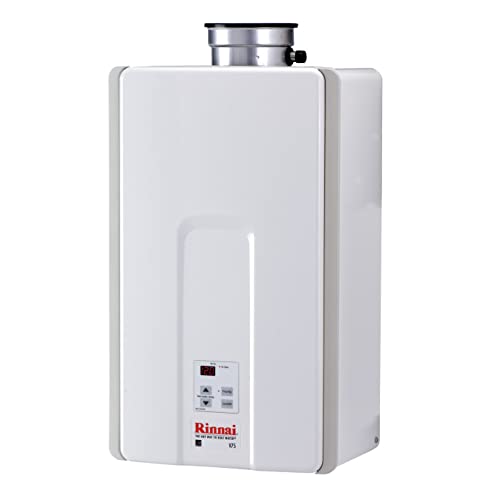
The Rinnai V75IN is an indoor tankless natural gas water heater designed to deliver endless hot water with a compact footprint. It provides up to 7.5 GPM, supporting multiple fixtures simultaneously for whole-house applications.
Key features include energy-efficient on-demand heating that only operates when hot water is needed, reducing standby losses. The model lists enhanced scale detection to help mitigate long-term mineral buildup. Rated flow and performance suggest serving around five appliances depending on temperature rise.
Installation considerations: indoor venting and proper gas supply are required, along with professional sizing to match household demand. The compact design suits tighter mechanical spaces while offering higher flow than many small tankless units.
ThermoMate 102,000 BTU 4.7 GPM Tankless Water Heater

Call 888-896-7031 for Free Local HVAC Quotes – Compare and Save Today!
The ThermoMate tankless unit offers 102,000 BTU with a rated 4.7 GPM, intended for multi-point simultaneous use in medium-sized households. It emphasizes tight temperature control with the built-in sensor adjusting heating power frequently to maintain ±1°F fluctuation.
Safety and reliability features listed include boil-dry protection, freeze protection, flame-out protection, and multiple over-temperature and pressure safeguards. The heat exchanger is oxygen-free copper for improved thermal conductivity and corrosion resistance, and the manufacturer highlights a high thermal efficiency and UEF.
Practical application: good for households needing balanced hot water across several fixtures where stable temperature and safety protections are priorities. Proper venting and professional installation are required for indoor natural gas models.
Orbek 100,000 BTU Natural Gas Tankless Water Heater

The Orbek 100,000 BTU tankless water heater delivers up to 4.3 GPM and is CSA certified for safety and compliance. The unit promotes endless on-demand hot water and is rated to serve 2–3 fixtures simultaneously depending on flow and temperature rise.
Highlighted features include multiple safety protections—dry combustion protection, overheat protection, water leakage protection, and flame failure protection. The heat exchanger is oxygen-free copper and the unit offers three heating modes for seasonal adjustments and energy savings.
Call 888-896-7031 for Free Local HVAC Quotes – Compare and Save Today!
Suitable uses include residential indoor installation where CSA certification and multi-mode energy settings are priorities. Consider matching GPM and BTU to household peak demand to avoid cold water events during simultaneous heavy use.
Rheem RTG-95DVLN-3 High Efficiency Tankless Natural Gas Water Heater

The Rheem RTG-95DVLN-3 is a high-capacity indoor non-condensing tankless water heater rated at 9.5 GPM, designed to handle whole-house demand including multiple showers and appliances running at once.
Primary features emphasize continuous hot water delivery and energy savings from on-demand operation. Rheem also notes a water-saving setting that can reduce household water usage significantly by minimizing wasted warm-up time.
Considerations: this higher-flow model requires sufficient gas supply capacity and appropriate venting. It targets larger homes where higher simultaneous demand for hot water is common. Professional sizing and installation ensure best performance and compliance.
Mr. Heater MHVFRD20NGT Vent Free Radiant 20,000 BTU Heater

The Mr. Heater MHVFRD20NGT is a vent-free radiant wall heater providing 20,000 BTU and designed as a supplemental heat source for spaces up to about 700 sq. ft. Its infrared radiant technology warms objects and people directly rather than heating air alone.
Features include automatic low-oxygen shut-off (ODS) for safety and multiple burner tiles to produce radiant warmth. The model is positioned for offices, garages, sunrooms, patios, and cabins as a supplemental or primary source in limited spaces.
Note: vent-free heaters introduce combustion byproducts into the living space and may be restricted by local codes or indoor air quality considerations. Installation guidance and adherence to manufacturer clearance requirements are important when used inside homes.
Buying Guide: How To Choose The Right Gas Heater For Your House
Selecting the best gas heater depends on the intended function: water heating for domestic hot water, space heating for rooms, or centralized systems. Below are key considerations to guide selection from multiple perspectives.
Tips for Getting the Best HVAC Prices
- Prioritize Quality Over Cost
The most critical factor in any HVAC project is the quality of the installation. Don’t compromise on contractor expertise just to save money. - Check for Rebates
Always research current rebates and incentives — they can significantly reduce your overall cost. - Compare Multiple Quotes
Request at least three estimates before making your choice. You can click here to get three free quotes from local professionals. These quotes include available rebates and tax credits and automatically exclude unqualified contractors. - Negotiate Smartly
Once you've chosen a contractor, use the proven strategies from our guide — How Homeowners Can Negotiate with HVAC Dealers — to get the best possible final price.
Type And Primary Use
- Tankless Water Heaters (On-Demand): Best for continuous domestic hot water. Evaluate GPM (gallons per minute) and BTU capacity relative to peak simultaneous fixtures.
- Vent-Free Radiant/Wall Heaters: Designed for supplemental room heating; note indoor combustion and ODS safety systems. Check local code allowances.
- Unit Heaters / Garage Heaters: High-BTU forced-air or unit heaters are suitable for large, open spaces like workshops or uninsulated garages.
Capacity And Sizing
- For tankless water heaters, calculate peak demand: add expected flow rates for simultaneous fixtures (showers ~1.5–2.5 GPM each, dishwasher ~1.5 GPM, washing machine ~1–2 GPM).
- For space heaters, size by square footage and insulation: a 20,000 BTU vent-free unit typically serves up to ~700 sq. ft under moderate conditions. Larger or poorly insulated spaces need higher BTU outputs.
- Ensure gas supply line and meter can support chosen BTU ratings; some high-BTU tankless units require service upgrades.
Efficiency And Operating Cost
- Tankless systems save energy by eliminating standby losses; check published UEF (Uniform Energy Factor) or thermal efficiency.
- High thermal efficiency and oxygen-free copper heat exchangers can reduce energy waste and improve longevity.
- Vent-free space heaters operate at very high combustion efficiency but may impact indoor air quality and humidity.
Venting And Installation
- Indoor tankless units require correct venting category (direct vent, power vent, or non-condensing requirements). Follow manufacturer venting specifications.
- Outdoor-rated tankless heaters avoid complex indoor venting but must be located where freeze protection and exposure are considered.
- Vent-free heaters do not need external venting; check local building codes and manufacturer minimum clearances.
Safety Features And Certifications
- Look for ODS (oxygen depletion sensor) on vent-free heaters, flame failure devices, freeze protection, overheat and boil-dry protections for water heaters.
- Certification matters: CSA, ANSI, or other local approvals indicate compliance with safety standards.
- For indoor combustion appliances, carbon monoxide detectors and proper CO monitoring are recommended for occupant safety.
Durability, Materials, And Maintenance
- Heat exchanger materials affect longevity: oxygen-free copper offers high conductivity; stainless steel is corrosion resistant. Check manufacturer claims and warranty terms.
- Scale detection and descaling procedures are important for hard-water areas; models with scale management can reduce maintenance frequency.
- Annual inspection and service by qualified technicians preserve efficiency and safety, especially for gas and venting systems.
Performance Tradeoffs And Comparison Perspectives
- Higher GPM vs. BTU: Higher GPM ratings provide more simultaneous flow; higher BTU supports larger temperature rises at the same flow. Match both to your household’s inlet water temperature and demand.
- Indoor Venting vs. Outdoor Units: Indoor units need proper venting and clearances; outdoor units can be easier to vent but are exposed to weather and may require freeze protection.
- Supplemental vs. Whole-House: Vent-free radiant heaters are efficient for targeted rooms but are not substitutes for whole-house heating systems. Tankless water heaters serve domestic hot water needs, not space heating.
Installation And Professional Advice
- Always consult licensed HVAC/plumbing professionals for sizing, gas line capacity, venting design, and local code compliance before purchase and installation.
- Confirm warranty conditions and whether professional installation by certified technicians is required to maintain warranty coverage.