
Choosing the right 90° heater hose or fitting is essential for reliable coolant routing in swaps, restorations, and custom engine bays. Below is a clear comparison of top 3/4″ to 5/8″ 90-degree solutions including molded hoses, fittings, and adapters suited for Chevy SBC, LS swaps, and universal applications.
| Product | Type | Fits / Notes |
|---|---|---|
| LS Swap Heater Hose Set (BLACKHORSE-RACING) | Molded Hose Set | LS engines, tight clearance |
| Vintage Air 099006 | Molded 90° Reducer | 3/4″ to 5/8″, molded elbow |
| EDGE INDUSTRIAL Brass Elbow | Barbed Brass 90° | 5/8″ barb to 3/4″ MNPT |
| HEATER HOSE FITTING (BLUE ELF) | 90° Aluminum Fitting | 5/8″ nipple x 1/2″ pipe thread |
| Aluminum Heater Hose Fitting (jasperautopart) | CNC Aluminum 90° | SBC Chevy applications |
Content Navigation
LS Swap Heater Hose Set 90° Molded

Type: Molded hose set with both 5/8″ and 3/4″ IDs. This kit was designed for LS engine swaps where passenger-side clearance is limited.
Key Features: Size pairing (5/8″ ID x 4″ x 24″ and 3/4″ ID x 4″ x 24″), molded 90° bends, intended to avoid interference with control arms or inner fenders. The set is marketed as a direct solution for common LS water pump heater outlet clearance issues.
Use Case: Recommended when routed paths need precise bends and when space prevents using standard straight hose plus clamps. The molded shape reduces kinking risk compared to flexible hose for tight bends.
Vintage Air 099006 90° Molded Reducer

Call 888-896-7031 for Free Local HVAC Quotes – Compare and Save Today!
Type: Single molded 90° reducer elbow from 3/4″ to 5/8″.
Key Features: Factory-style molded elbow that reduces from 3/4″ to 5/8″ bore and provides a clean 90° turn. Molded construction provides consistent diameter transition and a smooth internal flow path.
Use Case: Ideal when a single, compact 90° reduction is needed between heater outlets and smaller hoses, especially in HVAC or restoration projects where OEM-style molded components are preferred.
EDGE INDUSTRIAL Brass 90° Elbow Barb

Type: Brass 90° barb to male NPT fitting, rated for multiple fluids.
Key Features: 5/8″ barb x 3/4″ Male NPT, 150 PSI max working pressure, -40° to 160°F temperature range. Note the 3/4″ NPT thread measures approximately 1.050″ OD in linear inches per the listing.
Call 888-896-7031 for Free Local HVAC Quotes – Compare and Save Today!
Use Case: Useful when connecting hose to threaded ports or adapters, and where metal barb fittings provide durable clamping surfaces. Brass offers corrosion resistance compatible with coolant, oil, and fuel applications under the listed conditions.
Blue Elf 90° Heater Hose Fitting

Type: 90° aluminum heater hose fitting with 5/8″ nipple and 1/2″ pipe thread interface.
Key Features: Marketed for Chevy part cross-references (#4530/9514X). The fitting provides a 5/8″ nipple for hose attachment and a 1/2″ pipe thread for intake manifold/interface use. The listed build emphasizes performance and fitment for Chevy water pump/outlet configurations.
Use Case: Appropriate when replacing or upgrading factory fittings on SBC engines or Chevy applications that expect a 1/2″ pipe thread to nipple transition with a 90° orientation.
Aluminum 90° Heater Fitting For Chevy SBC
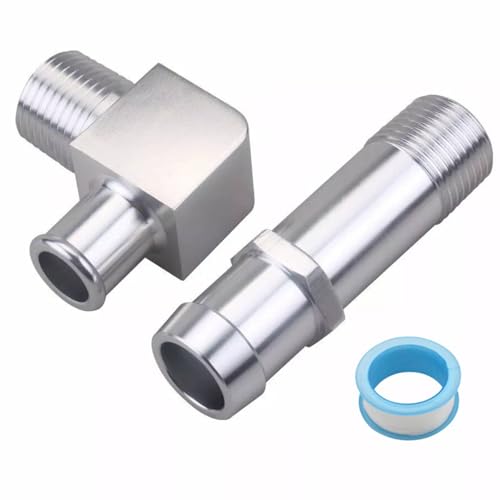
Type: CNC-machined aluminum 90° fitting targeted at SBC Chevy engines (283–400 series).
Key Features: 5/8″ nipple x 1/2″ pipe thread for intake manifold and a straight 3/4″ nipple with 1/2″ pipe thread for the water pump. Made from 6011 aluminum alloy, corrosion resistant and machined for tighter tolerances.
Use Case: Best suited for restorations or custom plumbing on classic Chevy platforms where a durable, lightweight metal fitting and OEM-style dimensions are required.
Buying Guide: What To Consider When Choosing A 3/4 To 5/8 90° Heater Hose Or Fitting
Application Compatibility — Confirm whether the part is intended for an LS swap, SBC Chevy engine, vintage HVAC, or universal systems. Check inlet/outlet thread standards (NPT vs pipe thread) and OEM cross-reference numbers where available.
Material And Durability — Molded rubber or silicone hoses provide flexibility and integrated bends, while aluminum and brass fittings offer rigidity and durability. Consider corrosion resistance and compatibility with coolant chemistry (ethylene glycol, propylene glycol, or mixed fluids).
Connection Types — Determine whether you need a barb-to-thread, barb-to-barb, or molded hose reducer. Barbed fittings require clamps; threaded fittings require correct sealing (PTFE tape or OEM-style seals). Verify thread sizes (3/4″ NPT vs 1/2″ pipe thread, etc.).
Internal Diameter And Flow — A reduction from 3/4″ to 5/8″ reduces cross-sectional area and may affect flow rate. For heater core feed/return lines, confirm that the reduced diameter still meets system heating needs and pump capacity.
Temperature And Pressure Ratings — Check max working pressure and temperature ratings for the material. Brass fittings often list PSI and temperature limits; silicone hoses typically offer higher temperature tolerance and improved longevity over basic rubber.
Fitment And Clearance — Molded 90° hoses are useful when precise bends are required to avoid interference. Metal fittings are better when space permits and when you need precise thread engagement or a secure mechanical joint.
Installation And Sealing — For hose-to-barb connections use quality clamps (worm gear, constant-tension). For NPT/pipe threads, use correct sealing method. When replacing factory parts, match orientation and thread type to prevent leaks.
OEM Versus Universal Parts — OEM-style molded parts match factory routing and appearance; universal hoses or fittings may require trimming, adapters, or additional clamps. CNC-machined aluminum parts offer tighter tolerances for engine restorations.
Corrosion And Chemical Resistance — Aluminum and brass resist corrosion differently. Consider anodized or chrome-plated finishes for aesthetic preference but confirm they withstand coolant exposure over time.
Multiple Comparison Perspectives:
- Performance vs Flexibility: Molded hoses deliver flexibility and precise bends; metal fittings provide rigid, durable connections.
- Flow vs Space: Larger internal diameters preserve flow but may not fit tight spaces; reduced 5/8″ nipples save clearance at a potential cost to flow rate.
- Cost vs Longevity: Silicone or CNC aluminum parts may cost more but offer longer service life and improved temperature/chemical resistance.
- OEM Fit vs Customization: OEM-style molded elbows simplify installation on stock locations; universal adapters enable custom routing and non-standard swaps.
Installation Tips: Always flush cooling system before installing new components, clamp hose ends properly, and pressure-test the system at operating temperature. Inspect threads and sealing surfaces for damage before assembly.
Tips for Getting the Best HVAC Prices
- Prioritize Quality Over Cost
The most critical factor in any HVAC project is the quality of the installation. Don’t compromise on contractor expertise just to save money. - Check for Rebates
Always research current rebates and incentives — they can significantly reduce your overall cost. - Compare Multiple Quotes
Request at least three estimates before making your choice. You can click here to get three free quotes from local professionals. These quotes include available rebates and tax credits and automatically exclude unqualified contractors. - Negotiate Smartly
Once you've chosen a contractor, use the proven strategies from our guide — How Homeowners Can Negotiate with HVAC Dealers — to get the best possible final price.