
Finding the best baseboard heater with remote means weighing smart thermostats, wired baseboard units, and wall-mounted heaters that include remote or app control. Below is a concise comparison of top options chosen for compatibility, smart features, and installation types.
| Product | Type | Key Remote/Smart Feature |
|---|---|---|
| Mysa Smart Thermostat For Electric Baseboard Heaters | Smart Thermostat | App + HomeKit, Alexa, Google, Remote Control |
| Mysa Smart Thermostat LITE For Electric Baseboard Heaters | Smart Thermostat (LITE) | App Remote Control, Wi‑Fi Programmable |
| meross Smart Thermostat For Electric Baseboard | Smart Thermostat | App + HomeKit, Alexa, Google, Remote via App |
| Cadet F Series 36″ Electric Baseboard Heater | Hardwired Baseboard Heater | Requires Thermostat (compatible with remote smart thermostats) |
| KING 4K1210BW K Series Baseboard Heater 4′ | Hardwired Baseboard Heater | Durable element, pairs with thermostats for remote control |
Content Navigation
- Mysa Smart Thermostat For Electric Baseboard Heaters 240V
- Mysa Smart Thermostat LITE For Electric Baseboard Heaters
- meross Smart Thermostat For Electric Baseboard And In-Wall Heaters
- Cadet F Series 36″ Electric Baseboard Heater (3F750-1W)
- KING 4K1210BW K Series Baseboard Heater 4′ / 1000W
- Buying Guide: How To Choose A Baseboard Heater With Remote
Mysa Smart Thermostat For Electric Baseboard Heaters 240V

This Mysa Smart Thermostat is designed for high/line voltage electric baseboards and fan-forced heaters. It supports up to 1900W at 120V and 3800W at 240V, and requires at least four wires including a neutral or second live wire.
- Works With HomeKit, Alexa, Google Home and offers a free mobile app for remote control.
- Features adaptive display and adaptive brightness; includes sleep/wake on approach and customizable display brightness.
- Install note: Not compatible with two‑wire or low‑voltage systems — verify wiring before purchase.
The Mysa offers advanced scheduling and notifications, such as temperature and humidity alerts, and is aimed at users replacing line-voltage mechanical thermostats with a Wi‑Fi smart option.
Mysa Smart Thermostat LITE For Electric Baseboard Heaters

The Mysa LITE brings many core smart features of the full Mysa at a pared-down price and feature set. Intended for high‑voltage baseboard and fan‑forced systems, it also requires at least four wires for correct function.
Call 888-896-7031 for Free Local HVAC Quotes – Compare and Save Today!
- Remote control via Mysa’s 100% free mobile app — no subscription fees.
- Energy savings through scheduling; Mysa reports potential efficiency improvements using program schedules.
- DIY friendly installation for compatible systems, with the same wiring caveat as the full Mysa model.
Choose the LITE if you want app-based remote control and schedules without some of the premium display features of the standard Mysa thermostat.
meross Smart Thermostat For Electric Baseboard And In-Wall Heaters

The meross Smart Thermostat supports 120–240V high‑voltage systems and lists a maximum output of 1920W at 120V and 3840W at 240V. It requires at least four wires in the wall box for installation.
- Integrates with Apple Home, Alexa, Google Home and SmartThings for voice and app control.
- Marketed as an easy install option, with remote control via app and scheduling functions.
- Compatible with baseboard, convector, fan‑forced, and in‑ceiling radiant systems when wiring is suitable.
Meross targets users looking for broad smart platform compatibility and a simplified installation workflow for high‑voltage heating circuits.
Cadet F Series 36″ Electric Baseboard Heater (3F750-1W)
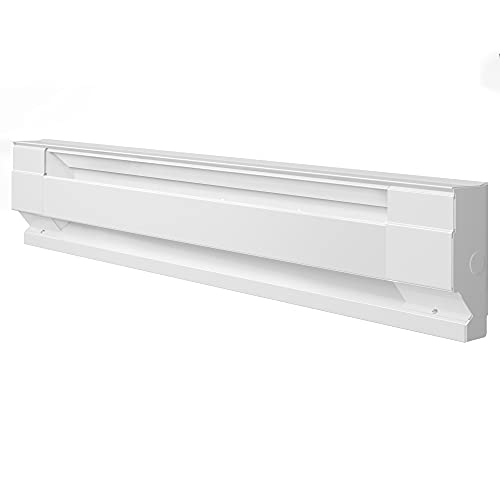
The Cadet F Series is a traditional hardwired baseboard heater intended to be used with a separate thermostat. It is constructed from metal with powder coating and includes a junction box with ground.
Call 888-896-7031 for Free Local HVAC Quotes – Compare and Save Today!
- Model 3F750-1W offers 750W at 120V output and is suitable for smaller rooms or supplemental heating.
- Requires a compatible thermostat (manual or smart) to provide remote or scheduled control.
- Built for durability with 25 gauge steel and a full metal junction box.
Cadet is a widely used OEM-style baseboard that pairs with smart thermostats (like Mysa or meross) for remote control capabilities.
KING 4K1210BW K Series Baseboard Heater 4′ / 1000W

The KING K Series is a 4-foot hardwired baseboard heater offering 1000W at 120V. It is not a plug-in model and must be wired into the home electrical system.
- Features an aluminum ribbon fin element for efficient heat transfer and a full-length safety cutout.
- Designed to be controlled by a compatible wall thermostat or smart thermostat for remote operation.
- Common choice for homeowners replacing older units or specifying a reliable permanent baseboard heater.
Pairing the KING unit with a smart thermostat provides remote scheduling and app-based control while keeping the heater’s proven element design.
Buying Guide: How To Choose A Baseboard Heater With Remote
Selecting the right baseboard heater or smart thermostat for remote control depends on wiring, heating capacity, control preferences, and integration needs. Below are key considerations and comparisons to help choose the best option for your situation.
System Type And Wiring Compatibility
Confirm whether you have a high/line-voltage baseboard system (120–240V) or a low-voltage setup. Most smart thermostats listed here require four wires including a neutral or second live conductor. Two‑wire older installations will not work with these smart thermostats without rewiring or a relay device.
Thermostat Vs. Integrated Heater
There are two main approaches:
- Smart Thermostats (Mysa, meross): Replace your wall thermostat and provide app, voice, and scheduling control to existing baseboard heaters. Best when you want smart control while keeping existing heating elements.
- Hardwired Baseboard Units (Cadet, KING): Physical heater units that deliver heat; pair with a thermostat for remote control. Choose these when the heater itself needs replacing, then add a smart thermostat for remote management.
Power And Room Sizing
Match wattage to room size. Common outputs range from 750W to 3800W. Use local climate, room insulation, and square footage to estimate required wattage. When using smart thermostats, ensure the thermostat’s maximum load rating matches the connected heaters.
Smart Features And Remote Control Options
Consider the platforms you use: HomeKit, Alexa, Google Home, SmartThings, and vendor apps. Mysa emphasizes HomeKit compatibility and adaptive display features. Meross focuses on platform breadth and an easier install pitch. Check whether remote control is via an app, voice, or a physical remote, and whether the manufacturer charges subscription fees (Mysa advertises a free app).
Installation Complexity And Safety
Smart thermostats for high-voltage systems typically require shut-off of breaker power and basic electrical skills or a licensed electrician. Verify junction box size and wire counts. Heaters themselves must be hardwired per local electrical codes; consult an electrician for older homes or two‑wire circuits.
Energy Efficiency And Scheduling
Remote thermostats enable scheduling, geofencing, and temperature setbacks to reduce energy use. Compare whether the device supports detailed schedules, energy usage reports, or learning algorithms. Even with efficient heaters, smart scheduling can improve comfort and lower bills.
Durability And Build Quality
For baseboard units, prioritize robust materials like powder‑coated steel and reliable heating elements (aluminum ribbon fins, PTC elements in wall heaters). For thermostats, look for rated load capacity and good thermal sensing to avoid cycling issues.
Noise, Airflow, And Placement
Hardwired baseboards are usually silent convection devices. Wall‑mounted PTC or fan‑forced space heaters (not the primary focus here) introduce airflow and noise considerations. If pairing with a thermostat, ensure the thermostat’s location reflects average room temperature, avoiding drafts or direct sunlight.
Multiple Comparison Perspectives
- Wiring Perspective: If your home has a four‑wire box, Mysa or meross are viable smart thermostat options. Two‑wire systems require rewiring or alternative solutions.
- Control Perspective: If you want robust voice and multi-platform integration, compare compatibility lists: Mysa (strong HomeKit), meross (broad platform support).
- Replacement vs. Upgrade: Replace an old heater with a Cadet or KING unit and add a smart thermostat for remote control, or retrofit your existing heater with a smart thermostat if the heater is sound.
- Energy Perspective: Smart thermostats with scheduling and temperature setbacks typically yield more savings than replacing heaters alone.
Use the product load ratings, wiring requirements, and smart platform compatibility to determine the correct combination of heater and thermostat for your home. When in doubt about wiring or load matching, consult a licensed electrician to ensure safe installation and optimal performance.
Tips for Getting the Best HVAC Prices
- Prioritize Quality Over Cost
The most critical factor in any HVAC project is the quality of the installation. Don’t compromise on contractor expertise just to save money. - Check for Rebates
Always research current rebates and incentives — they can significantly reduce your overall cost. - Compare Multiple Quotes
Request at least three estimates before making your choice. You can click here to get three free quotes from local professionals. These quotes include available rebates and tax credits and automatically exclude unqualified contractors. - Negotiate Smartly
Once you've chosen a contractor, use the proven strategies from our guide — How Homeowners Can Negotiate with HVAC Dealers — to get the best possible final price.