
Choosing the right gas heater for a living room requires balancing heat output, venting type, safety features, and room size. The table below summarizes five gas heaters selected for living room use based on capacity, fuel type, and control options.
| Model | Fuel | Max BTU | Coverage | Controls |
|---|---|---|---|---|
| Bluegrass Living B20TNIR-BB | Natural Gas | 20,000 | Up To 950 Sq. Ft. | Thermostat, Blower |
| Bluegrass Living B18TPIR-BB | Propane | 18,000 | Up To 950 Sq. Ft. | T-Stat, Blower |
| ProCom MN300HBA-B | Natural Gas | 30,000 | Up To 1,400 Sq. Ft. | Manual Control |
| ProCom MN100TBG | Natural Gas | 10,000 | Up To 500 Sq. Ft. | Thermostat, 5 Settings |
| Mr. Heater MHVFBF30NGT | Natural Gas | 30,000 | Up To 1,000 Sq. Ft. | Thermostat, Electric Ignition |
Content Navigation
- Bluegrass Living B20TNIR-BB Natural Gas Infrared Heater
- Bluegrass Living B18TPIR-BB Propane Infrared Space Heater
- ProCom MN300HBA-B 30,000 BTU Blue Flame Heater
- ProCom MN100TBG 10,000 BTU Blue Flame Heater
- Mr. Heater MHVFBF30NGT 30,000 BTU Blue Flame Heater
- Buying Guide: How To Choose A Gas Heater For Your Living Room
- 1. Heat Output And Room Coverage
- 2. Ventless Versus Vented
- 3. Fuel Type: Natural Gas Or Propane
- 4. Controls And Convenience
- 5. Safety Features
- 6. Installation And Placement
- 7. Air Quality And Vent-Free Considerations
- 8. Energy Efficiency And Operating Costs
- 9. Noise And Heat Distribution
- 10. Maintenance And Reliability
- Comparison Perspectives
Bluegrass Living B20TNIR-BB Natural Gas Infrared Heater

This ventless infrared space heater uses natural gas to deliver up to 20,000 BTU, rated to heat areas as large as 950 sq. ft. It offers a built-in thermostat control with Low-Med-High settings and includes a blower to distribute warmth. The unit ships with wall mounting hardware and base feet for floor placement, supporting flexible installation in living rooms. The slim profile and modern styling are noted features when integrating the heater into decor.
Key operational points include infrared heat transfer, which provides direct warming of objects and occupants, and a ventless design that requires no chimney or ducting. The thermostat cycles the burner to maintain temperature. Consider room ventilation requirements and local codes for vent-free gas appliances before installation.
Bluegrass Living B18TPIR-BB Propane Infrared Space Heater
This model is a propane-fed infrared unit producing up to 18,000 BTU with a stated coverage similar to the natural gas variant. It features a thermostat (T-Stat) that cycles the heater to maintain the selected temperature and a blower to improve heat distribution. The product emphasizes vent-free efficiency—a high combustion efficiency rating typical for such burners.
Call 888-896-7031 for Free Local HVAC Quotes – Compare and Save Today!
Propane models require safe fuel storage and proper regulator and connection fitting. As with vent-free heaters, check indoor air quality considerations and local regulations since ventless combustion introduces combustion byproducts into the room air. The heater is positioned as an economical, efficient option for rooms where a propane supply is preferred or available.
ProCom MN300HBA-B 30,000 BTU Blue Flame Heater

The ProCom MN300HBA-B is a ventless blue flame heater rated at 30,000 BTU, suitable for larger living spaces up to 1,400 sq. ft. It operates on natural gas only and includes an oxygen depletion sensor (ODS) for automatic shut-off if oxygen levels fall below safe thresholds. This model uses a push-button piezo ignition and has manual three-level heat settings.
Notably, the unit requires no electricity to run, which can be advantageous during power outages. Manual controls provide straightforward operation but less precise temperature regulation than models with digital thermostats. Installation options typically include wall mount or floor placement using included accessories, subject to local vent-free appliance codes.
ProCom MN100TBG 10,000 BTU Blue Flame Heater

This compact 10,000 BTU blue flame heater is designed for smaller living rooms or supplemental heating of adjacent spaces, with a stated coverage up to 500 sq. ft. It offers a thermostat with five heat settings for finer temperature control compared to simple high/medium/low models. The slim profile is intended to integrate with residential decor and allow floor or wall placement.
Call 888-896-7031 for Free Local HVAC Quotes – Compare and Save Today!
As a lower-output unit, the MN100TBG is suited for zone heating—focusing warmth where it’s needed—while minimizing fuel consumption. The blue flame design delivers convection heat that warms air and surfaces for even room temperature. Verify local building codes for ventless equipment before installing indoors.
Mr. Heater MHVFBF30NGT 30,000 BTU Blue Flame Heater
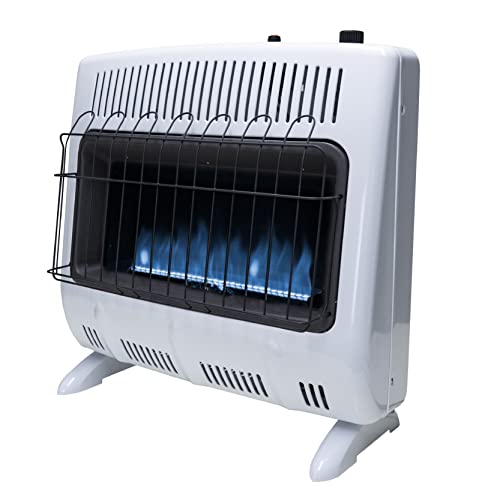
The Mr. Heater MHVFBF30NGT is a high-capacity 30,000 BTU vent-free blue flame natural gas unit intended for rooms up to about 1,000 sq. ft. It includes a built-in thermostat for precise temperature adjustment and an electric ignition powered by a battery for easier start-up. The model emphasizes fuel efficiency, consistent convection heat, and capability at altitude up to 4,500 feet.
Features include reliable thermostat control for maintaining setpoint temperatures and a design focused on steady, energy-efficient heating. Installation requires adherence to vent-free appliance clearances and oxygen-depletion safety provisions. The inclusion of electric ignition simplifies operation compared to piezo-style starters.
Buying Guide: How To Choose A Gas Heater For Your Living Room
Selecting the right gas heater involves evaluating room size, fuel type, venting, safety features, and control options. Below are focused considerations to help compare models from multiple perspectives.
1. Heat Output And Room Coverage
BTU rating is the primary metric for sizing. Estimate living room square footage and account for ceiling height and insulation quality. Rough guidance: 10,000 BTU for small rooms (~500 sq. ft.), 20,000 BTU for medium rooms (~950 sq. ft.), and 30,000 BTU for larger or open-plan living spaces (~1,000–1,400 sq. ft.).
2. Ventless Versus Vented
Ventless (vent-free) heaters deliver combustion heat directly to the room and avoid chimney/duct work. They are efficient but add combustion byproducts to indoor air and may be restricted by code in some regions. Vented units exhaust combustion products outdoors but require installation of flues or direct-vent systems.
3. Fuel Type: Natural Gas Or Propane
Choose based on fuel availability and infrastructure. Natural gas is common in many homes; propane is an option where natural gas is not available. Propane requires safe cylinder storage and correct regulator fittings. Fuel choice affects operating logistics and sometimes appliance efficiency.
4. Controls And Convenience
Thermostat-equipped models provide automatic cycling and maintain set temperatures with less manual intervention. Manual-control models are simpler and can work without electricity. Consider electronic ignition vs. piezo or manual pilot for start-up convenience.
5. Safety Features
Key safety items include an oxygen depletion sensor (ODS), tip-over or overheat protection (more relevant for portable units), and proper clearances. Verify that the heater meets applicable safety standards and includes automatic shut-off features.
6. Installation And Placement
Decide between wall-mount and floor placement. Wall-mounted units save floor space but require secure installation and adherence to clearance distances. Some models include both mounting hardware and base feet for flexibility.
7. Air Quality And Vent-Free Considerations
Ventless heaters introduce combustion byproducts such as water vapor and low levels of NOx into the room air. Ensure adequate ventilation and avoid use in tight, unventilated spaces. Local regulations may limit vent-free appliance use in bedrooms or small rooms.
8. Energy Efficiency And Operating Costs
While BTU output indicates heating power, operational efficiency and local fuel rates determine cost. Blue flame and infrared technologies can influence perceived warmth: infrared heats objects directly while blue flame convection warms room air. Compare fuel consumption metrics and claimed efficiencies if available.
9. Noise And Heat Distribution
Models with blowers provide faster, more even heat distribution but add operational noise. Pure convection or infrared heaters are typically quieter. Assess living room tolerance for blower noise when selecting a model.
10. Maintenance And Reliability
Periodic checks of burner integrity, pilot/ignition components, and gas connections are important. Vent-free models can require occasional cleaning of burner ports. Consider manufacturer support and availability of replacement parts.
Comparison Perspectives
- Small Living Rooms: Lower-BTU blue flame or infrared units (around 10,000 BTU) provide targeted comfort with finer thermostat control.
- Medium Living Rooms: 18,000–20,000 BTU vent-free infrared models balance capacity and efficiency.
- Large Living Rooms/Open Plans: 30,000 BTU blue flame or high-capacity vent-free units deliver broader coverage; verify clearances and ventilation.
- Power Outage Resilience: Manual-ignition, non-electric models operate without grid power. Battery or piezo ignitions offer partial independence.
- Air Quality Sensitive Homes: Prefer vented solutions or ensure strong ventilation with vent-free units; consider adding air exchanges when running ventless heaters.
Use the guide above to match heater characteristics—BTU capacity, fuel type, venting, and controls—to your living room’s size and usage patterns. Confirm local building codes and consult a licensed installer for safe, compliant installation of gas appliances.
Tips for Getting the Best HVAC Prices
- Prioritize Quality Over Cost
The most critical factor in any HVAC project is the quality of the installation. Don’t compromise on contractor expertise just to save money. - Check for Rebates
Always research current rebates and incentives — they can significantly reduce your overall cost. - Compare Multiple Quotes
Request at least three estimates before making your choice. You can click here to get three free quotes from local professionals. These quotes include available rebates and tax credits and automatically exclude unqualified contractors. - Negotiate Smartly
Once you've chosen a contractor, use the proven strategies from our guide — How Homeowners Can Negotiate with HVAC Dealers — to get the best possible final price.