
Compact Guide: This article compares five vent-free gas wall heaters that include built-in thermostat control for maintaining room temperature. The selected models cover a range of BTU outputs, technologies (blue flame vs. infrared), and installation scales for small rooms to larger spaces.
| Model | Type | BTU | Coverage (Approx.) | Thermostat |
|---|---|---|---|---|
| ProCom MN100TBA-B | Blue Flame | 10,000 | Up to 500 sq. ft. | Yes (High/Med/Low) |
| ProCom MN300TPA-B | Infrared | 30,000 | Up to 1,400 sq. ft. | Yes (High/Med/Low) |
| Bluegrass Living B20TNIR-BB | Infrared | 20,000 | Up to 950 sq. ft. | Yes (Low/Med/High) |
| Mr. Heater MHVFBF30NGT | Blue Flame | 30,000 | Up to 1,000 sq. ft. | Yes (Precise thermostat) |
| Dyna-Glo BFSS20NGT-2N | Blue Flame | 10,000–20,000 | Up to 700 sq. ft. | Yes (Adjustable) |
Content Navigation
- ProCom MN100TBA-B Ventless Natural Gas Blue Flame Space Heater With Thermostat
- ProCom MN300TPA-B Ventless Natural Gas Infrared Space Heater With Thermostat
- Bluegrass Living B20TNIR-BB Ventless Infrared Natural Gas Heater With Thermostat
- Mr. Heater MHVFBF30NGT 30,000 BTU Vent Free Blue Flame Heater With Thermostat
- Dyna-Glo BFSS20NGT-2N 20,000 BTU Blue Flame Thermostatic Vent Free Wall Heater
- Buying Guide: How To Choose A Gas Wall Heater With Thermostat
- Heat Output (BTU) And Room Size
- Heat Type: Blue Flame Vs. Infrared
- Thermostat Features And Controls
- Installation And Venting
- Fuel Type And Conversion
- Safety Features And Codes
- Efficiency And Operating Cost
- Air Quality And Room Use
- Placement And Heat Distribution
- Maintenance And Serviceability
- Comparison Perspectives
ProCom MN100TBA-B Ventless Natural Gas Blue Flame Space Heater With Thermostat

The ProCom MN100TBA-B is a compact blue flame ventless heater rated at 10,000 BTU and intended for smaller spaces up to about 500 square feet. It includes a built-in thermostat control with High/Medium/Low settings designed to regulate heat output and maintain comfort.
- Technology: Blue flame burner for convective air warming.
- Control: Thermostat with three heat levels for simple temperature management.
- Installation: Wall mount with included hardware; base feet included for floor placement.
- Design: Slim profile aimed at fitting in compact rooms or offices.
This model emphasizes straightforward thermostat operation and compact footprint, making it suitable where space is limited and convective heat is preferred.
ProCom MN300TPA-B Ventless Natural Gas Infrared Space Heater With Thermostat

The ProCom MN300TPA-B uses infrared technology and delivers up to 30,000 BTU, intended for larger open areas up to approximately 1,400 square feet. It offers a thermostat controlled selection of High/Medium/Low output to stabilize room temperature.
Call 888-896-7031 for Free Local HVAC Quotes – Compare and Save Today!
- Technology: Infrared radiant heat warms objects and occupants directly.
- Control: Integrated thermostat provides staged heat output for set-and-forget operation.
- Installation: Includes wall mount hardware and base feet for floor use.
- Profile: Slim modern styling designed to integrate into living spaces.
Infrared operation may produce perceived faster warmth for occupants and items in the room, with an adjustable thermostat to tailor heat intensity.
Bluegrass Living B20TNIR-BB Ventless Infrared Natural Gas Heater With Thermostat

The Bluegrass Living B20TNIR-BB is a 20,000 BTU infrared ventless wall heater with a built-in thermostat and blower. It’s rated to heat spaces up to about 950 square feet and offers Low/Med/High thermostat settings for controlling output.
- Technology: Infrared radiant heating for direct warming of surfaces and people.
- Control: Three-stage thermostat control for tailored comfort levels.
- Extras: Includes blower to assist heat distribution when needed.
- Installation: Wall mount and included base feet provide mounting flexibility.
The included blower may improve heat circulation in rooms where radiant heat alone needs assistance reaching farther corners.
Mr. Heater MHVFBF30NGT 30,000 BTU Vent Free Blue Flame Heater With Thermostat
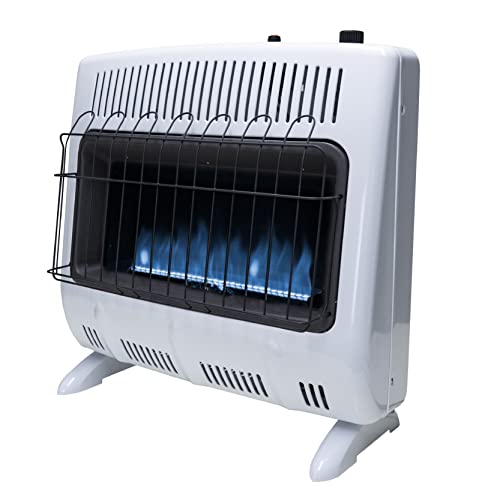
The Mr. Heater MHVFBF30NGT is a convection-style blue flame vent-free heater rated at 30,000 BTU designed for spaces up to roughly 1,000 square feet. It features a built-in thermostat for precise temperature adjustment and includes electric ignition functionality.
Call 888-896-7031 for Free Local HVAC Quotes – Compare and Save Today!
- Power: Up to 30,000 BTU suitable for larger rooms or additions.
- Control: Integrated thermostat allows accurate temperature control.
- Efficiency: Blue flame technology focuses on fuel efficiency and even convection heat.
- Installation: Wall mounting optimized for room heating; designed for altitudes up to 4,500 feet.
This model highlights a combination of higher output and a more precise thermostat for larger living areas or colder climates where stronger convection heat is desired.
Dyna-Glo BFSS20NGT-2N 20,000 BTU Blue Flame Thermostatic Vent Free Wall Heater

The Dyna-Glo BFSS20NGT-2N is a thermostatic blue flame vent-free wall heater offering adjustable output up to 20,000 BTU for rooms up to ~700 square feet. It uses convection to heat air similar to central systems and includes an adjustable thermostat.
- Technology: Blue flame convective heating for consistent air warming.
- Control: Adjustable thermostat for fine-tuning room temperature.
- Range: Variable output allows matching heater size to room needs.
- Installation: Designed for wall mounting and residential use.
This unit targets users who prefer convective heat with thermostatic control and a mid-range BTU capacity for moderate-sized rooms.
Buying Guide: How To Choose A Gas Wall Heater With Thermostat
Selecting the right gas wall heater with a thermostat depends on multiple factors beyond just BTU rating. Below are key considerations to compare models objectively.
Heat Output (BTU) And Room Size
Match the heater’s BTU output to your room square footage and insulation level. Higher BTUs suit larger or poorly insulated spaces. Manufacturers typically list an approximate coverage area—use that as a baseline, and increase capacity for high ceilings or colder climates.
Heat Type: Blue Flame Vs. Infrared
- Blue Flame (Convective): Heats air, producing even room temperature similar to central heating. Good for general room warming.
- Infrared (Radiant): Warms objects and people directly; often feels warmer faster and is useful for open areas or spot heating.
Thermostat responsiveness can differ: infrared may create a faster perceived warmth while convective systems maintain even ambient temperatures over time.
Thermostat Features And Controls
- Precision: Some models offer a simple Low/Med/High thermostat while others provide more precise temperature settings. Choose based on desired control granularity.
- Placement: Built-in thermostats sense the immediate near-heater temperature. Consider thermostat accuracy if the heater is mounted in a drafty or out-of-the-way location.
- Additional Controls: Look for blowers, timers, or remote control features if you need enhanced distribution or scheduling.
Installation And Venting
All models covered are vent-free (ventless). Ensure vent-free operation complies with local building codes and safety recommendations. Models typically include wall-mount hardware and optional base feet for floor placement; confirm clearances and mounting surface suitability.
Fuel Type And Conversion
Confirm the heater is compatible with your home fuel: Natural gas or liquid propane. Many units are factory-configured for a specific fuel and do not permit field conversion. Verify fuel type before purchase.
Safety Features And Codes
- Oxygen Depletion Sensor (ODS): Standard on vent-free heaters to shut off if oxygen levels fall.
- Flame Failure Device: Prevents gas flow if the pilot or burner extinguishes.
- Clearances: Follow manufacturer-specified clearances from combustibles and ensure proper room size per model guidance.
Efficiency And Operating Cost
Blue flame models often claim efficient fuel consumption through convective heat distribution. Infrared units may reduce perceived runtime because occupants feel direct warmth sooner. Compare published BTU per hour and estimated coverage rather than relying solely on marketing claims.
Air Quality And Room Use
Vent-free units introduce combustion byproducts into the room. Assess occupant sensitivity (allergies, asthma), and avoid installation in bedrooms or sleeping areas if local codes advise against it. Consider supplemental ventilation or using higher-capacity units in larger spaces to minimize continuous run time.
Placement And Heat Distribution
Wall-mounted placement influences thermostat reading and distribution. When buying a model with an internal thermostat, plan to mount it where the thermostat can sense representative room temperatures, not near drafts, windows, or direct sunlight. Models with blowers assist in moving warmed air into adjacent spaces.
Maintenance And Serviceability
Regular maintenance tasks include checking burners, cleaning grills, and confirming ignition reliability. Choose brands and models with available replacement parts and accessible service guides if long-term upkeep is a priority.
Comparison Perspectives
- Small Rooms (≤500 sq. ft.): Lower BTU blue flame units with simple thermostats provide steady convection heat.
- Medium Rooms (500–1,000 sq. ft.): Mid-range BTU blue flame or 20,000 BTU infrared units balance coverage and responsiveness.
- Large Rooms (≥1,000 sq. ft.): Higher BTU infrared or 30,000 BTU blue flame units deliver required capacity; consider models with blowers for distribution.
- Precision Control Need: If precise temperature control is a priority, opt for a model specifying accurate thermostat adjustment rather than basic stage settings.
Use these criteria to cross-compare candidate heaters by BTU match, thermostat capability, heating method, safety features, fuel type, and installation restrictions. Objective matching of these traits to your room and use case will identify the most suitable gas wall heater with thermostat control.
Tips for Getting the Best HVAC Prices
- Prioritize Quality Over Cost
The most critical factor in any HVAC project is the quality of the installation. Don’t compromise on contractor expertise just to save money. - Check for Rebates
Always research current rebates and incentives — they can significantly reduce your overall cost. - Compare Multiple Quotes
Request at least three estimates before making your choice. You can click here to get three free quotes from local professionals. These quotes include available rebates and tax credits and automatically exclude unqualified contractors. - Negotiate Smartly
Once you've chosen a contractor, use the proven strategies from our guide — How Homeowners Can Negotiate with HVAC Dealers — to get the best possible final price.