
Choosing the right heater for a greenhouse requires balancing capacity, controls, safety, and installation. The table below summarizes five top options that pair digital thermostats, overheat protection, and fast heating for small to medium greenhouses.
| Product | Power / Mode | Key Features |
|---|---|---|
| SOSUNLID Greenhouse Heater With Thermostat | 1500W / Fan + Heat | Auto temp control kit, fast 3s heating, overtemp protection |
| DR Infrared DR-268 Smart Greenhouse Heater | Infrared / Multiple Mounts | IPX5 water resistance, digital display, probe thermostat |
| Buyplus Greenhouse Heater With Digital Thermostat | 1500W / Rapid Heat | Waterproof probe, 215 sq ft coverage claim, auto reset protection |
| Joanolga Greenhouse Heater With Digital Thermostat | 1500W / 2 Modes | 5118 BTU output, fan-only mode, internal limit thermostat |
| LHUKSGF Greenhouse Heater With Thermostat | 3-Stage: 20/750/1500W | PTC ceramic, IPX4, adjustable output levels |
Content Navigation
SOSUNLID Greenhouse Heater With Thermostat

The SOSUNLID kit includes a 1500W heater and a separate digital thermostat. The thermostat provides auto temperature control, switching the heater on or off to maintain the setpoint. The unit advertises fast heating in 3 seconds and adjustable fan speed for both heating and ventilation.
Safety elements feature fireproof materials and an independent overheat protection. The thermostat supports up to 15A, accommodating high-power loads. Manufacturer guidance suggests suitability for greenhouses up to ~120 sq ft when used with the fan/heater mode.
DR Infrared DR-268 Smart Greenhouse Heater

This model uses infrared heat and lists an IPX5 water resistance rating for indoor/outdoor flexibility. It includes a corded thermal probe for accurate sensing and a built-in digital display that supports manual and auto modes.
Call 888-896-7031 for Free Local HVAC Quotes – Compare and Save Today!
Mounting versatility is notable: wall, ceiling, or hanging chain installations are supported. The infrared approach provides direct radiant heating rather than forced-air circulation, which can be advantageous for targeting plants and reducing airflow-driven moisture loss.
Buyplus Greenhouse Heater With Digital Thermostat

The Buyplus unit is a 1500W heater with a digital thermostat and a waterproof temperature probe. It advertises rapid 3-second heating and an adjustable temperature range of 40°F–108°F (5°C–42°C).
Manufacturer claims coverage up to 215 sq ft for warm conditions. Built-in safety uses a self-resetting heat breaker to cut power at thermal thresholds and resume when temperatures drop. The product is positioned for greenhouse, patio, garage, and grow tent use.
Joanolga Greenhouse Heater With Digital Thermostat

Joanolga’s heater delivers 5118 BTU / 1500W and operates with two modes: fan-only (20W) and fan+heater (1500W). The thermostat is compatible with other heaters and supports a 40°F–108°F (5°C–42°C) set range.
Call 888-896-7031 for Free Local HVAC Quotes – Compare and Save Today!
An internal temperature limiting thermostat provides overheat protection, shutting down the element if temperatures climb above safe thresholds. The unit emphasizes low noise and straightforward thermostat operation suitable for grow room scenarios.
LHUKSGF Greenhouse Heater With Thermostat
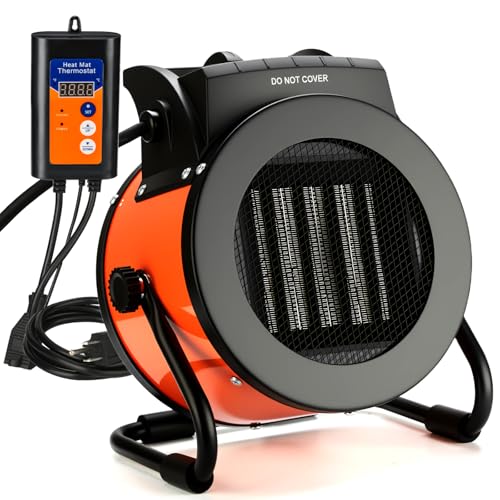
LHUKSGF offers a 3-stage output (20W / 750W / 1500W) with a PTC ceramic heating element that provides instant warmth. The digital thermostat can be set from 40°F–108°F and enables staged power to match ambient requirements.
The product highlights an IPX4 waterproof rating, making it suitable for humid greenhouse environments. The staged outputs allow for energy-saving low-power operation during mild cold spells and full output in colder conditions.
Buying Guide: Choosing The Right Greenhouse Space Heater
This buying guide covers the main considerations when selecting a greenhouse heater. Assess each point relative to your greenhouse size, ducting, plant types, and local climate.
Heating Type And Distribution
- Forced-air / fan heaters: Provide quick, uniform air circulation. Best for greenhouses that need even ambient air temperature and ventilation.
- Infrared / radiant heaters: Heat objects and plant surfaces directly. Useful when you want to warm plants without drastically increasing ambient humidity loss.
- PTC ceramic heaters: Self-regulating ceramic elements that reduce power draw as they warm and offer staged power options for efficiency.
Capacity And Coverage
Match heater power to greenhouse volume. A 1500W
Consider insulation, glazing type, and expected low temperatures. For marginal nights, staged heat output or thermostatic control avoids temperature swings that stress plants.
Thermostat And Controls
- Digital Thermostat With Probe: Provides more accurate control by measuring ambient air near plants rather than the heater casing.
- Auto Mode vs Manual: Auto mode maintains setpoints automatically. Manual is useful when constant high output or fan-only operation is desired.
- Remote / Timer Features: Remote control or programmable timers aid convenience and energy savings.
Safety Features
- Overheat Protection: Automatic shutdown prevents thermal damage to the heater and reduces fire risk.
- Water Resistance / IP Rating: Greenhouses are humid environments; IPX4–IPX5 ratings increase durability and safe operation.
- Stable Mounting & Tip Protection: Wall-mount or ceiling options minimize tipping hazards; secure installation reduces the chance of accidental contact.
Energy Use And Efficiency
Consider staged power or multi-mode heaters to reduce runtime at full power. Infrared systems can use less energy for targeted heating, while fan heaters may be more effective for whole-space warming.
Estimate runtime and circuit compatibility. Many 1500W units draw ~12–13A on 120V circuits; ensure wiring and outlets meet local code and do not overload other equipment.
Installation And Placement
- Mounting Options: Wall, ceiling, or hanging mounts influence air distribution. Place heaters to avoid direct contact with delicate foliage when using high-output modes.
- Airflow: Ensure the heater’s fan does not create drafts that stress plants; adjustable fan speed helps.
- Probe Placement: Position temperature probes where they reflect the plant canopy, not direct heater airflow, for accurate control.
Durability And Maintenance
Look for corrosion-resistant housings and washable grilles if dust or pollen buildup is expected. IP-rated units perform better in humid conditions. Check for replaceable probes or accessible internal fuses for easier service.
Tips for Getting the Best HVAC Prices
- Prioritize Quality Over Cost
The most critical factor in any HVAC project is the quality of the installation. Don’t compromise on contractor expertise just to save money. - Check for Rebates
Always research current rebates and incentives — they can significantly reduce your overall cost. - Compare Multiple Quotes
Request at least three estimates before making your choice. You can click here to get three free quotes from local professionals. These quotes include available rebates and tax credits and automatically exclude unqualified contractors. - Negotiate Smartly
Once you've chosen a contractor, use the proven strategies from our guide — How Homeowners Can Negotiate with HVAC Dealers — to get the best possible final price.
Comparison Perspectives
- Small Greenhouses / Grow Tents: Prioritize compact 1500W units with accurate digital thermostats and probe placement.
- Humid Or Outdoor-Exposed Structures: Choose models with IPX4–IPX5 ratings to resist moisture damage.
- Energy-Conscious Users: Consider staged PTC ceramic heaters or infrared radiant options to limit full-power runtime.
- Install Flexibility: If mounting options matter, select heaters with wall/ceiling/hanging compatibility for optimal placement.
Final Practical Tips
- Pair a heater with a reliable digital thermostat and a correctly placed probe for stable temperatures.
- Use insulation or bubble wrap around glazing to reduce required heater output during extreme cold.
- Confirm electrical circuit ratings and follow local codes; consult an electrician for permanent installations.
- Regularly inspect wiring, mounting hardware, and any IP-rated seals for wear due to humidity and temperature cycling.