
Quick Summary: This guide compares five horizontal unit heaters suited for residential garages, workshops, and light commercial spaces. Below is a compact table showing core specs to help you scan options quickly.
| Product | Type / Fuel | Max BTU / Power | Notable Feature |
|---|---|---|---|
| Mr. Heater Big Maxx MHU80NG | Natural Gas | 80,000 BTU | Category 1 vertical / Category 3 horizontal venting |
| Reznor UDXC-45 | Natural Gas | 45,000 BTU (dual low/high) | 83% thermal efficiency, ceiling mount ready |
| Reznor UDXC-150 | Natural Gas | 150,000 BTU (dual low/high) | High capacity for large spaces, 83% efficiency |
| Mr. Heater 4″ Stainless Horizontal Vent Kit | Accessory / Venting | — | Complete horizontal venting parts for Big Maxx series |
| Marley 7500/10000W Unit Heater | Electric | 7.5kW / 10kW (208/240V) | Pull-through air design, linear thermal cutout |
Content Navigation
Mr. Heater Big Maxx MHU80NG Unit Heater
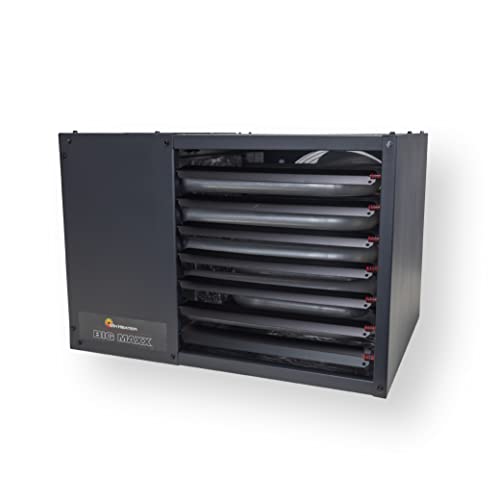
The Mr. Heater Big Maxx MHU80NG is a natural gas unit heater designed to heat large areas up to about 2,000 sq. ft. It provides 80,000 BTU output and operates on 120 V at 2.3 amps. The unit ships with two angle brackets and an LPG conversion kit, while thermostat, hose and regulator are not included.
Key installation notes from the feature list: the unit requires a minimum 8 ft. clearance from the floor to the base and is compatible with Category 1 vertical and Category 3 horizontal venting. Dimensions are approximately 29.33″ L x 15.50″ W x 26.37″ H. This model suits larger single-zone spaces where fixed natural gas service is available.
Reznor UDXC-45 Natural Gas Unit Heater

The Reznor UDXC-45 is an indoor natural gas unit geared for garages, workshops, and small commercial rooms. It is rated at 45,000 BTU with two output levels—low and high—to match varying outdoor conditions and load requirements.
Call 888-896-7031 for Free Local HVAC Quotes – Compare and Save Today!
Manufacturer features include an 83% thermal efficiency, a quiet forced-air fan with a low static propeller design, and threaded-nut suspension points for ceiling mounting. The unit can be installed as a hanging unit or wall-mounted with appropriate brackets sold separately. The combination of dual-stage output and high efficiency supports energy-conscious operation while providing flexible heat control.
Reznor UDXC-150 Commercial Unit Heater
The Reznor UDXC-150 is a high-capacity natural gas unit intended for large industrial or commercial spaces. With a top rating of 150,000 BTU, it offers two staged outputs (low and high) and the same 83% efficiency profile as other UDXC models.
Designed for ceiling mounting using four suspension points, the UDXC-150 uses a quiet forced-air fan and low static propeller for consistent airflow over the heat exchanger. This model is suitable when heating large open areas such as warehouses, large shops, or production bays where a high BTU rating and robust airflow are required.
Mr. Heater 4″ Stainless Steel Horizontal Vent Kit

This 4-inch stainless steel horizontal vent kit is designed to provide a complete venting solution for compatible Mr. Heater Big Maxx series heaters. The kit includes an adjustable elbow, wall thimble, roof flashing, storm collar, vent cap, and multiple pipe sections to complete a through-wall horizontal installation.
Call 888-896-7031 for Free Local HVAC Quotes – Compare and Save Today!
Features specify all parts needed for horizontal venting and adaptability for MHU45 and MHU75 units. For installations requiring code-compliant, durable venting, this kit centralizes components to simplify planning and reduce part mismatches. Note that vent configuration and clearances must follow local codes and the heater manufacturer’s venting instructions.
Marley 7500/10000W Electric Unit Heater
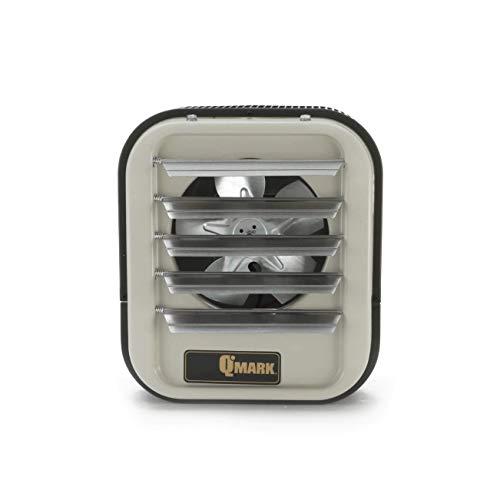
The Marley electric unit heater is a dual-power electric option for spaces with 208/240V service. Offered in 7.5kW and 10kW variants, it uses a pull-through air design to distribute heat evenly while maintaining a compact footprint.
Manufacturer features highlight a linear thermal cutout for element protection and available 24V control transformer models for safer thermostat integration. Electric heaters like this are advantageous where gas is not available or where zero on-site combustion is preferred, but they require sufficient electrical capacity and proper breaker sizing for installation.
Buying Guide: How To Choose A Horizontal Unit Heater
This buying guide covers key considerations to compare horizontal unit heaters across fuel type, capacity, installation, venting, controls, efficiency, and maintenance.
1. Fuel Type And Site Availability
- Natural Gas: Common in garages and shops with gas service. Typically delivers higher BTU output for lower operating cost where gas is economical.
- Electric: Simplifies installation where gas piping and venting would be costly. Requires adequate electrical panel capacity and appropriate breakers.
- Venting Needs: Combustion units require venting—category ratings (Cat 1, Cat 3, B-vent, Z-vent) matter for routing and code compliance.
2. Heating Capacity And Sizing
- Match the unit’s BTU or kW rating to your space. Consider insulation, ceiling height, and intended temperature rise.
- Small garages may need 20k–40k BTU; larger workshops or warehouses may require 80k–150k BTU or multiple units.
3. Efficiency And Energy Use
- Look for stated efficiency ratings (e.g., 83% thermal efficiency on some models). Higher efficiency typically reduces fuel consumption.
- Dual-stage units let you run on partial output for mild days, improving comfort and lowering fuel usage.
4. Venting And Installation Constraints
- Confirm the unit’s venting category and whether horizontal vent kits are available for your mounting plan.
- Account for clearance requirements, combustion air needs, and local code restrictions.
5. Mounting And Air Distribution
- Ceiling-mounted units typically save floor space and improve overall room circulation. Check suspension points and available brackets.
- Downflow or horizontal discharge options affect how heat mixes and reaches work areas; units with forced-air fans distribute heat more uniformly.
6. Controls And Safety Features
- Determine thermostat compatibility and whether a remote or built-in control is supplied. Many heaters require separate thermostats.
- Safety features to check: thermal cutouts, flame safeguards, pressure switches, and recommended clearances.
7. Maintenance And Serviceability
- Consider ease of access for burner cleaning, filter replacement (if applicable), and motor/fan service.
- Availability of replacement parts, vent kits, and authorized service centers matters for long-term reliability.
8. Comparison Perspectives
- Small-To-Medium Garages: Lower-BTU natural gas models or electric units with appropriate kW rating provide balanced cost and performance.
- Large Shops / Warehouses: High-BTU natural gas units such as the UDXC-150 are better suited to open floor plans and high ceilings.
- Installing Without Gas Line: Electric units eliminate venting needs but require electrical upgrades and may have higher operating costs depending on local electricity rates.
- Venting Complexity: If wall-penetration horizontal venting is required, choose a heater with a compatible horizontal vent kit or purchase a manufacturer kit to ensure fit and code compliance.
9. Practical Installation Checklist
- Confirm fuel source and line sizing or electrical service capacity before selecting a unit.
- Measure available mounting clearances and ceiling heights; review manufacturer clearances.
- Identify vent route and order the proper vent kit (horizontal or vertical) if using gas units.
- Plan for controls and thermostat location for accurate sensing and safe operation.
- Verify local code requirements and obtain required permits for gas or electrical work.
Final Note: Select the unit that best balances required capacity, fuel availability, installation complexity, and efficiency. For combustion heaters, pair with manufacturer-approved venting kits and follow clearance and service recommendations to maintain performance and safety.
Tips for Getting the Best HVAC Prices
- Prioritize Quality Over Cost
The most critical factor in any HVAC project is the quality of the installation. Don’t compromise on contractor expertise just to save money. - Check for Rebates
Always research current rebates and incentives — they can significantly reduce your overall cost. - Compare Multiple Quotes
Request at least three estimates before making your choice. You can click here to get three free quotes from local professionals. These quotes include available rebates and tax credits and automatically exclude unqualified contractors. - Negotiate Smartly
Once you've chosen a contractor, use the proven strategies from our guide — How Homeowners Can Negotiate with HVAC Dealers — to get the best possible final price.