
Inline duct fans are essential for moving conditioned air, transferring heat, and maintaining ventilation in HVAC, grow rooms, and utility spaces. This guide compares reliable inline fans with integrated controllers, automation, and high airflow to help you match capacity, noise, and controls to your application.
| Product | Key Feature | Size / Airflow |
|---|---|---|
| AC Infinity CLOUDLINE PRO T8 | Temp/Humidity VPD Controller + WiFi | 8″ / High |
| Toolazy Inline Duct Fan 6″ | WiFi App Controller, 405 CFM | 6″ / 405 CFM |
| AC Infinity CLOUDLINE S8 PRO | 10-Speed Wired Controller, EC Motor | 8″ |
| AC Infinity CLOUDLINE A6 | Value EC Motor Series, 10-Speed | 6″ |
| iPower 8 Inch Inline Booster Fan | 420 CFM Centrifugal Style, Durable | 8″ / 420 CFM |
Content Navigation
- AC Infinity CLOUDLINE PRO T8 — 8″ Inline Fan With Temp/Humidity Controller
- Toolazy Inline Duct Fan 6″ With WiFi Temperature/Humidity Controller
- AC Infinity CLOUDLINE S8 PRO — Quiet 8″ Inline Duct Fan With 10-Speed Controller
- AC Infinity CLOUDLINE A6 — Quiet 6″ Inline Duct Fan With Speed Controller
- iPower 8 Inch Inline Booster Duct Fan — 420 CFM Centrifugal Blower
- Buying Guide — How To Choose An Inline Duct Fan With Controls
- 1. Determine Required Airflow And Duct Size
- 2. Motor Type — EC vs. AC vs. Centrifugal
- 3. Controls And Automation
- 4. Noise Levels And Mounting
- 5. Static Pressure And Duct Resistance
- 6. Energy Efficiency And Heat Output
- 7. Build Quality, Bearings, And Maintenance
- 8. Compatibility With Existing Systems
- 9. Safety And Certifications
- 10. Installation Considerations
AC Infinity CLOUDLINE PRO T8 — 8″ Inline Fan With Temp/Humidity Controller

The CLOUDLINE PRO T8 is designed for climate-sensitive environments. It pairs an 8″ inline fan with a built-in temperature and humidity (VPD) controller and WiFi app integration for remote monitoring and automation.
- Controls: Dynamic temperature and humidity programming, timers, scheduling, and minimum speed settings.
- Connectivity: WiFi app for remote access to climate data and advanced programs.
- Application: Suitable for grow rooms, AV closets, or any space requiring automated climate control.
- Performance: EC motor design provides energy-efficient, quiet operation and responsiveness to programmed setpoints.
Toolazy Inline Duct Fan 6″ With WiFi Temperature/Humidity Controller
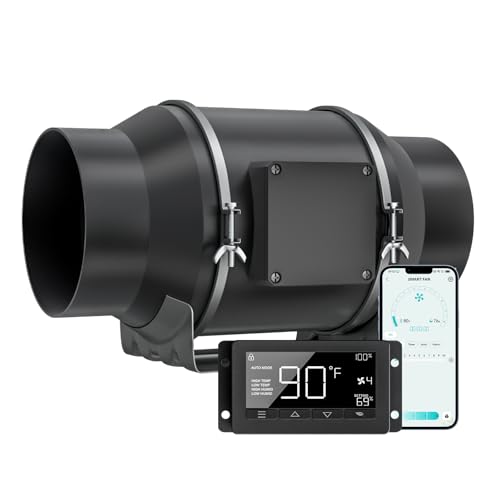
The Toolazy 6″ inline fan combines a high CFM mixed-flow fan with a WiFi-enabled temperature/humidity controller. It targets indoor grow facilities, vertical farms, and HVAC boost tasks.
- Airflow: Rated at 405 CFM, designed for high-resistance ducting and negative pressure setups.
- Controller: WiFi app and wired controller with scheduling, temp/humidity setpoints, timers, and alarm options.
- Motor: PWM-controlled EC motor for lower noise, reduced heat, and improved efficiency.
- Use Cases: Heating/cooling transfer, odor exhaust, commercial drying, and automated ventilation systems.
AC Infinity CLOUDLINE S8 PRO — Quiet 8″ Inline Duct Fan With 10-Speed Controller

Call 888-896-7031 for Free Local HVAC Quotes – Compare and Save Today!
The CLOUDLINE S8 PRO is an 8″ inline fan featuring an external wired 10-speed controller and a PWM EC motor for quiet, efficient ventilation. It’s built for grow tents and general HVAC boosting.
- Controller Compatibility: Comes with a 10-speed wired controller and is compatible with UIS smart controllers for intelligent programming.
- Motor: EC motor provides energy savings and lower operating noise, with reduced internal heat.
- Applications: Transfer heating/cooling, exhaust odors, cool AV closets, and ventilate hydroponic spaces.
- Design: Balanced for quiet operation and suitable for inline installations in ductwork runs.
AC Infinity CLOUDLINE A6 — Quiet 6″ Inline Duct Fan With Speed Controller

The CLOUDLINE A6 offers the CLOUDLINE build quality in a value package. It includes a wired 10-speed controller and an EC motor, targeting quieter, efficient ventilation in smaller spaces.
- Value-Focused: Same core innovations as CLOUDLINE Series but in a cost-conscious model.
- Controller: Wired 10-speed controller included; works with other CLOUDLINE smart controllers.
- Use Cases: Grow tents, small HVAC booster jobs, transfer heating/cooling to adjacent rooms, and AV cabinet ventilation.
- Operational Traits: Low noise, low heat output, and energy-efficient EC motor operation.
iPower 8 Inch Inline Booster Duct Fan — 420 CFM Centrifugal Blower

The iPower 8″ inline booster is a centrifugal-style blower rated around 420 CFM. It emphasizes robust airflow and durable construction for general ventilation and HVAC boost tasks.
- Airflow: High airflow suitable for basements, bathrooms, attics, and grow tents requiring strong duct pressure.
- Build: Balanced centrifugal impeller, high-strength housing, and permanently lubricated bearings for maintenance-free operation.
- Noise: Manufacturer notes sub-40 dB operation at typical speeds; actual level varies with ducting and mounting.
- Installation: Portable design with grounded power cord for straightforward inline mounting.
Buying Guide — How To Choose An Inline Duct Fan With Controls
Selecting the right inline duct fan depends on airflow needs, control features, noise tolerance, and installation constraints. Below are primary considerations to compare models effectively.
Call 888-896-7031 for Free Local HVAC Quotes – Compare and Save Today!
1. Determine Required Airflow And Duct Size
Calculate needed CFM based on room volume and desired air changes per hour. Match fan diameter to duct size (e.g., 4″, 6″, 8″, 10″) to minimize pressure loss and noise. Oversized fans can be controlled down, but undersized fans struggle against resistance.
2. Motor Type — EC vs. AC vs. Centrifugal
EC (Electronically Commutated) motors offer higher efficiency, lower heat, and better speed control than traditional AC motors. Centrifugal/booster fans provide higher static pressure for long runs and restrictive filters.
3. Controls And Automation
Decide if you need a simple speed dial, a multi-speed wired controller, or advanced automation with temperature/humidity setpoints and WiFi. Integrated VPD/temp-humidity controllers help maintain climate without extra devices.
4. Noise Levels And Mounting
Check noise specs where available, but expect real-world levels to depend on ducting, mount isolation, and speed setting. Use vibration isolators and flexible duct to reduce transmitted noise.
5. Static Pressure And Duct Resistance
High-resistance systems (long runs, many bends, HEPA filters) require fans rated for higher static pressure. Mixed-flow and centrifugal designs handle resistance better than basic axial fans.
6. Energy Efficiency And Heat Output
EC motors run cooler and more efficiently. If the fan will operate continuously, choose energy-efficient models to reduce operating cost and prevent added heat in conditioned spaces.
7. Build Quality, Bearings, And Maintenance
Look for permanently lubricated bearings or sealed motors to minimize maintenance. Durable housings and balanced impellers extend life and reduce vibration issues.
8. Compatibility With Existing Systems
Ensure controller compatibility with existing automation (UIS, smart controllers), power requirements, and whether multiple fans can be linked under one controller if needed.
9. Safety And Certifications
Confirm that the fan meets applicable electrical and safety standards for your installation class. For humid or wet spaces, check suitability and required protection measures.
10. Installation Considerations
Account for mounting space, straight run requirements, and access for maintenance. Some models include long power cords and prewired controllers which simplify installation.
Comparing performance curves, control features, and noise in your specific duct layout will provide the most accurate selection. Use the buying guide criteria to weigh trade-offs between airflow, automation, efficiency, and installation complexity.
Tips for Getting the Best HVAC Prices
- Prioritize Quality Over Cost
The most critical factor in any HVAC project is the quality of the installation. Don’t compromise on contractor expertise just to save money. - Check for Rebates
Always research current rebates and incentives — they can significantly reduce your overall cost. - Compare Multiple Quotes
Request at least three estimates before making your choice. You can click here to get three free quotes from local professionals. These quotes include available rebates and tax credits and automatically exclude unqualified contractors. - Negotiate Smartly
Once you've chosen a contractor, use the proven strategies from our guide — How Homeowners Can Negotiate with HVAC Dealers — to get the best possible final price.