
Choosing a natural gas heater means balancing output, venting, efficiency, and installation needs. The table below summarizes five strong options that cover wall-mounted infrared, vent-free blue-flame, and high-BTU unit heater styles suitable for homes, garages, workshops, and additions.
| Model | Type | Max BTU | Coverage | Key Feature |
|---|---|---|---|---|
| Dyna-Glo IR30NMDG-1 | Infrared Wall Heater | 30,000 | Up To 1,000 Sq. Ft. | Radiant Infrared Heat |
| Mr. Heater Big Maxx MHU80NG | Unit Heater (Ventable) | 80,000 | Up To 2,000 Sq. Ft. | High Output, Venting Options |
| ProCom MN100TBA-B | Ventless Blue Flame | 10,000 | Up To 500 Sq. Ft. | Thermostat Control |
| Mr. Heater MHVFBF30NGT | Vent-Free Blue Flame Wall | 30,000 | Up To 1,000 Sq. Ft. | Thermostat & Electric Ignition |
| ProCom MN300HBA-B | Ventless Blue Flame | 30,000 | Up To 1,400 Sq. Ft. | No Electricity Required, ODS |
Content Navigation
- Dyna-Glo IR30NMDG-1 30,000 BTU Natural Gas Infrared Wall Heater
- Mr. Heater F260560 Big Maxx MHU80NG Natural Gas Unit Heater
- ProCom MN100TBA-B Ventless Natural Gas Blue Flame Space Heater
- Mr. Heater MHVFBF30NGT 30,000 BTU Vent Free Blue Flame Natural Gas Heater
- ProCom MN300HBA-B Ventless Natural Gas Blue Flame Heater With Base Feet
- Buying Guide: How To Choose A Natural Gas Heater
Dyna-Glo IR30NMDG-1 30,000 BTU Natural Gas Infrared Wall Heater

This infrared wall heater uses radiant technology to warm objects and people directly, similar to sunlight. It is designed for natural gas only (fuel conversion is not permitted). Rated at 30,000 BTU, the unit is specified to heat areas up to 1,000 sq. ft., making it appropriate for garages, workshops, and larger rooms where targeted radiant heat is preferred over convective warming.
Key operational points include the radiant heating method that can feel quicker at the point of use, and the product’s natural gas readiness. This model is best considered where a wall-mounted radiant solution is desired and where local codes permit infrared installations. Installation typically requires clearances and secure wall mounting per manufacturer guidelines.
Mr. Heater F260560 Big Maxx MHU80NG Natural Gas Unit Heater
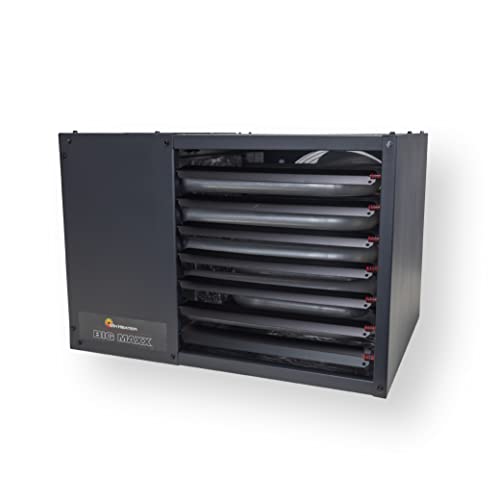
The Big Maxx MHU80NG is a high-output natural gas unit heater providing 80,000 BTU, suited for large garages, shops, and commercial spaces. Manufacturer specs list coverage up to 2,000 sq. ft. and a requirement for clearances such as a minimum 8 ft. from floor to base of the unit.
Call 888-896-7031 for Free Local HVAC Quotes – Compare and Save Today!
Included with the heater are two angle brackets and a propane conversion kit (note: conversion kit supplied but use per local code), while thermostat, hose, and regulator are not included. The unit supports vertical category 1 or horizontal category 3 venting options, and requires 120 V power for fan and controls. This model is designed for situations where a high-BTU, ventable solution is needed to move heat across larger volumes.
ProCom MN100TBA-B Ventless Natural Gas Blue Flame Space Heater

This ventless blue flame heater produces up to 10,000 BTU and is sized for small rooms and offices, with a stated coverage up to 500 sq. ft. It offers three thermostat-controlled settings (High/Medium/Low) for adjustable comfort and includes both wall-mount hardware and base feet for flexible placement.
Because it is ventless, the heater relies on indoor combustion and requires adherence to vent-free usage guidelines, such as adequate ventilation and following local codes related to indoor combustion appliances. The built-in thermostat enables more precise room temperature control compared to manual-only units.
Mr. Heater MHVFBF30NGT 30,000 BTU Vent Free Blue Flame Natural Gas Heater
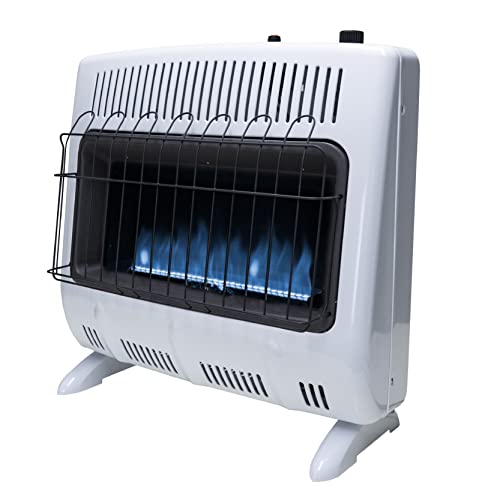
The Mr. Heater 30,000 BTU vent-free blue flame wall heater is designed to warm spaces up to about 1,000 sq. ft. It provides convection heat and includes a thermostat for precise setpoint control plus an electric ignition powered by a supplied battery.
Call 888-896-7031 for Free Local HVAC Quotes – Compare and Save Today!
Manufacturer notes highlight fuel-efficient blue flame combustion and a consumption rate specification. The unit is rated for use at elevations up to 4,500 feet. As with all ventless units, users should follow room size and ventilation recommendations and ensure compatibility with local codes and household fuel supply.
ProCom MN300HBA-B Ventless Natural Gas Blue Flame Heater With Base Feet

This ProCom ventless blue flame model produces up to 30,000 BTU and lists heating capability up to 1,400 sq. ft. It operates on natural gas only and is notable for not requiring electricity for ignition, using a push-button piezo ignition. The unit has manual low/medium/high settings and includes an Oxygen Depletion Sensor (ODS) for automatic shut-off in unsafe low-oxygen conditions.
Manual control and no-electric operation make this a candidate for installations where electrical supply is limited or where simplicity is preferred. Ventless operation requires attention to indoor air quality and adherence to any local restrictions on vent-free appliances.
Buying Guide: How To Choose A Natural Gas Heater
Selecting the right natural gas heater involves evaluating heating needs, installation constraints, fuel and venting options, and safety considerations. Below are key purchase factors and comparison perspectives to guide a decision.
1. Heater Type And Heat Delivery
- Infrared (Radiant): Heats objects and people directly. Good for targeted warmth in garages, patios, or workspaces where you want heat at the point of use. Example: Dyna-Glo IR30NMDG-1.
- Unit Heaters (Ventable): High BTU output with forced air or fan assistance. Suitable for large open areas and shops. Require venting and often electrical power. Example: Mr. Heater Big Maxx MHU80NG.
- Ventless Blue Flame: Efficient convective heating without flue venting. Simpler installation but requires adequate indoor ventilation and compliance with local codes. Examples: ProCom MN300HBA-B, Mr. Heater MHVFBF30NGT.
2. BTU Output And Coverage
- Match BTU to space size and insulation level. Higher BTU is needed for larger or poorly insulated areas.
- Consider heat distribution: radiant units warm people/objects directly, while convective units warm air for whole-room circulation.
3. Venting, Fuel, And Installation
- Vented Units require proper flue/venting and may need professional installation to meet codes.
- Ventless Units are easier to install but have indoor combustion and may be restricted in some jurisdictions or multi-family housing.
- Confirm the unit is configured for Natural Gas and whether conversion is allowed or supplied. Some models are natural-gas-only by design.
4. Controls, Thermostat, And Power Needs
- Integrated thermostats provide better temperature regulation and energy savings versus manual-only controls.
- Check electrical requirements: many unit heaters require 120 V for fans and ignition; some ventless models can operate without electricity.
- Remote or wired thermostats can improve convenience for larger or permanently installed systems.
5. Safety Features And Code Compliance
- Important safety features include Oxygen Depletion Sensors (ODS), tip-over/overheat protection, and reliable ignition methods.
- Always verify local building codes and manufacturer installation requirements—ventless units often have room-size and ventilation limits.
- Consider altitude limits published by the manufacturer for consistent performance.
6. Efficiency, Operating Considerations, And Air Quality
- Ventless heaters are nearly 100% efficient at point of use because combustion heat goes into the room, but combustion by-products remain indoors and can affect air quality.
- Vented condensing or non-condensing appliances exhaust combustion gases outdoors, which is preferable for indoor air quality in many cases.
- For frequent or whole-house use, consider vented solutions or central systems for better long-term indoor air management.
7. Installation Context And Use Cases
- Garages and workshops: infrareds or high-BTU vented unit heaters for rapid and distributed heat.
- Living spaces and additions: vented wall furnaces or ventless blue flame units depending on ventilation and code compliance.
- Vacation homes or cabins with limited electricity: manual or piezo-ignition ventless units avoid electrical dependency.
8. Maintenance And Longevity
- Follow manufacturer maintenance for burners, pilot assemblies, and sensors.
- Vent management (for vented appliances) and regular inspections help prevent performance loss and maintain safety.
Comparative perspectives: choose based on whether priority is air quality and venting (favor vented systems), ease of installation and lower upfront cost (ventless models), or point-specific radiant comfort (infrared). For large areas requiring high output, unit heaters with venting and fans offer broader distribution and higher BTU capacity.
Tips for Getting the Best HVAC Prices
- Prioritize Quality Over Cost
The most critical factor in any HVAC project is the quality of the installation. Don’t compromise on contractor expertise just to save money. - Check for Rebates
Always research current rebates and incentives — they can significantly reduce your overall cost. - Compare Multiple Quotes
Request at least three estimates before making your choice. You can click here to get three free quotes from local professionals. These quotes include available rebates and tax credits and automatically exclude unqualified contractors. - Negotiate Smartly
Once you've chosen a contractor, use the proven strategies from our guide — How Homeowners Can Negotiate with HVAC Dealers — to get the best possible final price.