
Quick Overview: This guide reviews five top natural gas wall-mount heaters suitable for homes, sunrooms, and additions. Each model summary includes heating capacity, mounting style, and notable safety or control features to help you compare options quickly.
| Model | BTU / Coverage | Mount Style | Notable Feature |
|---|---|---|---|
| ProCom MN100TBA-B | 10,000 BTU / Up to 500 sq. ft. | Ventless Wall Mount (also floor) | Thermostat control, compact blue flame |
| ProCom MN300TPA-B | 30,000 BTU / Up to 1,400 sq. ft. | Infrared Wall Mount (also floor) | Infrared heat, high output |
| Mr. Heater MHVFBF30NGT | 30,000 BTU / Up to 1,000 sq. ft. | Vent-free Wall Mount | Blue flame burner, thermostat |
| Comfort Glow 17,000 BTU | 17,000 BTU / Up to 570 sq. ft. | Direct Vent Wall Mount | Sealed burn system, safety pilot |
| Comfort Glow 25,000 BTU | 25,000 BTU / Up to 825 sq. ft. | Direct Vent Wall Mount | Sealed burn, larger coverage |
Content Navigation
ProCom MN100TBA-B Ventless Blue Flame Heater

Type: Ventless blue flame space heater with thermostat control. Heating Output: 10,000 BTU rated to heat up to 500 sq. ft. The design supports wall mounting with included hardware or floor placement using the supplied base feet.
Key Features: Built-in thermostat control offers High/Medium/Low settings for temperature regulation. The unit emphasizes a slim profile for tighter spaces and easy installation on an interior wall. As a ventless model, it delivers direct convection heat and is intended for supplemental heating in properly ventilated homes.
Safety & Use Notes: Ventless units rely on room air for combustion, so follow local codes and ventilation recommendations. The thermostat control simplifies maintaining a set comfort range, and included mounting hardware supports typical interior wall installations.
ProCom MN300TPA-B Infrared Natural Gas Heater

Call 888-896-7031 for Free Local HVAC Quotes – Compare and Save Today!
Type: Infrared natural gas wall or floor heater. Heating Output: 30,000 BTU with coverage up to 1,400 sq. ft. Infrared technology warms surfaces and objects directly rather than only heating air.
Key Features: Thermostat control with selectable High/Medium/Low settings and a modern slim profile designed for wall mounting. The infrared approach produces radiant heat which can be effective in spaces where direct warm surfaces are preferred, such as garages, workshops, or large open rooms.
Safety & Use Notes: Infrared heaters are efficient at delivering perceived warmth quickly to people and objects. Proper clearances and mounting height are important to avoid overheating nearby materials. This unit includes hardware for wall or floor installation.
Mr. Heater MHVFBF30NGT 30,000 BTU Blue Flame
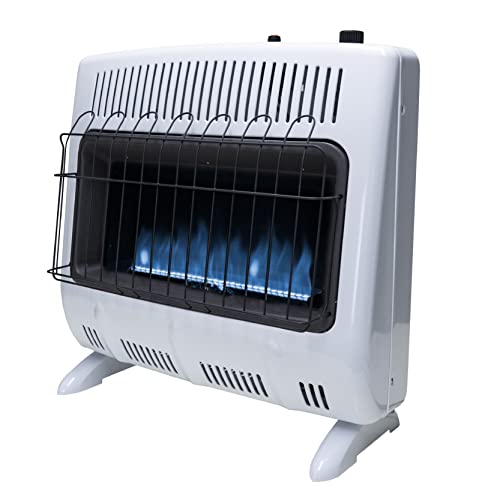
Type: Vent-free blue flame wall heater providing convection heat. Heating Output: Up to 30,000 BTU, suitable for areas up to roughly 1,000 sq. ft.
Key Features: Equipped with a built-in thermostat for precise temperature adjustments and an electric ignition supported by an included battery. The blue flame burner is noted for fuel-efficient combustion and even convection heat distribution.
Call 888-896-7031 for Free Local HVAC Quotes – Compare and Save Today!
Safety & Use Notes: Vent-free blue flame units produce water vapor and small amounts of combustion byproducts, making ventilation and adherence to appliance clearances important. This model supports installation in many interior spaces, with effective performance at elevations up to about 4,500 feet per manufacturer guidance.
Comfort Glow 17,000 BTU Direct Vent Wall Heater

Type: Direct vent natural gas wall heater with sealed combustion. Heating Output: 17,000 BTU for areas up to approximately 570 sq. ft.
Key Features: Sealed burn system isolates combustion from room air, improving indoor air quality and safety. The unit includes a Matchless Piezo ignition and a safety pilot with a built-in pressure regulator that stops gas flow if the pilot is extinguished.
Safety & Use Notes: Direct vent models are often preferred where indoor air quality and combustion isolation are priorities. Installation requires routing a vent to the exterior, which typically involves wall penetration or suitable vent kit installation to ensure correct draft and exhaust.
Comfort Glow 25,000 BTU Direct Vent Wall Heater

Type: Direct vent natural gas wall heater designed for larger rooms. Heating Output: 25,000 BTU with coverage up to about 825 sq. ft.
Key Features: Like other direct vent designs, this model uses a sealed combustion chamber and includes safety features such as a pressure-regulated safety pilot and Matchless Piezo ignition. The space-saving design mounts easily on walls and supports larger coverage than smaller direct vent units.
Safety & Use Notes: Direct vent heaters require correct venting to the outdoors; installation generally involves following local codes and ensuring an appropriate vent path. Sealed combustion reduces indoor combustion byproducts and can be suitable for tighter homes.
Buying Guide: Choosing The Right Natural Gas Wall Mount Heater
Identify Heating Needs: Calculate the area to be heated and the desired indoor temperature. Use square footage and local climate to determine required BTU. Small rooms commonly need under 10,000–17,000 BTU, while large open areas or additions may require 25,000–30,000 BTU or more.
Ventless vs Direct Vent: Ventless (vent-free) heaters burn fuel using room air and deliver high efficiency because no heat is lost through venting. They may increase indoor humidity and require proper ventilation and adherence to local codes. Direct vent models have sealed combustion and exhaust gases routed outdoors, improving indoor air quality and often meeting stricter code or insurance requirements.
Infrared vs Blue Flame vs Convection: Infrared heaters radiate heat directly to people and objects and can feel warmer quickly. Blue flame burners produce convection heat that warms air for steady distribution. Choose infrared for directed warmth and fast comfort; choose blue flame or convection for overall ambient heating.
Thermostat & Controls: Built-in thermostats and multiple heat settings improve comfort and efficiency. Models with precise thermostats reduce fuel use by maintaining set temperatures rather than continuous high output. Consider compatibility with external controls if smart home integration is desired.
Safety Features: Look for oxygen depletion sensors (ODS), sealed combustion chambers, pressure-regulated safety pilots, and automatic shut-off mechanisms. Vent-free units should include CO and ODS protections and meet applicable safety standards. Direct vent units inherently reduce indoor combustion exposure.
Installation Requirements: Verify whether the unit requires a direct vent through an exterior wall or can be ventless. Wall construction, clearance to combustibles, and gas line routing will affect installation complexity. A licensed HVAC or gas technician can confirm local code compliance and perform hookups safely.
Room Use And Air Quality: For bedrooms, tight homes, or spaces with limited ventilation, direct vent models are often preferable. Ventless heaters are suitable for well-ventilated spaces and where high efficiency is prioritized, but check local restrictions.
Mounting Options And Space: Confirm unit dimensions and clearance specifications to ensure proper wall placement. Some models include base feet for temporary floor placement; others are strictly wall-mounted. Consider mounting height for effective heat distribution and safety.
Fuel Supply And Conversion: Ensure the heater is configured for natural gas and note whether any fuel conversion is permitted by the manufacturer. Some models are factory-set for natural gas and do not allow conversion to propane without authorized kits.
Efficiency And Operating Conditions: Evaluate manufacturer-stated consumption rates, altitude limitations, and whether the heater requires electricity for ignition. Some models offer piezo or battery ignition for operation during power outages.
Maintenance And Serviceability: Routine inspection of burners, pilot assemblies, vents (for direct vent), and gas connections is essential. Choose models with accessible components and available replacement parts. Annual professional inspection is recommended for safety and efficiency.
Comparison Perspectives: Compare models on these axes: BTU coverage vs. room size, vent type (ventless vs direct vent), heat delivery method (infrared vs convection), safety features, and installation complexity. For tight, airtight homes, prioritize sealed-combustion direct vent units. For flexible, efficient supplemental heat in open spaces, ventless blue flame or infrared models may be suitable.
Regulatory And Local Code Considerations: Check local building codes and rental or HOA rules about ventless gas appliances. Some jurisdictions restrict ventless heater use in sleeping areas or new construction. Confirm compliance before purchase and installation.
Final Selection Tips: Match BTU output to your square footage, select vent type per air-quality needs, prioritize safety features, and budget for professional installation if venting or gas line work is required. Review manufacturer installation manuals and warranty details before committing.
Tips for Getting the Best HVAC Prices
- Prioritize Quality Over Cost
The most critical factor in any HVAC project is the quality of the installation. Don’t compromise on contractor expertise just to save money. - Check for Rebates
Always research current rebates and incentives — they can significantly reduce your overall cost. - Compare Multiple Quotes
Request at least three estimates before making your choice. You can click here to get three free quotes from local professionals. These quotes include available rebates and tax credits and automatically exclude unqualified contractors. - Negotiate Smartly
Once you've chosen a contractor, use the proven strategies from our guide — How Homeowners Can Negotiate with HVAC Dealers — to get the best possible final price.