
Choosing the right natural gas overhead heater depends on space, venting, and BTU needs. Below is a concise summary table of the five selected heaters and their core specs to help quick comparison.
| Product | Type | Max BTU | Approx. Coverage |
|---|---|---|---|
| Mr. Heater Big Maxx MHU80NG | Overhead Unit Heater | 80,000 BTU | Up To 2,000 Sq. Ft. (manufacturer coverage) |
| Mr. Heater MHU80NG Unit Heater | Overhead Unit Heater | 80,000 BTU | Up To 1,000 Sq. Ft. (application varies) |
| Modine Hot Dawg HD45AS0111 | Overhead Garage Heater | 45,000 BTU | Residential/Commercial Certified |
| Dyna-Glo IR30NMDG-1 | Infrared Wall/Space Heater | 30,000 BTU | Up To 1,000 Sq. Ft. |
| Comfort Glow 17,000 BTU Direct Vent | Wall Heater (Direct Vent) | 17,000 BTU | Up To 570 Sq. Ft. |
Mr. Heater Big Maxx MHU80NG Unit Heater
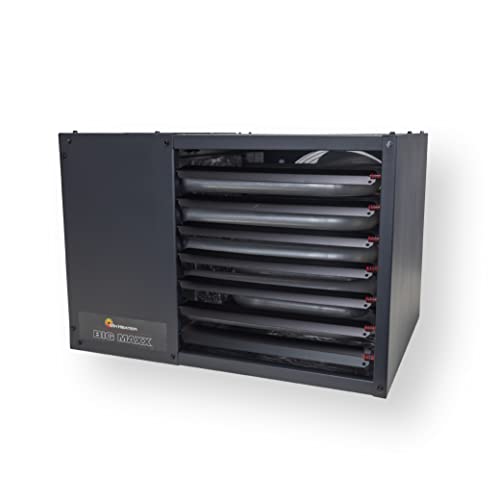
The Mr. Heater Big Maxx MHU80NG is a heavy-duty natural gas overhead unit designed for large garages and workshops. The unit delivers 80,000 BTU and lists a coverage area up to 2,000 sq. ft. It includes two angle brackets and a propane conversion kit with the purchase; a thermostat, hose and regulator are not included. Physical dimensions are 29.33” L x 15.50” W x 26.37” H, and it requires a minimum 8 ft. clearance from floor to base.
Vent options include Category 1 vertical and Category 3 horizontal venting, allowing flexibility for different building layouts. Electrical specs show 120 V at 2.3 amps. As an overhead unit, it’s intended for ceiling or high-wall mounting to distribute warm air across floor space.
Mr. Heater Natural Gas MHU80NG Overhead Heater

This Mr. Heater MHU80NG model is specified as an 80,000 BTU natural gas unit heater suited for overhead installation. The unit is noted for a spark ignition with a self-diagnostic control module, which assists with startup diagnostics and fault identification during operation.
Call 888-896-7031 for Free Local HVAC Quotes – Compare and Save Today!
Included are two angle brackets for easy ceiling mounting. Manufacturer mentions heating applicability up to around 1,000 sq. ft. in some product descriptions, which depends on insulation, ceiling height, and climate. This unit is focused on straightforward overhead installation and serviceability for workshop or garage use.
Modine Hot Dawg HD45AS0111 Garage Heater
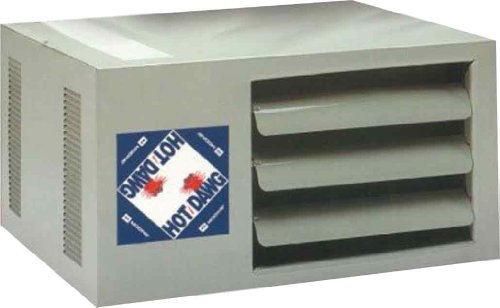
The Modine Hot Dawg delivers 45,000 BTU and is specifically certified for residential, commercial and industrial installations. Its compact, low-profile design is meant to blend into garage or shop ceilings while providing direct heat distribution below the unit.
Manufacturer highlights quiet operation and reliability for spaces requiring consistent heat. As a purpose-built overhead garage heater, the Hot Dawg is often chosen where certification and a compact footprint are priorities. Venting and installation specifications should be verified against local codes and ceiling clearances.
Dyna-Glo IR30NMDG-1 Infrared Wall Heater

The Dyna-Glo IR30NMDG-1 is a 30,000 BTU natural gas infrared heater that warms objects and people directly rather than only heating the air. Infrared heating performs similarly to sunlight by radiating heat, which can feel faster and more efficient in drafty or high-ceiling spaces.
Call 888-896-7031 for Free Local HVAC Quotes – Compare and Save Today!
This model is natural gas ready and does not permit fuel conversion. Manufacturer notes heating applicability up to 1,000 sq. ft. The unit is wall-mounted rather than overhead, but infrared radiant performance can be a practical alternative where overhead venting or large unit installation is not feasible.
Comfort Glow 17,000 BTU Direct Vent Wall Heater

The Comfort Glow 17,000 BTU direct vent natural gas wall heater offers a sealed-burn design that vents combustion directly to the outdoors. It’s rated to heat up to 570 sq. ft. and is present in applications where indoor air quality and sealed combustion are required.
Key safety features include a sealed burn system, matchless piezo ignition, and a pilot with an integrated pressure regulator that stops gas flow if the pilot goes out. This wall-mounted, direct-vent design is space-saving where overhead mounting or open-flame venting is restricted by building codes.
Buying Guide: How To Choose A Natural Gas Overhead Heater
Choosing the right heater requires assessing several technical and practical factors. Below are key considerations and comparison perspectives to guide selection.
Tips for Getting the Best HVAC Prices
- Prioritize Quality Over Cost
The most critical factor in any HVAC project is the quality of the installation. Don’t compromise on contractor expertise just to save money. - Check for Rebates
Always research current rebates and incentives — they can significantly reduce your overall cost. - Compare Multiple Quotes
Request at least three estimates before making your choice. You can click here to get three free quotes from local professionals. These quotes include available rebates and tax credits and automatically exclude unqualified contractors. - Negotiate Smartly
Once you've chosen a contractor, use the proven strategies from our guide — How Homeowners Can Negotiate with HVAC Dealers — to get the best possible final price.
1. BTU Output And Space Size
- Match BTUs To Volume: Calculate cubic feet (floor area x ceiling height). Higher ceilings increase required BTUs. Unit heaters range from 17,000 BTU to 80,000 BTU in this selection.
- Coverage Estimates: Manufacturer coverage is a guideline; actual performance depends on insulation, openings, and climate.
2. Overhead vs Wall vs Infrared
- Overhead Unit Heaters: Designed to distribute heated air downward across a workspace; common for garages and large shops (e.g., Mr. Heater, Modine).
- Wall/Direct-Vent Heaters: Seal combustion and vent directly outdoors; useful for improved indoor air quality and tighter installations (e.g., Comfort Glow).
- Infrared Heaters: Heat objects and people directly, often perceived as faster heat in open or drafty spaces (e.g., Dyna-Glo).
3. Venting And Installation Requirements
- Venting Category: Check venting category (Category 1, 3, etc.) and whether vertical or horizontal venting is supported.
- Clearances: Observe required clearances from floor, ceiling, and combustible materials; many overhead units require minimum floor clearance and specific mounting brackets.
- Electrical Needs: Some units need line voltage for blowers and ignition modules; others are ventless or piezo-ignition and may not require electricity.
4. Safety Features And Certifications
- Sealed Combustion/Direct Vent: Reduces indoor combustion byproducts and is often mandated by code in certain applications.
- ODS And Auto Shutoff: Oxygen depletion sensors and automatic pilot shutoffs enhance safety for enclosed spaces.
- Certifications: Look for residential/commercial certification when required by local codes (e.g., Modine specifies certification).
5. Ignition And Controls
- Spark Ignition With Diagnostics: Diagnostic control modules aid troubleshooting and can reduce service time (e.g., Mr. Heater spark ignition).
- Thermostat Compatibility: Determine if a remote thermostat is supported or included; many overhead units require separate thermostats for automated control.
- Manual vs Thermostat Control: Simpler units may use manual setting or piezo ignition; choose based on user preference and automation needs.
6. Installation And Maintenance Considerations
- Mounting Hardware: Verify included brackets and whether additional hardware is required for your ceiling type.
- Service Access: Choose units with accessible ignition and blower components for easier maintenance.
- Spare Parts: Common replacement parts, such as ignition control boards, are available for many popular overhead heater models.
7. Energy Efficiency And Operation
- Radiant vs Convection: Infrared radiant units heat people and objects efficiently, while overhead convection units heat air which may be better for whole-space comfort.
- Runtime And Fuel Use: Larger BTU output increases gas consumption; match output to need instead of oversizing to save fuel.
8. Code, Venting, And Local Regulations
- Local Codes: Always confirm local building and fuel gas codes, especially for ventless appliances and direct-vent installations.
- Professional Installation: Many installations require licensed HVAC or gas fitters for compliance and safety.
Comparison Perspectives
- High BTU, Coverage-Oriented Choice: Choose the Mr. Heater Big Maxx or MHU80NG for maximum output and broad coverage when ceiling space and venting allow.
- Certified, Compact Overhead: Modine Hot Dawg is suitable where certification and a smaller footprint are important.
- Air Quality/Sealed Combustion: Direct-vent models like Comfort Glow are preferable where sealed combustion is required.
- Targeted Instant Comfort: Infrared units such as Dyna-Glo work well when immediate radiant heat is needed in specific work areas rather than whole-space heating.