
Choosing the right ceiling-mount propane shop heater depends on space, BTU output, efficiency, and installation needs. The table below summarizes five ceiling-mount heaters and close alternatives selected for garage, workshop, or small warehouse heating. Each product section includes the manufacturer features and objective notes to help compare models.
| Product | Fuel / Type | BTU / Power | Mounting |
|---|---|---|---|
| Mr. Heater Propane Unit Heater MHU80LP | Propane (LP) | 80,000 BTU | Ceiling mount (angle brackets included) |
| Mr. Heater F260560 Big Maxx | Natural Gas (LP conversion kit included) | 80,000 BTU | Ceiling or wall (brackets included) |
| Reznor UDXC-60 (UDXC-60) | Propane (LP) | 60,000 BTU (two output levels) | Ceiling mount (suspension points; mounting sold separately) |
| Reznor UDXC-100 | Natural Gas (NG) | 105,000 BTU | Ceiling mount (suspension points) |
| Dr Infrared 10,260 BTU (3000W) Infrared Heater | Electric Infrared | 10,260 BTU / 3000W | Ceiling or wall mount (hardware included) |
Content Navigation
- Mr. Heater Propane Unit Heater MHU80LP
- Mr. Heater F260560 Big Maxx MHU80NG
- Reznor 60,000 BTU Propane Unit UDXC-60
- Reznor UDXC-100 Natural Gas Unit Heater
- Dr. Infrared 10,260 BTU (3000W) Infrared Heater
- Buying Guide: How To Choose A Ceiling Mount Propane Shop Heater
- 1. Fuel Compatibility And Availability
- 2. BTU Output And Space Sizing
- 3. Mounting, Clearances, And Venting
- 4. Efficiency, Fan Type, And Airflow
- 5. Controls, Ignition, And Safety Features
- 6. Installation Costs And Professional Requirements
- 7. Maintenance And Serviceability
- 8. Alternative Heating Perspectives
- 9. Code Compliance And Safety Checks
Mr. Heater Propane Unit Heater MHU80LP

Brand: Mr. Heater. The MHU80LP is a dedicated propane unit heater designed for garages and small shops. The unit advertises an 80,000 BTU/hr capacity and ceiling mounting via included angle brackets.
- Heating Coverage: Manufacturer lists suitability for spaces up to approximately 1,000 square feet (coverage varies with insulation and climate).
- Ignition & Controls: Spark ignition with a self-diagnostic control module—reduces need for manual pilot management.
- Mounting: Includes two angle brackets for ceiling install; follow clearance and venting instructions in the manual.
- Use Case: Commonly used in detached garages, small workshops, and farm buildings where propane supply is available.
Objectively, this model provides a high BTU output in a compact cabinet with mounting hardware included, making it a practical choice where propane is the fuel source and ceiling mounting is desired.
Mr. Heater F260560 Big Maxx MHU80NG
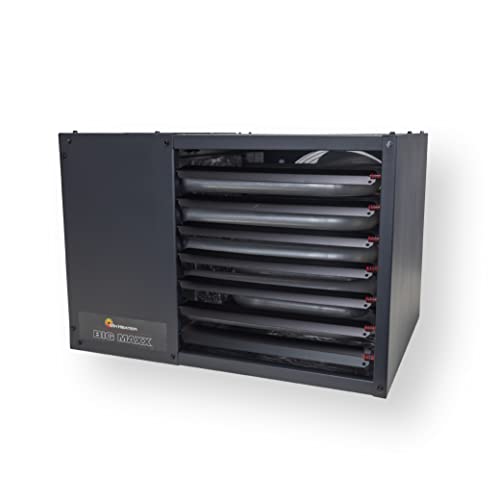
Brand: Mr. Heater. This Big Maxx MHU80NG is shipped as a natural gas unit but includes a liquid propane conversion kit, offering flexibility if you prefer propane.
Call 888-896-7031 for Free Local HVAC Quotes – Compare and Save Today!
- BTU & Coverage: 80,000 BTU; manufacturer indicates coverage up to 2,000 sq. ft. (actual performance dependent on building envelope).
- Package Contents: Heater with two angle brackets and LP conversion kit. Thermostat, hose, and regulator are not included.
- Electrical: 120V operation for fan and controls; low electrical draw listed at 2.3 amps.
- Mounting & Clearances: Ceiling mount capable; requires minimum 8 ft clearance from floor to base of unit—verify local codes for gas venting and clearances.
Because it includes an LP conversion kit, this unit can be adapted to propane supply. The inclusion of mounting brackets makes installation planning simpler, though additional accessories (thermostat/regulator) are commonly needed.
Reznor 60,000 BTU Propane Unit UDXC-60

Brand: Reznor (1HVAC). The UDXC-60 is rated for indoor propane use and advertises forced-air heating with quiet, low-static operation for ceiling mounting.
- BTU & Modulation: Rated 60,000 BTU with multiple output levels (low ~34,860 BTU and high ~49,800 BTU depending on configuration), improving part-load efficiency.
- Efficiency: Manufacturer claims approximately 83% thermal efficiency.
- Mounting Options: Four suspension points with threaded-nut retainers for ceiling hanging; specific brackets sold separately, giving installer flexibility.
- Use Cases: Suited for workshops, small warehouses, and garages needing a compact-ceiling-fanned gas heater.
The dual-output feature makes this model appropriate for variable heating demand, while the suspension-point design supports secure ceiling installs when paired with recommended mounting hardware.
Reznor UDXC-100 Natural Gas Unit Heater
Brand: Reznor (1HVAC). The UDXC-100 is a higher-capacity forced-air unit, intended for larger spaces where ceiling mounting and robust airflow are required.
Call 888-896-7031 for Free Local HVAC Quotes – Compare and Save Today!
- BTU Output: Rated at 105,000 BTU with two firing levels (low and high outputs specified by manufacturer).
- Efficiency: Manufacturer lists an approximate 83% thermal efficiency rating.
- Mounting: Four suspension points for ceiling hanging; mounting brackets generally sold separately and should meet local code requirements.
- Intended Spaces: Larger workshops, garages, or small warehouses where higher BTU capacity is needed; typically used with natural gas but similar mounting principles apply for propane-capable variants if available through conversion or specific models.
As a higher-capacity model, the UDXC-100 is objectively suited to applications requiring greater BTU and airflow. Confirm fuel compatibility and conversion options if propane is required in your location.
Dr. Infrared 10,260 BTU (3000W) Infrared Heater
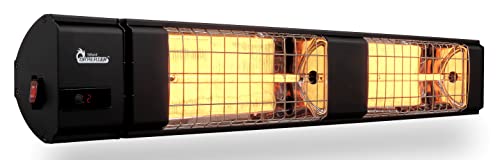
Brand: DR. INFRARED HEATER. This model is an electric infrared ceiling- or wall-mount heater intended as an alternative to gas units when propane supply or gas venting is not desired.
- Power & Output: 3000W / ~10,260 BTU equivalent, with remote control and two power levels for quick, clean heat.
- Installation: Provided mounting hardware for ceiling or wall; requires 220–240V electrical supply per manufacturer specification.
- Indoor/Outdoor Rating: Weatherproof and suitable for some outdoor-covered spaces (manufacturer IP55 rating on certain models).
- Use Case: Garages and patios where electric heat is preferred or where gas venting and clearances complicate installation.
While not a propane heater, this infrared electric option offers quick, odorless heating and simplified installation for spaces where gas infrastructure or venting is not available or desired.
Buying Guide: How To Choose A Ceiling Mount Propane Shop Heater
Selecting a ceiling-mount propane heater requires balancing heating capacity, installation constraints, fuel supply, and safety compliance. Below are key considerations and comparison perspectives.
1. Fuel Compatibility And Availability
Propane Availability: Confirm reliable propane supply (tank size, refill logistics). Some units ship as natural gas but include LP conversion kits—verify included parts before purchase.
Conversion Considerations: Conversion kits change orifices and regulators; ensure conversions are manufacturer-approved and installed by qualified technicians.
2. BTU Output And Space Sizing
Calculate Heat Load: Estimate required BTU by space volume, insulation levels, ceiling height, and desired temperature rise. As a rough guide, 40-50 BTU per square foot may be used for uninsulated or cold garages; better-insulated spaces require fewer BTU.
Multiple Firing Levels: Models with low/high outputs or modulating outputs improve efficiency by matching heat production to demand.
3. Mounting, Clearances, And Venting
Ceiling Support: Verify ceiling structure can support heater weight and vibration. Suspension points and brackets must meet the heater’s specifications.
Clearances: Follow manufacturer minimum clearances from combustibles and floor-to-base height. High ceilings may require different placement or dedicated fans for heat distribution.
Venting And Category Ratings: Some gas heaters require specific venting categories (e.g., Category I, III). Confirm venting needs and local code compliance; incorrect venting risks carbon monoxide or incomplete combustion.
4. Efficiency, Fan Type, And Airflow
Thermal Efficiency: Higher efficiency ratings mean more of the fuel’s energy becomes usable heat. Look for units with published efficiency percentages or multiple firing levels for better part-load performance.
Fan And Noise: Low-static propeller or quiet forced-air fans improve comfort in working spaces. Compare fan noise ratings and airflow patterns for even heat distribution.
5. Controls, Ignition, And Safety Features
Ignition Type: Spark ignition and self-diagnostic modules reduce pilot maintenance and improve reliability in intermittent use spaces.
Controls: Thermostat compatibility, remote control, and onboard timers enhance convenience. Confirm whether a thermostat is included or must be purchased separately.
Safety: Look for overheat protection, flame sensors, and pressure regulators appropriate for propane use. Installation should include proper regulators and leak testing per code.
6. Installation Costs And Professional Requirements
Professional Installation: Gas heaters typically require qualified gas-fitters or HVAC technicians for piping, regulator sizing, venting, and combustion air considerations. Factor labor and permit costs into total project planning.
Electrical Needs: Verify electrical supply for model controls and fans; some units require 120V while others need 240V.
7. Maintenance And Serviceability
Routine Maintenance: Gas units require periodic inspection of burners, filters, vent paths, and ignition systems. Access to service parts and local support can reduce downtime.
Longevity Factors: Corrosion-resistant housings, enclosed motors, and replaceable components extend service life in dusty or humid shops.
8. Alternative Heating Perspectives
Electric Infrared Vs Propane Forced-Air: Electric infrared heaters (like the Dr. Infrared model) provide instant, localized radiant heat without combustion byproducts or venting needs, but require high electrical capacity and typically offer lower overall BTU per unit compared to propane. Propane forced-air heaters deliver higher BTU for larger spaces but need gas connections, venting planning, and combustion safety management.
Capacity Matching: For small, well-insulated garages, a mid-range propane unit or electric infrared may suffice. For larger, poorly insulated workshops or warehouses, higher-BTU forced-air units with multiple firing levels are more appropriate.
9. Code Compliance And Safety Checks
Local Codes: Check local building and fuel codes, ventilation regulations, and permit requirements. Code constraints may dictate heater location, combustion air, and venting methods.
Carbon Monoxide Monitoring: Install CO detectors in occupied spaces where combustion appliances are present, and ensure adequate combustion air per the unit’s installation instructions.
Use the above factors to compare products by objective criteria: BTU per square foot, fuel availability, mounting requirements, efficiency, and installation complexity. Measure your shop, list constraints (venting, electrical service, ceiling structure), and consult a licensed installer for final selection and safe setup.
Tips for Getting the Best HVAC Prices
- Prioritize Quality Over Cost
The most critical factor in any HVAC project is the quality of the installation. Don’t compromise on contractor expertise just to save money. - Check for Rebates
Always research current rebates and incentives — they can significantly reduce your overall cost. - Compare Multiple Quotes
Request at least three estimates before making your choice. You can click here to get three free quotes from local professionals. These quotes include available rebates and tax credits and automatically exclude unqualified contractors. - Negotiate Smartly
Once you've chosen a contractor, use the proven strategies from our guide — How Homeowners Can Negotiate with HVAC Dealers — to get the best possible final price.