
Thin wall heaters provide targeted warmth without taking up floor space, ideal for bedrooms, offices, and small living areas. The table below summarizes five compact, wall-mounted electric heaters that balance size, control, and safety for efficient supplemental heating.
| Product | Brand | Key Feature |
|---|---|---|
| Heat Storm HS-1500-PHX-WIFI | Heat Storm | Wi‑Fi Control & Wall Mount |
| Dreo Smart Wall Heater WH719S | Dreo | 120° Oscillation & Smart App |
| Dreo IP24 PTC Wall Heater | Dreo | PTC Heating, Low Noise |
| Cadet Com-Pak CSC151TW | Cadet | Built-In Thermostat, 1500W |
| ENVI Plug-in Electric Panel | ENVI | Fan‑less Quiet Panel, Safety Sensor |
Content Navigation
Heat Storm HS-1500-PHX-WIFI Wall Mounted Heater

This wall-mounted infrared heater is designed to save floor space while delivering supplemental heat. Key points include Wi‑Fi enabled control for smartphone operation, a touch screen and digital thermostat, and a remote for manual adjustments. The unit includes a tip‑over safety shut-off despite being wall mounted, and its slim profile is suitable for bedrooms, kitchens, and offices. Installation is intended as a mounted unit; it does not include freestanding hardware. The feature set emphasizes remote convenience and space-saving installation.
Dreo WH719S Smart Wall Heater

The Dreo WH719S emphasizes wide 120° vertical oscillation to distribute heat top-to-bottom, improving coverage compared to fixed outlet heaters. It supports smart controls via the Dreo app and voice assistants, plus a precise thermostat with 1°F accuracy across a wide range. The PTC ceramic element provides steady heating and the unit is designed for easy wall mounting. Controls include a 24-hour timer and remote, enabling scheduled operation and remote temperature adjustments to match daily routines.
Dreo IP24 PTC Wall Heater

Call 888-896-7031 for Free Local HVAC Quotes – Compare and Save Today!
This model focuses on quiet, powerful performance using a PTC heating system and optimized airflow for strong output with low noise (~28 dB). It offers 30° manual oscillation to direct heat and multiple control methods: included remote, Dreo app, and voice with Alexa. The heater includes an ECO mode for energy‑aware operation and temperature calibration via app to maintain accurate readings. IP24 indicates splash resistance suitable for some indoor placement scenarios.
Cadet Com-Pak CSC151TW 1500W Wall Heater

The Cadet Com-Pak is a traditional electric wall heater with an integrated thermostat and a 1500W rating. It provides reliable coil-based heating and is designed as a complete unit for wall installation. Cadet units are commonly used for consistent supplemental heating in small rooms and feature a straightforward control layout. The design favors durability and steady output rather than smart features or oscillation, and it fits retrofit applications where a compact electric wall unit is preferred.
ENVI Plug-In Electric Panel Wall Heater
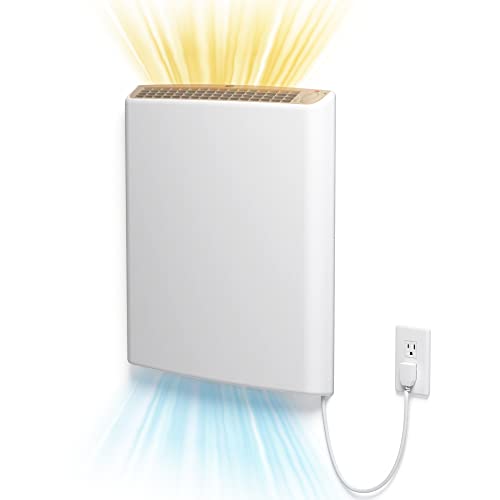
The ENVI panel heater uses a fan‑less convection design to provide quiet, continuous warmth with minimal air movement and no forced‑air noise. It operates at a gentle surface temperature (~90°F) and includes a wall-sense safety sensor that cuts power if removed from the wall. The unit is positioned as energy‑efficient for 24/7 operation, reducing drafts and airborne dust compared to fan heaters, and is suitable for bedrooms, nurseries, and allergy‑sensitive spaces.
Buying Guide For Thin Wall Heaters
Choosing a thin wall heater depends on room size, control needs, installation options, and safety preferences. Consider these factors to match a heater to your space and usage patterns.
Call 888-896-7031 for Free Local HVAC Quotes – Compare and Save Today!
Tips for Getting the Best HVAC Prices
- Prioritize Quality Over Cost
The most critical factor in any HVAC project is the quality of the installation. Don’t compromise on contractor expertise just to save money. - Check for Rebates
Always research current rebates and incentives — they can significantly reduce your overall cost. - Compare Multiple Quotes
Request at least three estimates before making your choice. You can click here to get three free quotes from local professionals. These quotes include available rebates and tax credits and automatically exclude unqualified contractors. - Negotiate Smartly
Once you've chosen a contractor, use the proven strategies from our guide — How Homeowners Can Negotiate with HVAC Dealers — to get the best possible final price.
Heating Method And Performance
- Infrared vs. Convection vs. PTC: Infrared heats objects and people directly, providing quick perceived warmth. Convection heats air gradually and can offer gentler, even room temperatures. PTC ceramic elements combine fast response with self‑limiting behavior for steady heat and safety.
- Wattage And Coverage: Typical wall-mounted units are 1000–1500W; 1500W commonly supplements small rooms. Estimate required output based on room size and insulation levels.
Control And Smart Features
- Thermostat Precision: Higher resolution thermostats (±1°F) help maintain comfort and reduce cycling.
- Remote, App, Or Voice: Smart control enables scheduling, remote preheating, and integration with home automation. Consider whether app reliability and compatibility (Alexa/Google) matter to you.
Distribution And Oscillation
- Fixed Outlet vs. Oscillating: Oscillating wall heaters distribute heat over a wider vertical area, useful in rooms with varied occupant positions. Fixed outlets concentrate heat in a single direction and may be better for targeted zones.
Noise And Indoor Air Quality
- Fan vs. Fan‑less: Fan models provide faster mixing but generate noise and can circulate dust. Fan‑less panels offer silent operation and reduced allergen movement.
Safety And Installation
- Mounting Type: Confirm whether the heater is wall‑mounted only or also freestanding. Verify mounting hardware and clearances for safe installation.
- Safety Features: Look for tip‑over protection (if portable), overheat shutoff, wall‑sense sensors, and surface temperature limits for child or pet safety.
- Electrical Requirements: Check voltage and circuit compatibility. Some models require dedicated circuits or 240V; others run on standard 120V outlets or hardwired connections.
Energy Use And Modes
- ECO And Timer Modes: Eco modes and programmable timers help reduce runtime and energy consumption while maintaining comfort.
- Continuous Low‑Watt Options: Low-watt, panel-style heaters can run continuously to maintain baseline warmth with less peak demand.
Durability, Maintenance, And Warranty
- Maintenance Needs: Coil and fan models may need occasional cleaning or filter checks; fan‑less panels require minimal upkeep.
- Warranty And Support: Compare manufacturer warranties and available customer support for installation or replacement parts.
Comparison Perspectives
- Small Bedroom: Prioritize quiet, fan‑less panels or low‑noise PTC units with thermostats and timers for overnight comfort.
- Office Or Workshop: Consider oscillating units for quick, directed warmth and remote control for convenience.
- Allergy Or Sleep Sensitivity: Choose fan‑less or convection panel heaters to minimize airborne dust movement and noise.
- Smart Home Integration: If scheduling and voice control are needed, select models with proven app ecosystems and voice assistant compatibility.