
Choosing a wall heater with a fan combines fast warm-up times with improved air circulation. Below is a concise comparison of five fan-forced wall heaters available on Amazon, followed by focused product breakdowns and a practical buying guide to help select the right model for bedrooms, bathrooms, basements, or spot heating.
| Product | Type / Wattage | Key Feature |
|---|---|---|
| Cadet Com-Pak CSC202TW | 2000/1500 W, 240/208 V | Fast Heating With Built-In Fan |
| Cadet Com-Pak CSC151TW | 1500 W, 120 V | Compact Fan-Forced Unit With Thermostat |
| Broan-NuTone 114 Kickspace | Fan-Forced, Line Voltage | Durable Grille With Vertical Louvers |
| Global Industrial Fan Forced Wall Heater | 4000/3000 W, 240/208 V | High Output Commercial-Style Heater |
| Stiebel Eltron 236304 CK Trend | 1500 W, 120 V | Quiet European Downdraft Design |
Content Navigation
- Cadet Com-Pak Electric Wall Heater (CSC202TW)
- Cadet Com-Pak Wall Heater With Thermostat (CSC151TW)
- Broan-NuTone 114 Kickspace Fan-Forced Wall Heater
- Global Industrial Fan Forced Wall Heater (4000/3000W)
- Stiebel Eltron CK Trend Wall-Mounted Electric Fan Heater
- Buying Guide: How To Choose A Fan-Forced Wall Heater
Cadet Com-Pak Electric Wall Heater (CSC202TW)
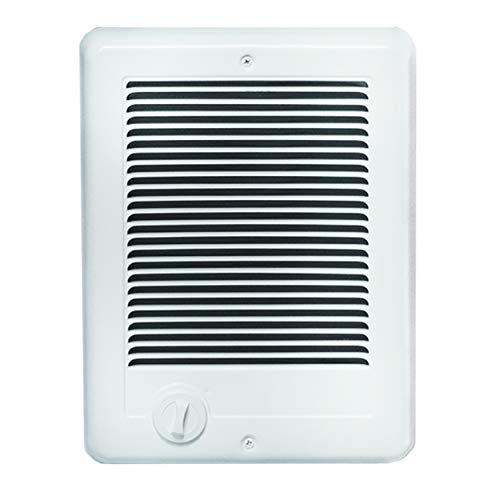
This Cadet Com-Pak model is a fan-forced wall heater designed for quicker room warm-up. It lists 2000/1500 Watt power options and supports 240/208 Volt circuits. The design emphasizes a fast heating coil element to warm areas up to roughly 200 sq. ft. depending on insulation and ceiling height.
Key features include a quiet fan to distribute heat evenly, compatibility for ceiling installation at lower wattages, and safety mechanisms that shut the unit off if operating temperatures exceed safe levels. The unit is intended for standard residential installations and works best under 10,000 feet elevation.
Cadet Com-Pak Wall Heater With Thermostat (CSC151TW)

The CSC151TW is a compact 120 Volt, 1500 Watt fan-forced wall heater with an integrated thermostat. It’s optimized for single-room heating where a 120 V circuit is preferred, such as bedrooms or small living spaces.
Call 888-896-7031 for Free Local HVAC Quotes – Compare and Save Today!
Features called out by the manufacturer emphasize a complete package with thermostat control and the typical Cadet reliability for forced-air distribution. This model suits retrofit situations where a compact footprint and easy wall mounting are priorities.
Broan-NuTone 114 Kickspace Fan-Forced Wall Heater

The Broan-NuTone 114 is a fan-forced wall heater supplied without a built-in thermostat, allowing owners to pair it with an optional line-voltage thermostat or timer. The white grille features a baked enamel finish and one-piece construction for durability in entryways, garages, or tight spaces.
Its vertical louvers are designed to disperse heat evenly across the width of the grille. Control flexibility is a notable point: choose from various optional thermostats or timers to match operational needs and energy-control preferences.
Global Industrial Fan Forced Wall Heater (4000/3000W)

This Global Industrial unit is a high-output fan-forced wall heater offering 4000/3000 Watt configurations for 240/208 Volt systems. The design targets larger zones, workshops, or commercial spaces where rapid heat and higher capacity are required.
Call 888-896-7031 for Free Local HVAC Quotes – Compare and Save Today!
Manufacturer notes highlight that the fan-forced approach provides quicker warm-up than conventional convection-only units. It also mentions recessed mounting options and a built-in thermostat, making it suitable for utility areas that demand heavy-duty heating performance.
Stiebel Eltron CK Trend Wall-Mounted Electric Fan Heater

The Stiebel Eltron CK Trend is a European-style surface-mount fan heater offering 1500 Watts at 120 V. It emphasizes quiet operation (manufacturer lists noise around 49 dB(a)) and a downdraft design intended to heat space evenly from top to bottom.
Its built-in thermostat and sleek housing suit modern interiors, where low noise and discrete appearance are priorities. The downdraft configuration helps prevent hot spots and supports a more consistent room temperature distribution.
Buying Guide: How To Choose A Fan-Forced Wall Heater
This buying guide highlights the primary factors to evaluate when selecting a wall heater with a fan. Review each category relative to your room size, wiring, and installation preferences.
Heating Capacity And Room Size
Calculate the needed wattage by room size and insulation. Typical guidance: 10–15 watts per square foot for well-insulated rooms. Smaller rooms can use 1500 W units, larger or poorly insulated areas may need 2000 W or higher. Commercial or workshop spaces often require higher-output models like 3000–4000 W.
Voltage And Electrical Requirements
Confirm the building’s circuit availability. Many residential fan-forced wall heaters come in 120 V or 240 V
Thermostat And Controls
Decide between models with built-in digital thermostats, simple mechanical thermostats, or heater-only units that require an external line-voltage thermostat or timer. Built-in thermostats simplify control; separate controls add flexibility for zoning or centralized control systems.
Fan Noise And Airflow
Fan-forced units warm faster than convection-only designs but produce noise. Look for sound ratings or manufacturer noise descriptions if you plan to install the heater in a bedroom or living room. Downdraft or engineered fan designs can reduce perceived noise while maintaining airflow.
Safety Features
Prioritize models with overheat protection, thermal safeties, and wall-sense or tilt cutoffs for installations near traffic areas, children, or pets. Some heaters include cool-surface operation or automatic shutoff if removed from the wall, useful for continuous-use scenarios.
Installation And Mounting Options
Consider recessed vs. surface mount and whether the heater uses a standard wall can or requires additional framing. Some units are designed to replace older heaters without wall patchwork, while others may require a new cutout or electrical modification.
Air Quality And Allergens
Fan-forced heaters can move dust and allergens more than radiant or convection panel heaters. If indoor air quality is a concern, select models with low-dust designs or consider additional air filtration in the room.
Durability And Environment
Match the heater to the environment: select durable grille finishes like baked enamel for high-traffic areas or utility rooms. For humid or unconditioned spaces, verify manufacturer recommendations and ratings for installation locations.
Control Features And Smart Connectivity
If remote control, scheduling, or voice commands matter, look for models that offer app control or compatibility with smart home platforms. Smart heaters provide flexible scheduling and can improve perceived efficiency via targeted operation.
Energy Efficiency And Runtime
While wattage determines heating capability, efficiency comes from targeted use and thermostat control. Use timers, programmable thermostats, or zoning to reduce runtime and lower energy consumption while maintaining comfort.
Tips for Getting the Best HVAC Prices
- Prioritize Quality Over Cost
The most critical factor in any HVAC project is the quality of the installation. Don’t compromise on contractor expertise just to save money. - Check for Rebates
Always research current rebates and incentives — they can significantly reduce your overall cost. - Compare Multiple Quotes
Request at least three estimates before making your choice. You can click here to get three free quotes from local professionals. These quotes include available rebates and tax credits and automatically exclude unqualified contractors. - Negotiate Smartly
Once you've chosen a contractor, use the proven strategies from our guide — How Homeowners Can Negotiate with HVAC Dealers — to get the best possible final price.
Comparison Perspectives
- Small Bedrooms/Offices: 120 V 1500 W models with built-in thermostats balance size and control.
- Medium Rooms: 1500–2000 W 240 V options deliver faster recovery and better temperature stability.
- Large Rooms/Workshops: 3000–4000 W fan-forced units provide the capacity needed for rapid heating.
- Quiet-Environments: Look for units with low dB ratings, downdraft designs, or fan-speed control.
- Retrofit Projects: Choose models that match existing wall cans or mounting footprints to avoid wall repairs.