
Choosing a ventless wall-mount propane heater requires balancing heat output, technology (blue flame vs. infrared), safety features, and room size. The table below summarizes five well-rated wall-mount ventless propane heaters to help you compare core specs at a glance.
| Product | Type / BTU | Coverage | Key Feature |
|---|---|---|---|
| ProCom ML100TPA-B | Infrared / 10,000 BTU | Up To 500 Sq. Ft. | Thermostat Control, Wall Or Floor Mount |
| ProCom ML100TBA-B | Blue Flame / 10,000 BTU | Up To 500 Sq. Ft. | Thermostat Control, Slim Profile |
| Dyna-Glo 30,000 BTU | Blue Flame / 24,000–30,000 BTU | Up To 1,000 Sq. Ft. | Variable Heat Output, Wall Mount |
| Mr. Heater MHVFBF20LPT | Blue Flame / 20,000 BTU | Up To 700 Sq. Ft. | Thermostat, ODS Safety Sensor |
| Rinnai FC824P | Ventless Propane / Compact Output | Small Rooms | Programmable Thermostat, Multiple Safety Switches |
Content Navigation
- ProCom ML100TPA-B Ventless Propane Infrared Heater
- ProCom ML100TBA-B Ventless Propane Blue Flame Heater
- Dyna-Glo 30,000 BTU Liquid Propane Blue Flame Wall Heater
- Mr. Heater MHVFBF20LPT 20,000 BTU Blue Flame Vent Free Heater
- Rinnai FC824P Ventless Propane Heater With Programmable Thermostat
- Buying Guide: How To Choose A Wall Mount Ventless Propane Heater
- 1. Heating Technology: Blue Flame vs. Infrared (Radiant)
- 2. BTU Output And Room Size
- 3. Safety Features And Codes
- 4. Thermostat And Control Options
- 5. Installation And Mounting Flexibility
- 6. Energy Use And Fuel Efficiency
- 7. Noise And Comfort Considerations
- 8. Coverage And Zoning Strategy
- 9. Maintenance And Durability
- 10. Comparison Perspectives
ProCom ML100TPA-B Ventless Propane Infrared Heater

This ProCom model is a compact infrared ventless heater that delivers up to 10,000 BTU and is rated for spaces up to 500 sq. ft. It operates using liquid propane and includes both wall-mount hardware and base feet for floor placement.
Key listed features include an adjustable thermostat with High/Medium/Low settings, a slim modern profile designed to fit limited spaces, and infrared technology that primarily warms objects and people rather than just air.
As a wall-mount option, the ML100TPA-B is suitable for bedrooms, offices, or living areas where point-source radiant heat is preferred. The inclusion of mounting hardware and feet delivers installation flexibility for homeowners or renters.
ProCom ML100TBA-B Ventless Propane Blue Flame Heater

Call 888-896-7031 for Free Local HVAC Quotes – Compare and Save Today!
The ML100TBA-B uses blue flame technology to convect heat into the air and is rated for 10,000 BTU, up to 500 sq. ft. It shares many mechanical features with the infrared ML100TPA-B but differs in heating method.
Listed features highlight thermostat control with multiple settings, a slim aesthetic for tight spaces, and the same mounting options—wall or floor. Blue flame models are designed to heat the air in a room similarly to central heating systems.
For users prioritizing air convection and even room temperature increase rather than targeted radiant warmth, the blue flame ProCom is the closer match among compact wall-mount ventless units.
Dyna-Glo 30,000 BTU Liquid Propane Blue Flame Wall Heater

The Dyna-Glo wall heater offers a much larger 24,000–30,000 BTU variable output intended for spaces up to 1,000 sq. ft. This model is liquid propane ready and is strictly wall mountable per the listed features.
Its blue flame design convects warm air into the room, providing a pattern of heating similar to central systems. The unit supports variable output to match room size and heat demand.
Call 888-896-7031 for Free Local HVAC Quotes – Compare and Save Today!
Because of its higher BTU range, this heater is more suitable for larger rooms, additions, or spaces where sustained convective heating is necessary. Fuel conversion is not permitted, so install and fuel type must align with the listed specification.
Mr. Heater MHVFBF20LPT 20,000 BTU Blue Flame Vent Free Heater
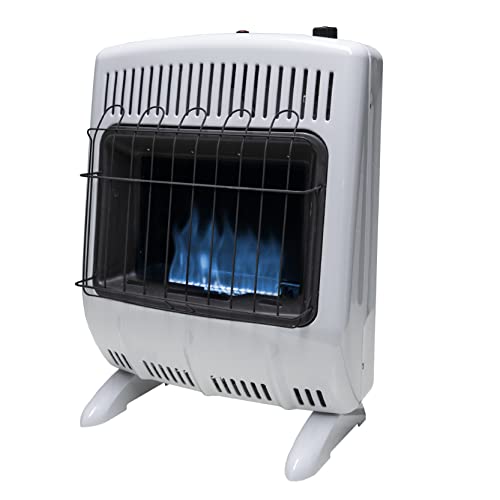
The Mr. Heater MHVFBF20LPT is a mid-range 20,000 BTU blue flame vent-free wall heater rated to heat areas up to 700 sq. ft. It emphasizes reliable startup and safety control in its feature set.
Listed features include a thermostat for accurate temperature control, battery-powered electronic ignition (battery included), and a factory-standard oxygen depletion sensor (ODS) for low-oxygen automatic shutdown. Fuel consumption rates and elevation performance (up to 4,500 ft.) are provided in the product details.
This heater is appropriate when a balance of room-scale convective heat and built-in safety systems are required, such as in cabins, garages converted to living spaces, or additions without ductwork.
Rinnai FC824P Ventless Propane Heater With Programmable Thermostat
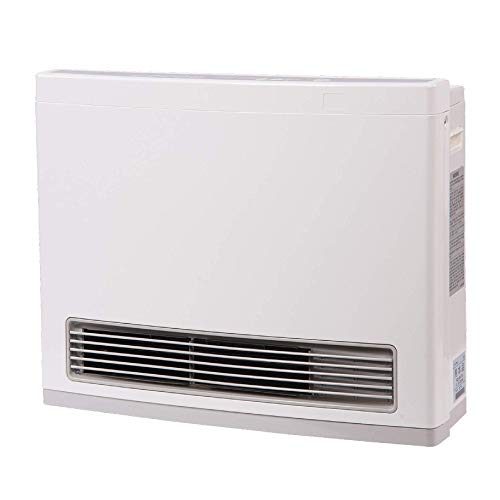
The Rinnai FC824P is described as an energy-efficient wall heater with a programmable thermostat and adaptive digital controls tailored for small rooms and compact applications.
Product features list a warm air outlet and bottom front louvers for effective distribution, self-diagnostics for maintenance, and multiple safety devices including flame failure, overheat, oxygen depletion (ODS), and tilt switches. These features are designed to automatically disable gas or power in unsafe conditions.
This model targets users seeking precise, programmable temperature control and layered safety interlocks in a ventless wall-mounted configuration, making it suitable for bedrooms, home offices, or small living spaces.
Buying Guide: How To Choose A Wall Mount Ventless Propane Heater
Selecting the right ventless propane wall heater requires attention to function, space size, fuel compatibility, ventilation rules, and safety systems. Below are key factors and comparison perspectives to consider before purchasing.
Tips for Getting the Best HVAC Prices
- Prioritize Quality Over Cost
The most critical factor in any HVAC project is the quality of the installation. Don’t compromise on contractor expertise just to save money. - Check for Rebates
Always research current rebates and incentives — they can significantly reduce your overall cost. - Compare Multiple Quotes
Request at least three estimates before making your choice. You can click here to get three free quotes from local professionals. These quotes include available rebates and tax credits and automatically exclude unqualified contractors. - Negotiate Smartly
Once you've chosen a contractor, use the proven strategies from our guide — How Homeowners Can Negotiate with HVAC Dealers — to get the best possible final price.
1. Heating Technology: Blue Flame vs. Infrared (Radiant)
- Blue Flame (Convective): Heats air that circulates throughout the room. Better for whole-room warming and spaces where even air temperature is desired.
- Infrared (Radiant): Warms objects and people directly. Feels like “sunshine” warmth and can be more efficient for targeted heating of seating areas or workspaces.
- Choose based on whether you want direct radiant comfort or room air temperature increase.
2. BTU Output And Room Size
- Match BTU to room square footage and insulation level. Higher BTU units (20k–30k) suit larger or poorly insulated areas.
- Smaller units (around 10k BTU) are intended for compact rooms up to ~500 sq. ft.
- Consider variable output models if you want flexibility across seasons or rooms.
3. Safety Features And Codes
- Oxygen Depletion Sensor (ODS): Automatically shuts off gas if oxygen is too low—common and important for ventless units.
- Flame Failure/Overheat/Tilt Switches: Prevent operation in unsafe conditions; check if included.
- Confirm local building codes and regulations regarding ventless appliances—some jurisdictions restrict or prohibit vent-free heaters in certain rooms.
4. Thermostat And Control Options
- Basic models offer three-position thermostat control (High/Medium/Low).
- Programmable thermostats and digital adaptive controls give finer temperature regulation and potential energy savings.
- Consider whether electronic ignition and battery backup are important for startup convenience.
5. Installation And Mounting Flexibility
- Confirm whether the unit is wall-only or includes a base/feet kit for floor placement; some models offer both.
- Installation must follow manufacturer clearances from combustible materials; professional installation is often recommended.
- Check fuel type compatibility—many units are liquid propane ready but do not permit fuel conversion.
6. Energy Use And Fuel Efficiency
- Look at listed fuel consumption rates where available to estimate runtime on typical LP cylinders.
- Infrared units can feel more efficient for people-focused warmth; convective units may be better for raising ambient air temperature.
7. Noise And Comfort Considerations
- Radiant units are often quieter since they rely less on convection; models with blowers will generate more sound.
- Consider blower-equipped models if you want faster heat distribution, but weigh against noise levels.
8. Coverage And Zoning Strategy
- Decide whether you need a single central heater for a larger zone or multiple smaller units for targeted zones.
- Smaller wall-mounted units are effective for zoning—supplemental heat in specific rooms saves energy versus heating the whole house.
9. Maintenance And Durability
- Review self-diagnostic features or easy-access panels for routine checks.
- Periodic cleaning of burner surfaces and checks of ODS sensors help maintain safety and performance.
10. Comparison Perspectives
- Performance vs. Size: High-BTU units heat larger areas but require more fuel and clearance; compact models are economical for bedrooms or offices.
- Safety vs. Features: Models with multiple safety switches and programmable thermostats provide both convenience and added safeguards.
- Technology Choice: Infrared for spot warmth and personal comfort; blue flame for general room heating and air temperature elevation.