
Finding a wall heater that combines low noise with efficient, even warmth is essential for bedrooms, offices, and living spaces. Below is a concise comparison of five wall-mounted heaters selected for quiet operation, installation options, and control features to help you choose the best fit for a calm indoor environment.
| Product | Power / Type | Noise / Key Quiet Feature |
|---|---|---|
| Dreo Smart Wall Heater WH719S | 1500W Electric, Oscillating PTC | Designed for steady PTC operation with balanced airflow |
| Dreo Smart Wall Heater IP24 | PTC Electric, 30° Oscillation | Low 28 dB noise level, optimized airflow |
| ENVI Plug-in Electric Panel Heater | Low-wattage Convection Panel, Fan-less | Patented Quiet Fan-less Design |
| 9815WH Large Capacity Wall Heater | 1500W Convection with Motorized Vent | Claims silent motor and reduced market-level noise |
| Heat Storm HS-1500-PHX-WIFI | Infrared Wall Mounted | Infrared panels are typically very quiet (no fan) |
Content Navigation
Dreo Smart Wall Heater, Electric Space Heater 1500W

This Dreo wall heater uses a PTC ceramic element and a 120° vertical oscillation to distribute warm air from top to bottom. The oscillation helps reduce hotspots and can give the perception of gentler, more continuous warmth compared with single-direction vents.
Key features: Smart control via the Dreo app and voice assistants, precise thermostat with 1°F accuracy, remote control, and a 24-hour timer. The unit emphasizes widespread warmth and fast heat delivery while aiming for balanced acoustic performance through controlled airflow.
Noise profile: The design is intended to be quieter than conventional wall fans by pairing oscillation with PTC heating. For rooms where even, rapid distribution is desired, this model balances performance and noise management.
Dreo Smart Wall Heater IP24, 30° Oscillation

Call 888-896-7031 for Free Local HVAC Quotes – Compare and Save Today!
The IP24 Dreo wall heater highlights a low 28 dB noise level, achieved through optimized airflow and a PTC heating system. The reduced decibel rating makes this model suitable for bedrooms and offices where minimal background sound is important.
Key features: 11.5 ft/s airflow, 30° manual oscillation to direct heat, smart controls with the Dreo app and Alexa compatibility, ECO mode for energy-efficient temperature maintenance, and a temperature calibration function in the app for consistent readings.
Noise profile: With a quantified decibel level and an emphasis on airflow tuning, this unit targets quieter operation while still providing active heat distribution. Fans are present but tuned for lower speed and noise relative to many wall-mounted fan heaters.
Envi Plug-in Electric Panel Wall Heater
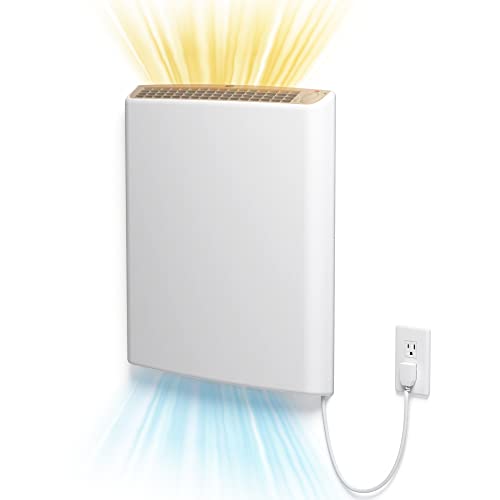
The ENVI panel heater features a patented fan-less “Stack Convection” design that provides gentle, silent warmth without blowing dust. The fan-less approach removes moving parts that generate noise, making this one of the quietest options for continuous background heating.
Key features: Plug-in installation, low-wattage continuous heating ideal for supplementing central heat, wall-sense safety sensor that cuts power if removed, and an auto-dimming power light for minimal distraction. The heater maintains a cool outer surface around 90°F and supports 24/7 operation.
Call 888-896-7031 for Free Local HVAC Quotes – Compare and Save Today!
Noise profile: Because it uses convection rather than forced air, the ENVI unit delivers near-silent operation. This makes it well-suited for bedrooms, nurseries, and spaces sensitive to auditory disturbance or airborne allergens.
9815WH Large Capacity Electric Wall Heater

The 9815WH wall-mounted heater advertises a silent motor and efficient heat distribution via louvers. It is factory wired for 120V/1500W with options for 240V wiring flexibility, and it emphasizes rapid, even area heating while minimizing operational noise.
Key features: Adjustable built-in thermostat, overheat protection, louvered design for even heat spread, and adaptable voltage options. The manufacturer claims noise levels below average market offerings through careful motor design and layout.
Noise profile: This model combines motor-driven convection with design steps to reduce operational sound. For rooms requiring stronger heat output than passive panel units but still needing quiet performance, it provides a middle-ground option.
Heat Storm HS-1500-PHX-WIFI Infrared Wall Heater

The Heat Storm HS-1500-PHX is an infrared wall-mounted heater with Wi-Fi control. Infrared heating warms objects and people directly rather than moving air, which generally results in very quiet operation since no fan is needed.
Key features: Wi-Fi-enabled control via smartphone, touch screen with digital thermostat, remote included, tip-over safety, and wall-saving mount. The unit is marketed as a space-saver for bedrooms, kitchens, and offices while providing direct radiant warmth.
Noise profile: Infrared panel heaters are effectively silent during operation because they rely on radiant heat transfer. For occupants sensitive to background sound or those preferring no air movement, infrared is a prominent low-noise option.
Buying Guide: How To Choose The Quietest Wall Heater
Selecting a quiet wall heater should balance noise level, heat delivery method, installation, and safety. Below are the main factors to compare when prioritizing silent operation.
Heating Method And Noise
- Fan-less Convection Panels (like ENVI) produce almost no noise because there are no moving parts. They provide gentle background warmth ideal for bedrooms and continuous use.
- Infrared Panels (like Heat Storm) are typically silent, warming objects and people directly. Best where quick perceived warmth and no air movement are desired.
- PTC Ceramic With Low-Noise Fans (Dreo models) use small fans or oscillation to distribute air. Look for specified decibel ratings (e.g., 28 dB) or manufacturer notes on low-noise motors.
- Motorized Convection Units (9815WH) can offer stronger airflow-based heating with reduced-noise motors; they often sit between fan-less and high-speed fan units for noise and power.
Decibel Ratings And Manufacturer Data
- Prefer models that list a decibel rating or describe a “silent motor” or “patented fan-less” design.
- Remember that perceived noise depends on distance, room acoustics, and baseline ambient sound. A ~28 dB rating is typically very quiet for indoor living spaces.
Control Options And Convenience
- Remote and App Control: Useful to adjust temperature without approaching the unit, minimizing disturbance.
- Timers and Schedules: Allow the heater to run during occupied hours and remain off when not needed, reducing both noise and energy use.
- Voice Control: Integrations with Alexa or Google Home add hands-free convenience but do not directly affect noise levels.
Safety And Installation
- Fan-less designs often have simpler plug-in installation and lower surface temperatures, useful around children and pets.
- Hardwired or built-in units provide permanent installation and may offer higher output; confirm electrical requirements and professional installation if needed.
- Look for overheat protection, tip-over sensors (for portable options), and wall-sense safety features that cut power if the unit is removed.
Energy Use And Efficiency
- Lower-wattage continuous heaters can be efficient for targeted comfort without the noise of powerful fans. Consider room size and insulation when matching wattage to space.
- ECO or calibrated thermostat modes help maintain comfort while minimizing runtime and noise associated with cycling fans.
Maintenance And Indoor Air Quality
- Fan-based heaters can circulate dust; fan-less and infrared units reduce airborne particle movement, aiding allergy sufferers.
- Check for accessible filters or easy cleaning for fan units to sustain quiet operation and performance over time.
Comparison Perspectives
- Quietest Overall: Fan-less convection panels and infrared models are typically the quietest because they lack moving parts.
- Best For Quick Even Heat: Low-noise PTC units with oscillation distribute warmth faster while still aiming for low sound levels.
- Best For Continuous Background Warmth: Low-wattage panel heaters that run steadily with almost no noise are ideal for bedrooms or home offices.
- Best For Adjustable Output: Motorized convection models can deliver stronger heat with reduced noise when manufacturers tune the motor and louvers for quiet operation.
When choosing, match the heater’s noise characteristics to your space and tolerance for background sound, and confirm installation requirements, safety features, and control options that support a quiet, comfortable environment.
Tips for Getting the Best HVAC Prices
- Prioritize Quality Over Cost
The most critical factor in any HVAC project is the quality of the installation. Don’t compromise on contractor expertise just to save money. - Check for Rebates
Always research current rebates and incentives — they can significantly reduce your overall cost. - Compare Multiple Quotes
Request at least three estimates before making your choice. You can click here to get three free quotes from local professionals. These quotes include available rebates and tax credits and automatically exclude unqualified contractors. - Negotiate Smartly
Once you've chosen a contractor, use the proven strategies from our guide — How Homeowners Can Negotiate with HVAC Dealers — to get the best possible final price.