
Overview: This guide compares top in-wall electric heaters and smart wall heating options for American homes. Below is a quick summary of the selected models, followed by concise product reviews and a practical buying guide to help match a heater to your space and needs.
| Product | Key Feature | Voltage / Wattage | Best For |
|---|---|---|---|
| Cadet Com-Pak CSC151TW | Integrated thermostat, complete unit | 120V / 1500W (5120 BTU) | Small rooms, retrofit installs |
| Heat Storm 1500W In-Wall Heater With WiFi | Built-in WiFi, dual watt settings | 120V / 1500W or 750W selectable | Smart control & scheduling |
| Cadet Com-Pak CSC202TW | Fan-forced fast heating, multi-voltage | 208/240V / 2000W or 1500W | Medium rooms, faster heat-up |
| Broan-NuTone 9815WH | High capacity with adjustable thermostat | 120/240V / 1500W | Large rooms or supplemental heat |
| Dreo Smart Wall Heater WH719S | Oscillating spread, smart app control | 120V / 1500W | Even distribution, voice control |
Content Navigation
Cadet Com-Pak Electric Wall Heater CSC151TW

The Cadet Com-Pak CSC151TW is a complete in-wall heater unit with a built-in thermostat. It delivers 1500 watts at 120 volts (about 5120 BTU), intended for small rooms and retrofit projects where a compact, self-contained unit simplifies installation.
- Integrated Thermostat: Front-mounted control provides direct temperature adjustment without extra wiring for a separate controller.
- Complete Unit Design: The model ships as a ready-to-install heater, reducing additional component purchases.
- Application: Appropriate for small bedrooms, bathrooms, or supplemental heating in modest living spaces.
Installation typically requires mounting in a standard recessed wall can or existing opening designed for in-wall heaters. The unit is an electric, fan-forced style that provides quicker circulation compared to purely convective designs.
Heat Storm In-Wall Heater With WiFi

The Heat Storm in-wall model combines traditional fan-forced heating with modern connectivity. It supports selectable outputs (1500W or 750W) and includes built-in WiFi for remote control and scheduling.
Call 888-896-7031 for Free Local HVAC Quotes – Compare and Save Today!
- WiFi & Scheduling: Built-in connectivity allows remote temperature changes and custom heat schedules via the manufacturer app.
- Dual Power Modes: Selectable 1500W or 750W enables flexible energy use depending on demand or circuit capacity.
- Digital Thermostat: Adjustable LED brightness and precise digital readout aid in accurate temperature management.
This heater is suited for homeowners who prioritize smart home integration and automated temperature control. The dual wattage option can help adapt to varying load or efficiency goals while providing consistent room comfort.
Cadet Com-Pak Electric Wall Heater CSC202TW
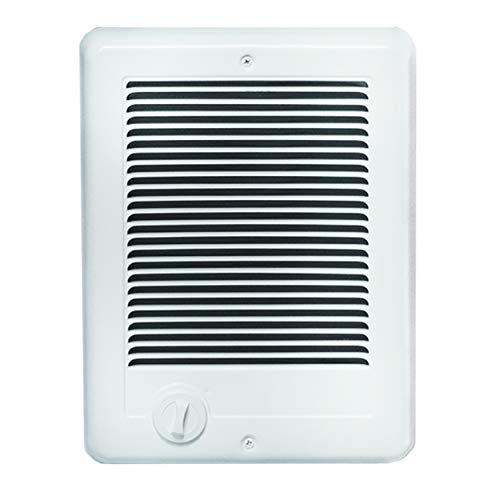
The Cadet CSC202TW is a higher-capacity Com-Pak model designed to heat larger spaces quickly. It offers multi-voltage capability (240/208V) and fan-forced circulation to spread warmth effectively.
- Fast Heating Coil: Designed to warm areas up to roughly 200 sq. ft. quickly, aided by a fan that disperses heat.
- Multi-Voltage Operation: Operates at 2000/1500 watts depending on wiring, suitable where higher voltage circuits are available.
- Safety Features: Built-in over-temperature shutoff helps mitigate risk in case of abnormal operating conditions.
This model is applicable for medium-sized rooms or locations where rapid heat delivery is a priority. The fan-forced system increases heat distribution speed compared with passive register-style heaters.
Broan-NuTone 9815WH High Capacity Wall Heater

The Broan-NuTone 9815WH is a long-standing in-wall fan-forced heater with a contemporary grille and an adjustable, front-mounted thermostat. It supports 120V operation and can be adapted to 240V wiring when required.
Call 888-896-7031 for Free Local HVAC Quotes – Compare and Save Today!
- High Capacity: Designed as an energy-saving supplemental heater, it operates at 1500W with options for 240V installations.
- Functional Design: Front grille styling and radius edges aim for a cleaner look in living spaces.
- Low Maintenance: Permanently lubricated fan motor eliminates oiling and routine disassembly for maintenance.
Its adjustable thermostat and mechanical simplicity make the 9815WH a practical choice for homeowners seeking a dependable supplemental heater with a modest design footprint.
Dreo Smart Wall Heater WH719S

The Dreo WH719S is a modern smart wall heater that emphasizes wide heat distribution via a 120° vertical oscillation feature and precise temperature control. It integrates with voice assistants and the Dreo app for remote and scheduled operation.
- Wide Oscillation: 120° vertical oscillation helps distribute warm air evenly from top to bottom.
- Smart Controls: Works with Alexa and Google Home and supports app-based scheduling and temperature presets.
- Accurate Thermostat: 1°F increments across a wide set point range support fine-grain temperature control.
With emphasis on balanced heat spread and smart home compatibility, this unit suits those who want app-driven convenience and even distribution, particularly in bedrooms and living rooms.
Buying Guide: How To Choose An In-Wall Heater
Selecting the right in-wall heater requires matching electrical capacity, room size, installation constraints, and control preferences. Below are the key considerations organized for practical decision-making.
Heating Capacity And Room Size
Calculate the required wattage by room square footage and insulation level. As a ballpark, a 1500W in-wall heater effectively services many small to medium rooms (roughly 100–200 sq. ft. depending on insulation). For larger rooms, consider higher wattage models or multiple units.
Voltage And Wiring Compatibility
Confirm the home’s circuit availability: many in-wall heaters use 120V circuits, while higher-capacity models can require 208/240V. Models like Cadet CSC202TW support multi-voltage operation; choose a model compatible with your existing electrical setup or budget for rewiring.
Type Of Heat Distribution
- Fan-Forced (Forced Air): Faster room warm-up and greater air circulation but includes a motor that may produce minimal noise.
- Convective/Register Style: Quieter, passive heat distribution; slower to warm the room but often simpler mechanically.
- Oscillating Designs: Provide broader vertical coverage for more uniform temperatures from floor to ceiling.
Control Options And Smart Features
Decide between basic mechanical thermostats and digital or smart thermostats. Built-in WiFi units (Heat Storm, Dreo) offer remote control, scheduling, and voice assistant integration. Smart thermostats can save energy through optimized schedules but may require additional wiring or a compatible heater type.
Safety And Certifications
Look for over-temperature shutoff, thermal fuses, and ETL/UL listings where applicable. Safety features protect against overheating and are critical for unattended operation in bathrooms, bedrooms, or living areas.
Installation And Retrofit Considerations
Confirm wall cavity depth and existing cutout compatibility. Some units are designed for standard recessed wall cans, while others might require a specific mounting bracket. If converting from 120V to 240V, consult a licensed electrician to evaluate circuit capacity and code compliance.
Noise And Maintenance
Fan-forced heaters move air and may generate motor sound; models marketed with silenced or permanently lubricated fans reduce maintenance and noise. Consider sound sensitivity in bedrooms or study areas when choosing a fan-driven unit.
Energy Use And Efficiency
Compare wattage control options and thermostatic accuracy. Models with dual watt settings or precise digital thermostats allow finer control of runtime and energy consumption. Smart scheduling and thermostats can reduce wasted runtime and improve efficiency.
Durability And Warranty
Review manufacturer warranty terms and typical component reliability—fans, thermostats, and heating elements are common wear points. Brands with long-standing HVAC experience may offer more accessible replacement parts and support.
Comparison Perspectives
- Best For Smart Home Integration: Built-in WiFi and app-enabled units provide scheduling and voice control for remote management.
- Best For Quick Warm-Up: Fan-forced, higher-wattage models heat a room faster than passive convective units.
- Best For Low Maintenance: Permanently lubricated motors and simple mechanical thermostats reduce upkeep needs.
- Best For Retrofit Simplicity: Complete units with integrated thermostats minimize additional wiring and separate component purchases.
Use the above considerations to shortlist models based on your room size, wiring capability, desired control features, and tolerance for fan noise. When in doubt, consult an electrician to confirm compatibility with home wiring and local electrical codes prior to purchase and installation.
Tips for Getting the Best HVAC Prices
- Prioritize Quality Over Cost
The most critical factor in any HVAC project is the quality of the installation. Don’t compromise on contractor expertise just to save money. - Check for Rebates
Always research current rebates and incentives — they can significantly reduce your overall cost. - Compare Multiple Quotes
Request at least three estimates before making your choice. You can click here to get three free quotes from local professionals. These quotes include available rebates and tax credits and automatically exclude unqualified contractors. - Negotiate Smartly
Once you've chosen a contractor, use the proven strategies from our guide — How Homeowners Can Negotiate with HVAC Dealers — to get the best possible final price.