
Quick Overview: This guide compares solar-powered ventilation and climate-control solutions suitable for greenhouses, sheds, and small horticultural spaces. Below is a summary table of the selected Amazon products for fast comparison.
| Product | Primary Function | Power Source | Notable Feature |
|---|---|---|---|
| DC HOUSE 20W Solar Powered Exhaust Fan | Ventilation/Exhaust | Solar | Plug-and-play, waterproof |
| Auzev Solar Exhaust Fan With 12000mAh Battery | Ventilation/Continuous Circulation | Solar + Internal Battery | Day & Night Performance, quiet |
| ecoCalm Solar Fan With Battery & Thermostat | Thermostatic Ventilation | Solar + Battery | Adjustable thermostat, bifacial panel |
| DC HOUSE 25W Solar Exhaust Fan Kit With 12000mAh Battery | High-Flow Ventilation | Solar + Large Battery | Intelligent operation modes, up to 180 CFM |
| SHENVITASO 25W Solar Exhaust Fan With Adapter | High-Airflow Ventilation | Solar or AC Adapter | High CFM, anti-backflow valve |
Content Navigation
- DC HOUSE 20W Solar Powered Exhaust Fan For Small Spaces
- Auzev Solar Exhaust Fan With 12000mAh Battery For Continuous Ventilation
- ecoCalm Solar Fan With Battery And Adjustable Thermostat
- DC HOUSE 25W Solar Exhaust Fan Kit With 12000mAh Battery
- SHENVITASO 25W Solar Exhaust Fan With Adapter And Anti-Backflow Valve
- Buying Guide: Choosing The Right Solar Greenhouse Heater Or Ventilation System
DC HOUSE 20W Solar Powered Exhaust Fan For Small Spaces

This solar exhaust fan is designed to remove heat and bring in cool air for compact greenhouses, chicken coops, sheds, and pet houses. The unit runs entirely on solar energy, eliminating the need for household electricity or complex wiring.
- Key Features: Fresh & Cool air removal, waterproof design, easy plug-and-play installation.
- Installation: Solar panel with mounting holes and a waterproof plug allow wall or roof installation with basic tools.
- Use Cases: Best suited for smaller greenhouse structures or as supplemental ventilation to prevent overheating during sunny periods.
This product emphasizes simplicity and solar-only operation, making it a low-complexity option for passive solar ventilation needs.
Auzev Solar Exhaust Fan With 12000mAh Battery For Continuous Ventilation

The Auzev kit includes a 22W solar panel coupled with a 12000mAh battery pack to enable ventilation during day and night. Its design targets continuous climate control and moisture removal.
Call 888-896-7031 for Free Local HVAC Quotes – Compare and Save Today!
- Key Features: Day & Night performance, 2000 RPM fan, ultra-quiet 35 dB operation.
- Performance: The battery-backed system maintains airflow after sunset and during low-sun conditions, supporting steady interior temperatures.
- Applications: Suitable for greenhouses, barns, attics, and larger sheds where uninterrupted circulation prevents heat spikes and humidity buildup.
This model prioritizes consistent ventilation with reduced noise, useful for environments where round-the-clock air exchange matters.
ecoCalm Solar Fan With Battery And Adjustable Thermostat
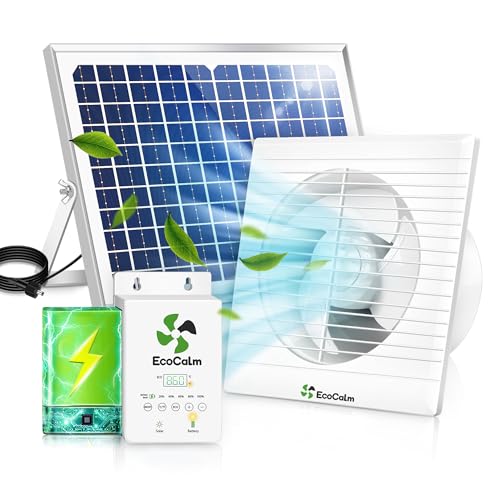
This kit integrates a bifacial solar panel and a rechargeable battery with an adjustable thermostat, allowing temperature-triggered operation. It aims to regulate greenhouse temperatures automatically.
- Key Features: 3000mAh battery for up to 8 hours of post-charge operation, intelligent power switching, adjustable temperature control.
- Bifacial Panel Benefit: Generates power from both sides to increase output in reflective environments or when sunlight angles vary.
- Thermostat Control: Allows set-and-forget ventilation based on ambient temperature thresholds to protect sensitive plants.
The ecoCalm option targets growers who require thermostatic control and enhanced panel efficiency for more predictable ventilation behavior.
DC HOUSE 25W Solar Exhaust Fan Kit With 12000mAh Battery

This higher-capacity kit features a 25W monocrystalline panel and a 12000mAh lithium battery designed for longer runtime and stronger airflow, suitable for medium-sized greenhouse applications.
Call 888-896-7031 for Free Local HVAC Quotes – Compare and Save Today!
- Key Features: Up to 12 hours runtime after full charge, intelligent daytime/nighttime operation modes, up to 2600 RPM and 180 CFM airflow.
- Operation Modes: Day mode runs 30 minutes on/10 minutes off; night mode cycles 20 minutes on/20 minutes off to conserve battery while maintaining ventilation.
- Suitability: Good for greenhouses or coops requiring reliable ventilation through varying sunlight conditions.
This kit balances high airflow with battery-backed continuity and energy-saving cycles for extended periods of reduced solar input.
SHENVITASO 25W Solar Exhaust Fan With Adapter And Anti-Backflow Valve

This 8″ fan kit emphasizes high airflow and installation flexibility. The system can run on solar power or via an included power adapter for AC support when needed.
- Key Features: 25W panel, 2300 RPM, 430 CFM claimed high airflow, 36 dB low-noise operation, anti-backflow valve, long 16.4 ft solar cable.
- Hybrid Power Option: Includes adapter to allow operation from household power during extended cloudy periods or nighttime use.
- Backflow Protection: Anti-backflow valve helps prevent pests and outside air from entering when the fan is off.
This product is tailored for users who want high ventilation capacity plus the option to switch to AC power to ensure continuous operation regardless of solar availability.
Buying Guide: Choosing The Right Solar Greenhouse Heater Or Ventilation System
Choosing the right solar climate-control solution depends on the greenhouse size, local climate, plant sensitivity, and desired level of automation. Below are objective factors and comparison perspectives to evaluate before purchasing.
System Type: Ventilation Vs. Heating
Solar Ventilation Fans move air to prevent overheating and reduce humidity. They are the primary solar-powered option shown above. These are effective where passive heat retention is acceptable and where the main issue is excess heat and moisture.
Active Heaters provide heat when temperatures drop. Most electric heaters require grid power and are not solar powered unless paired with a dedicated solar array and battery inverter. If your goal is supplemental heat during frost, consider hybrid approaches: combine solar ventilation and thermostatic vent openers with grid or generator-backed heaters.
Power And Runtime Considerations
- Panel Wattage: Higher wattage panels (22W–25W) generally provide more fan power and faster battery charging under similar sunlight.
- Battery Capacity: Kits with 12000mAh batteries deliver multi-hour runtime after clouds or at night. Smaller batteries (3000mAh) offer limited post-sun operation.
- Energy Management: Intelligent control modes and thermostats extend runtime by cycling fans based on temperature or light.
Airflow And Fan Performance
CFM (Cubic Feet Per Minute) and RPM indicate airflow potential. For greenhouses, choose a fan size that exchanges the air volume frequently enough to control humidity and temperature spikes. Higher CFM values suit larger spaces but check fan noise and mounting requirements.
Control And Automation
- Thermostats: Thermostatically controlled fans or window openers maintain set temperatures automatically, reducing manual intervention.
- Battery Backup: Battery-backed fans or hybrid power options ensure night and cloudy-day operation—important for frost-prone or poorly insulated structures.
- Solar-Only vs Hybrid: Solar-only systems are simpler and install without wiring but may be limited at night. Hybrid systems with adapters or AC options provide redundancy.
Installation And Durability
Consider mounting options for panels and fans, cable lengths, and waterproof ratings. IP67 or waterproof connectors are preferable for long-term outdoor exposure. Look for anti-backflow valves or pest guards to prevent animal intrusion through vents.
Climate And Seasonal Needs
In consistently sunny regions, smaller solar ventilation fans may suffice. In areas with cold nights or winter frost, rely on battery-backed fans plus a backup heating strategy. For frost protection, combine thermostatic vents with insulated covers and, if necessary, electric or gas heaters on a separate power source.
Maintenance And Longevity
- Panel Cleaning: Keep panels free of dust and debris to maintain output.
- Fan Bearings And Seals: Periodic inspection helps prevent failure from moisture or dust ingress.
- Battery Care: For lithium batteries, follow manufacturer guidance on charge cycles and storage to preserve capacity.
Comparison Perspectives
Small Greenhouses (Compact): Prioritize simple solar fans with straightforward mounting and waterproof connectors.
Medium Greenhouses: Choose higher-wattage panels with larger batteries or thermostatic control to maintain day-night balance.
Large Or Commercial Structures: Consider multiple fan units, larger solar arrays, or hybrid systems that integrate grid power or dedicated battery banks for reliable heating during cold spells.
Compatibility And Accessories
- Cable Lengths: Confirm solar cable lengths and extension options to place panels in optimal sunlight locations.
- Mounting Hardware: Ensure included brackets and mounts match your greenhouse frame or roof material.
- Anti-Backflow And Pest Guards: Valuable for animal and insect prevention when fans cycle off.
When selecting a system, balance airflow, battery-backed runtime, automation features, and the availability of hybrid power options based on your greenhouse size and local weather patterns. Integrating ventilation, thermostatic control, and backup heating strategies provides the most resilient approach to maintaining stable greenhouse temperatures.
Tips for Getting the Best HVAC Prices
- Prioritize Quality Over Cost
The most critical factor in any HVAC project is the quality of the installation. Don’t compromise on contractor expertise just to save money. - Check for Rebates
Always research current rebates and incentives — they can significantly reduce your overall cost. - Compare Multiple Quotes
Request at least three estimates before making your choice. You can click here to get three free quotes from local professionals. These quotes include available rebates and tax credits and automatically exclude unqualified contractors. - Negotiate Smartly
Once you've chosen a contractor, use the proven strategies from our guide — How Homeowners Can Negotiate with HVAC Dealers — to get the best possible final price.