
Find reliable gas heaters designed for large spaces. This guide compares unit heaters, infrared models, and forced-air options suited for warehouses, workshops, and industrial bays. The selected products prioritize high BTU output, venting flexibility, and durable mounting.
| Product | Type | Max BTU | Coverage Notes |
|---|---|---|---|
| Mr. Heater Big Maxx MHU50NG | Natural Gas Unit Heater | 50,000 BTU | Up To ~1250 Sq. Ft., Venting Options |
| Mr. Heater Big Maxx MHU80NG | Natural Gas Unit Heater | 80,000 BTU | Up To ~2000 Sq. Ft., Category 1/3 Venting |
| Reznor UDXC-45 (Propane) | Propane Forced-Air Unit | 45,000 BTU | Ceiling Mount, Multi-Level Output |
| Dyna-Glo IR30NMDG-1 | Infrared Wall Heater | 30,000 BTU | Infrared Radiant Heat, Up To ~1,000 Sq. Ft. |
| ProCom MN300TPA-B Infrared | Ventless Infrared Space Heater | 30,000 BTU | Thermostat Control, Up To ~1,400 Sq. Ft. |
Content Navigation
- Mr. Heater F260550 Big Maxx MHU50NG Natural Gas Unit Heater,Black
- Mr. Heater F260560 Big Maxx MHU80NG Natural Gas Unit Heater, 80,000 BTU, Black
- Reznor 45,000 BTU Gas Unit Propane Garage Heater, UDXC-45
- Dyna-Glo IR30NMDG-1 30,000 BTU Natural Gas Infrared Wall Heater
- ProCom MN300TPA-B Ventless Natural Gas Infrared Space Heater
- Buying Guide: Choosing The Right Gas Heater For A Warehouse
- Space Volume And BTU Requirements
- Heater Type And Heat Distribution
- Fuel Type And Availability
- Venting, Combustion Air, And Installation
- Energy Efficiency And Operating Costs
- Control Options And Zoning
- Safety Features And Compliance
- Maintenance And Service Access
- Mounting, Placement, And Coverage Strategy
- Installation Costs And Long-Term Considerations
- Comparison Perspectives
Mr. Heater F260550 Big Maxx MHU50NG Natural Gas Unit Heater,Black
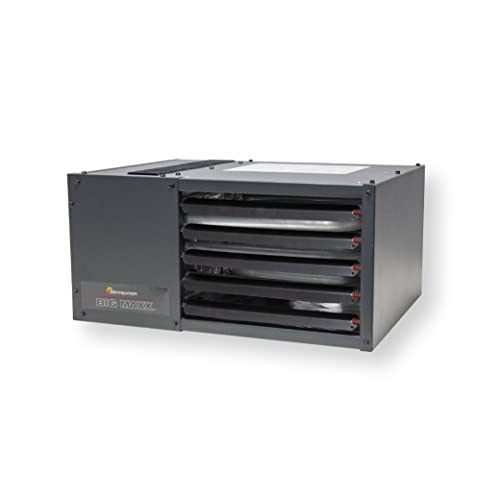
Type: Natural Gas Unit Heater. Output: 50,000 BTU per hour. This model is designed for larger workspaces and small warehouses.
The unit features a powered exhaust allowing both vertical and horizontal venting, which provides flexibility for varied warehouse layouts. The exterior access to the thermostat, A/C terminals, and gas connection simplifies installation and maintenance in commercial settings where service access can be restricted.
Manufacturer specifications indicate coverage for up to approximately 1,250 square feet, though real-world performance depends on ceiling height, insulation, and air leakage. This heater is suitable for mounting where a dedicated venting path is available and where a mid-range BTU output meets the space heating load.
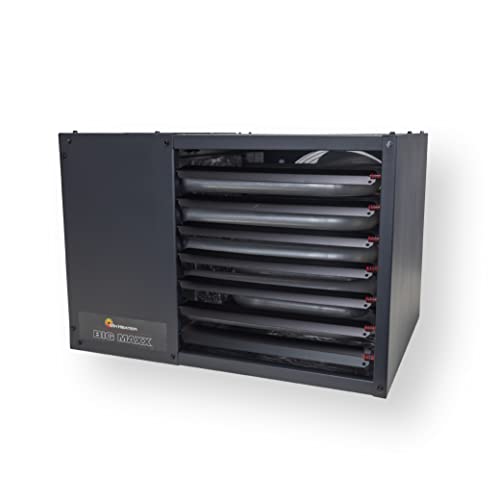
Mr. Heater F260560 Big Maxx MHU80NG Natural Gas Unit Heater, 80,000 BTU, Black
Call 888-896-7031 for Free Local HVAC Quotes – Compare and Save Today!
Type: Natural Gas Unit Heater. Output: 80,000 BTU. Bigger footprint and higher capacity for larger warehouses and open industrial spaces.
This heater supports Category 1 vertical and Category 3 horizontal venting, giving installers multiple routing options. The product includes angle brackets and a liquid propane conversion kit (thermostat and regulator typically not included), which can be helpful where fuel options may change.
Rated coverage is around 2,000 square feet under ideal conditions. Clearances and installation height requirements (minimum 8 ft from floor to base) should be observed when integrating this unit into high-bay areas. The higher BTU output makes it suitable where faster recovery and larger volume heating are required.
Reznor 45,000 BTU Gas Unit Propane Garage Heater, UDXC-45

Type: Propane Forced-Air Unit Heater. Output: Rated 45,000 BTU with two heat output levels for variable conditions.
The UDXC-45 is designed for indoor commercial and industrial use and offers ceiling mount installation with threaded-nut retainers at four suspension points. It features two heating stages (low and high fire) and an 83% reported thermal efficiency rating, which can improve fuel utilization relative to single-stage units.
Call 888-896-7031 for Free Local HVAC Quotes – Compare and Save Today!
Forced-air distribution supports larger spaces where convection alone may not provide even heat. Mounting hardware is a consideration; brackets may be sold separately depending on the application. Propane fuel supply logistics should be evaluated for continuous use in warehouse environments.
Dyna-Glo IR30NMDG-1 30,000 BTU Natural Gas Infrared Wall Heater

Type: Infrared Radiant Heater. Output: 30,000 BTU. Infrared technology heats objects and surfaces rather than air, which can be effective in drafty or high-ceiling spaces.
Infrared units are useful in large warehouses where convective heat is lost quickly; by warming people and equipment directly, they can provide perceived comfort with lower ambient air temperature. This model is natural gas ready and rated for up to roughly 1,000 square feet, depending on installation height and spacing.
Infrared heaters often require careful placement to ensure coverage patterns match activity zones. These units typically support wall mounting and operate without the ducting or venting complexity of high-capacity unit heaters, though ventilation and combustion air must meet code.
ProCom MN300TPA-B Ventless Natural Gas Infrared Space Heater

Type: Ventless Infrared Space Heater. Output: 30,000 BTU. Includes thermostat control and multiple mounting options.
Ventless infrared heaters can be effective for localized heating in areas of a warehouse where supplemental warmth is needed, such as office spaces, break rooms, or tool bays. This model offers thermostat control and a compact profile for flexible placement.
Because it is ventless, ambient air quality and building codes must be considered for full-time use in commercial occupancy. These units can supplement primary heating systems where installing vented unit heaters is impractical, but they are generally not a substitute for properly vented industrial heaters in many warehouse scenarios.
Buying Guide: Choosing The Right Gas Heater For A Warehouse
Selecting a gas heater for a warehouse depends on multiple technical and operational factors. This buying guide covers the core criteria to evaluate before purchase and installation.
Space Volume And BTU Requirements
Calculate the warehouse volume (square footage x ceiling height) rather than floor area alone. Higher ceilings increase heat stratification and require more BTUs or focused radiant heating for occupants at floor level.
Estimate required BTUs based on insulation, building envelope tightness, and desired indoor temperature. Use manufacturer guidance for suggested coverage but adjust for local heat loss factors.
Heater Type And Heat Distribution
- Unit Heaters (Vented): Forced-air or flue-vented units provide higher outputs and are suitable for whole-space heating. They require venting and adequate combustion air.
- Infrared (Radiant): Radiant heaters warm objects and people directly. Effective where heating specific work zones matters more than warming all the air.
- Ventless/Blue Flame: Best for supplemental or enclosed spaces with proper ventilation and code allowances; typically not ideal as sole warehouse heat sources.
Fuel Type And Availability
Decide between natural gas and propane based on site fuel supply. Propane can be convenient in off-grid locations but requires tank storage and refilling logistics. Natural gas offers continuous supply where utility connections exist.
Venting, Combustion Air, And Installation
Vented heaters need proper exhaust routing. Confirm whether the unit supports horizontal or vertical venting and check clearance requirements. Venting classification (Category 1, 3, etc.) affects allowable installations.
Combustion air must be provided per code to avoid negative pressure. Ceiling or wall-mounted installations require structural consideration for weight and anchoring.
Energy Efficiency And Operating Costs
Compare thermal efficiency and modulating output features. Multi-stage or modulating heaters deliver variable output to match demand, reducing cycling losses. Higher efficiency reduces fuel consumption, especially for continuous operation.
Control Options And Zoning
Thermostat control, multiple heating stages, and the ability to zone areas can improve comfort and reduce fuel costs. Forced-air units paired with thermostats and dampers enable better distribution control across a large warehouse.
Safety Features And Compliance
Look for features like oxygen depletion sensors, automatic shut-off, and certified ignition systems. Ensure the chosen heater meets local building codes, fire codes, and ventilation standards for commercial occupancies.
Maintenance And Service Access
Evaluate ease of access for routine maintenance: filter changes, burner servicing, and thermostat adjustments. Units with exterior access panels or service-friendly layouts lower downtime and maintenance costs.
Mounting, Placement, And Coverage Strategy
For uniform heating, consider multiple smaller units spaced across the ceiling. For targeted warmth, place infrared units over workstations or loading docks. Account for high-bay stratification by positioning heat sources closer to occupied zones when feasible.
Installation Costs And Long-Term Considerations
Factor in venting materials, gas line sizing, electrical connections (if required), and professional installation. Consider fuel price volatility, local utility incentives, and projected duty cycles when planning total cost of ownership.
Comparison Perspectives
- Coverage vs. Output: Higher BTU units cover larger areas but require more stringent venting and clearances.
- Radiant vs. Convective: Radiant units can be more efficient in drafty, high-ceiling spaces by heating people directly; convective units warm the air and are better for whole-space conditioning.
- Vented vs. Ventless: Vented units are typically preferred for continuous warehouse heating due to combustion exhaust control; ventless may be acceptable only for limited, well-ventilated, and code-compliant areas.
Use these criteria alongside manufacturer specifications and local code consultation to determine the most suitable gas heating solution for a given warehouse. Professional HVAC assessment and licensed installation are recommended for commercial gas heaters.
Tips for Getting the Best HVAC Prices
- Prioritize Quality Over Cost
The most critical factor in any HVAC project is the quality of the installation. Don’t compromise on contractor expertise just to save money. - Check for Rebates
Always research current rebates and incentives — they can significantly reduce your overall cost. - Compare Multiple Quotes
Request at least three estimates before making your choice. You can click here to get three free quotes from local professionals. These quotes include available rebates and tax credits and automatically exclude unqualified contractors. - Negotiate Smartly
Once you've chosen a contractor, use the proven strategies from our guide — How Homeowners Can Negotiate with HVAC Dealers — to get the best possible final price.