
Choosing a high efficiency electric baseboard heater requires balancing room size, energy controls, and safety features. Below is a concise comparison of five selected models to help you evaluate performance, controls, and installation needs at a glance.
| Product | Type | Power / Fit | Notable Features |
|---|---|---|---|
| EZ-HEAT 1,500 Watt CZ600 | Convection Baseboard | 1500W / Medium Rooms | Adjustable Thermostat, Overheat & Tip-Over Protection, Silent |
| Cadet F Series 36″ (3F750-1W) | Convection Baseboard | 750W / 36″ Unit | All-Metal Construction, Requires Thermostat |
| Cadet F Series 24″ (2F350W) | Convection Baseboard | 350W / 24″ Unit | Steel Body, Compact For Small Areas |
| Heat Storm HS-1500-PHX-WIFI | Infrared Wall-Mounted | 1500W / Wall Mount | Wi‑Fi Control, Remote, Touch Thermostat |
| GiveBest Electric Wall Heater 1500W | Wall Or Floor Mount | 1500W / Large Room Coverage | Wi‑Fi, Remote, ECO Mode, Touch Controls |
EZ-HEAT 1,500 Watt Baseboard Heater

This EZ-HEAT model is a convection baseboard heater rated at 1500 watts and intended for medium-sized rooms. It offers two heat settings plus an adjustable thermostat to control output.
Key safety features include a tip-over switch, overheat protection, and a stay-cool body. The product claims whisper-quiet operation, which suits bedrooms or shared living spaces where noise is a concern.
From an efficiency perspective, adjustable heat settings and thermostat control help reduce runtime compared to fixed-output units. The unit’s design emphasizes user safety and low noise rather than advanced smart energy-saving integrations.
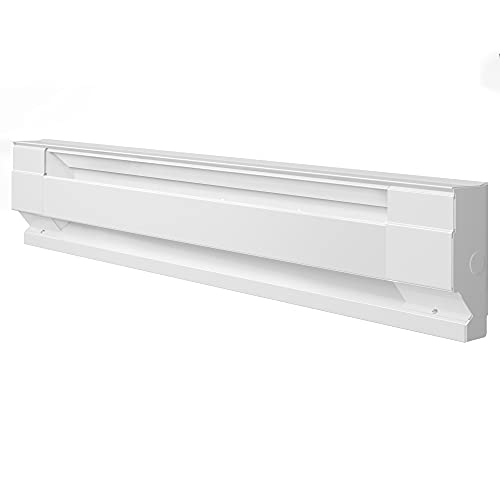
Cadet F Series 36″ Electric Baseboard Heater
Call 888-896-7031 for Free Local HVAC Quotes – Compare and Save Today!
The Cadet F Series 36″ is a metal-bodied convection baseboard heater rated at 750 watts. It is constructed from 25-gauge steel with a 20-gauge junction box and powder-coated finish for durability.
This model requires a separate thermostat, allowing integration with wall thermostats or programmable controllers. Using a programmable or smart thermostat can improve runtime scheduling and energy efficiency compared to onboard mechanical controls.
Cadet’s all-metal design favors long service life and heat distribution. For efficiency considerations, match the wattage to your room size and use a thermostat with setback schedules to lower consumption.
Cadet F Series 24″ Electric Baseboard Heater
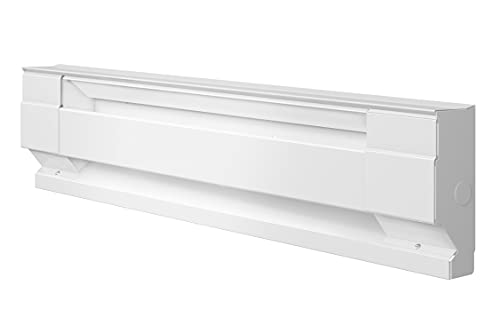
The Cadet 24″ unit is a compact 350W convection baseboard heater suited for smaller rooms, hallways, or bathrooms. It uses a steel housing and is intended for built-in installations.
Like its larger sibling, this model is designed to work with an external thermostat. Choosing a high-accuracy thermostat can reduce overshoot and minimize energy waste in small spaces.
Call 888-896-7031 for Free Local HVAC Quotes – Compare and Save Today!
Its lower wattage makes it a practical choice for targeted heating or supplemental heat where full-size 1500W units would be oversized.
Heat Storm HS-1500-PHX-WIFI Infrared Wall Heater

The Heat Storm HS-1500 is an infrared wall-mounted heater with Wi‑Fi control and a touch-screen thermostat. It delivers 1500W of heat and includes remote control and safety features such as tip-over shutoff for portable installations.
Infrared technology heats surfaces and occupants directly, which can feel efficient compared to convection-only baseboards in some scenarios. Remote and app control allow scheduling and preheating, which reduces wasted runtime.
This model’s Wi‑Fi capability enables integration with mobile schedules and remote adjustments that can support energy-saving strategies when used with occupancy-aware routines.
GiveBest Electric Wall Heater With WiFi

GiveBest’s heater is a flexible floor or wall-mounted unit rated at 1500W. It features Wi‑Fi, remote control, a touch panel, and an ECO mode that claims to maintain set temperatures while conserving energy.
The dual mounting options increase placement flexibility. Integrated thermostat control and ECO mode support reduced energy use by modulating output and avoiding continuous full-power operation.
For homes where connectivity and programmable control are priorities, this model’s smart features enable schedule-based heating and remote management to reduce overall electricity usage.
Buying Guide: Choosing A High Efficiency Electric Baseboard Heater
When selecting a high-efficiency electric baseboard heater, evaluate these core factors to match performance to your needs.
1. Match Wattage To Room Size
Estimate heating needs by room size. Typical guidance: about 10 watts per square foot for a well-insulated room. Oversized units waste energy through cycling; undersized units run continuously.
2. Convection Versus Infrared
- Convection Heaters (traditional baseboards) heat air; they work well for whole-room heating and even distribution.
- Infrared Heaters heat objects and people directly and can feel more efficient in rooms where you want direct warmth quickly.
3. Thermostat And Control Options
Integrated adjustable thermostats improve runtime control. For best efficiency, use a programmable or smart thermostat to implement setback schedules and remote control. Models that require an external thermostat allow upgrading to more advanced controllers.
4. Installation And Wiring
Confirm voltage and wiring needs. Many baseboards operate at 120V or 240V. Smart thermostats and higher-watt units may require a 4‑wire circuit or specific amperage; check compatibility before purchase or hire an electrician for installation.
5. Safety Features
Look for overheat protection, tip-over switches (for portable or floor models), and stay-cool surfaces if the heater will be in contact-prone areas. Metal housings resist damage and help with long-term reliability.
6. Energy Saving Modes And Connectivity
Units with ECO modes, Wi‑Fi, or remote scheduling allow more precise control and can reduce wasted runtime. Integrating heaters with smart home systems or occupancy schedules helps minimize energy use.
7. Build Quality And Durability
Steel construction and quality junction boxes support safer, longer-lasting installations. Powder-coated finishes resist corrosion in humid environments like bathrooms.
8. Noise And Comfort
If low noise is important, prioritize models that advertise silent or whisper-quiet operation. Convection baseboards are typically quieter than fan-equipped space heaters.
9. Maintenance And Serviceability
Consider ease of cleaning and availability of replacement parts. Simpler mechanical thermostats are easy to swap, while integrated electronics may require manufacturer support.
10. Comparison Perspectives
- Efficiency: Combine correct sizing, thermostat control, and ECO features to minimize run time for equivalent comfort.
- Cost Of Operation: Higher wattage runs cost more per hour; target wattage to actual heating needs and use scheduling to reduce runtime.
- Comfort Delivery: Infrared may feel warmer faster in localized areas; convection provides more uniform room temperature.
- Installation Flexibility: Wall-mounted Wi‑Fi units offer portability and remote control; fixed baseboards paired with smart thermostats offer permanent, scalable solutions.
Use this guide to weigh features like wattage, control options, and safety before choosing a high-efficiency electric baseboard or wall heater for your space.
Tips for Getting the Best HVAC Prices
- Prioritize Quality Over Cost
The most critical factor in any HVAC project is the quality of the installation. Don’t compromise on contractor expertise just to save money. - Check for Rebates
Always research current rebates and incentives — they can significantly reduce your overall cost. - Compare Multiple Quotes
Request at least three estimates before making your choice. You can click here to get three free quotes from local professionals. These quotes include available rebates and tax credits and automatically exclude unqualified contractors. - Negotiate Smartly
Once you've chosen a contractor, use the proven strategies from our guide — How Homeowners Can Negotiate with HVAC Dealers — to get the best possible final price.