
Quick Overview: This guide compares five top gas wall heaters, covering ventless blue flame and infrared models, natural gas and propane options, and features like BTU output, coverage area, and control types. Use the summary table to match heaters to your room size and installation needs.
| Model | Type | BTU | Coverage | Fuel |
|---|---|---|---|---|
| Dyna-Glo IR30NMDG-1 | Infrared Wall Heater | 30,000 | Up To 1,000 Sq. Ft. | Natural Gas |
| ProCom MN300TPA-B | Ventless Infrared | 30,000 | Up To 1,400 Sq. Ft. | Natural Gas |
| Dyna-Glo 10,000 BTU Blue Flame | Vent Free Blue Flame | 5,000–10,000 | Up To 300 Sq. Ft. | Natural Gas |
| ProCom MN300HBA-B | Ventless Blue Flame | 30,000 | Up To 1,400 Sq. Ft. | Natural Gas |
| Mr. Heater MHVFBF30NGT | Vent Free Blue Flame | 30,000 | Up To 1,000 Sq. Ft. | Natural Gas |
Dyna-Glo IR30NMDG-1 Infrared Wall Heater

Key Features: Natural Gas Ready, Infrared Technology, Up To 30,000 BTU, Coverage Up To 1,000 Sq. Ft.
This Dyna-Glo wall heater uses infrared radiant heat to warm objects and occupants directly rather than only heating the air. That method can create a perception of faster localized warmth in rooms with moderate ceiling heights. The model is specified as Natural Gas Ready and does not permit fuel conversion. Installation is designed for wall mounting and the heater supports continuous radiant output up to 30,000 BTU to serve medium to large rooms.
Consider this unit if you want radiant heating that targets occupants and furnishings. Infrared units typically perform differently than convective blue flame heaters, so match the technology to the space and usage pattern.
ProCom MN300TPA-B Ventless Infrared Heater

Call 888-896-7031 for Free Local HVAC Quotes – Compare and Save Today!
Key Features: 30,000 BTU Ventless Infrared, Heats Up To 1,400 Sq. Ft., Thermostat Control, Wall Mount or Floor Placement
The ProCom MN300TPA-B is a ventless infrared space heater with a maximum output of 30,000 BTU. Its design supports both wall mounting and floor placement using included base feet. The built-in thermostat offers High/Medium/Low control for zoning or supplemental heating. The seller notes suitability for residential rooms such as offices, bedrooms and living areas.
Because it is ventless, combustion products enter the room and proper ventilation and local building codes must be observed. The unit’s slim profile aims to integrate into modern interiors while delivering high radiant output for larger spaces.
Dyna-Glo 10,000 BTU Blue Flame Wall Heater

Key Features: Blue Flame Technology, Natural Gas Ready, Variable Output 5,000–10,000 BTU, Coverage Up To 300 Sq. Ft.
This Dyna-Glo model uses blue flame convective heating to warm air, functioning similarly to simple central heating in a smaller footprint. The variable output range between 5,000 and 10,000 BTU makes it suitable for small rooms, garages, or supplemental warmth where gentle convective circulation is preferred.
Call 888-896-7031 for Free Local HVAC Quotes – Compare and Save Today!
Being vent free, this heater does not require a flue but relies on room air for combustion; many homeowners select blue flame units when steady convection and uniform air warming are priority considerations for compact spaces.
ProCom MN300HBA-B Ventless Blue Flame Heater

Key Features: Up To 30,000 BTU, Manual Control With 3 Heat Settings, Oxygen Depletion Sensor, No Electricity Required
The ProCom MN300HBA-B is a high-output ventless blue flame heater offering manual low/medium/high settings and a push-button piezo ignition. It is designed to operate on natural gas without electrical power, which can be beneficial during power outages. The integrated Oxygen Depletion Sensor (ODS) provides automatic shut-off if combustion air becomes insufficient.
This model aims to provide robust convective heat for large open areas up to the manufacturer-stated coverage. Its mechanical control layout makes it straightforward to operate, and the no-electric requirement simplifies installation in locations without nearby power.
Mr. Heater MHVFBF30NGT Blue Flame Wall Heater
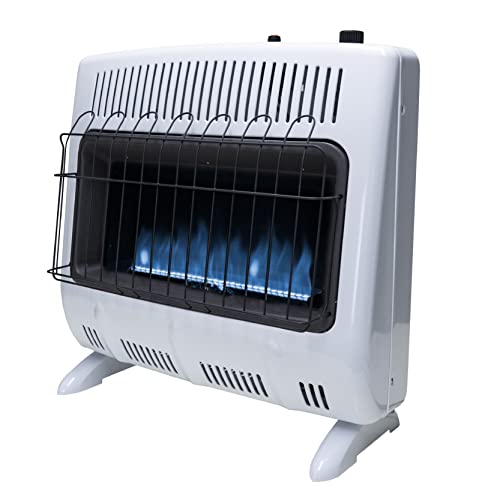
Key Features: Up To 30,000 BTU, Thermostat Control, Fuel-Efficient Blue Flame, Effective To 1,000 Sq. Ft.
The Mr. Heater MHVFBF30NGT provides up to 30,000 BTU of convective warmth via a blue flame burner and includes a built-in thermostat for precise temperature adjustment. The unit supports a free battery for electric ignition and is rated for use at altitudes up to 4,500 feet. Manufacturer notes indicate consistent convective heat delivery with attention to fuel efficiency.
This heater is commonly selected where controlled room temperature and even distribution are required for spaces like sunrooms, additions, or cold rooms. The thermostat option allows for more automated temperature maintenance compared with strictly manual units.
Buying Guide: How To Choose The Right Gas Wall Heater
Choosing the best gas wall heater involves matching technology, BTU output, fuel type, safety features, and installation constraints to your space. Use the following checklist to compare options objectively.
1. Heating Technology: Infrared Versus Blue Flame
Infrared (Radiant) heats objects and people directly and can feel warm quickly in targeted areas. Radiant units are useful for open rooms where you want directed warmth. Blue flame (Convective) warms air and provides more uniform room temperature over time. Select based on whether you need immediate localized comfort or steady whole-room heat.
2. BTU Output And Room Size
Match the heater’s BTU rating to your room size. Typical guidance: 5,000–10,000 BTU for small rooms; 20,000–30,000 BTU for large or open spaces. Consider ceiling height, insulation, and exterior exposure; poorly insulated spaces may require higher BTU capacity.
3. Ventless Versus Vented Installation
Ventless (vent-free) heaters do not require flues and are easier to install but release combustion byproducts into the room and may be restricted by some local codes. Vented
4. Fuel Type And Conversion
Confirm fuel compatibility—Natural Gas or Liquid Propane. Many models are fuel-specific and do not permit conversion. Check supply availability and whether your installation can support the specified fuel type.
5. Controls And Operation
Options include manual knobs, thermostats, and multi-stage settings. Thermostatic control delivers automatic temperature regulation, while manual models are simpler and may operate without electricity. Choose based on desired convenience and available power.
6. Safety Features
Look For ODS (Oxygen Depletion Sensor), flame failure protection, and certified safety listings. Ventless models especially benefit from ODS and tip-over or overheat shut-off protections to reduce combustion-related risks.
7. Installation And Clearance Requirements
Wall heaters require specific clearances from combustible materials and guidance for mounting height and framing. Review manufacturer installation manuals and local codes; professional installation is often recommended for gas appliances.
8. Efficiency And Operating Cost Considerations
Efficiency differs by technology: ventless units typically approach 99% combustion efficiency but may affect indoor air quality; convective units with blue flame burners provide steady heat with modest fuel consumption. Compare reported BTU usage patterns and match to your heating schedule to estimate operating costs.
9. Code And Local Restrictions
Local building codes can restrict ventless heaters in bedrooms, bathrooms, or entire jurisdictions. Verify whether ventless gas heaters are allowed where you live and whether permits are required for installation.
10. Maintenance And Serviceability
Periodic cleaning, pilot inspection, and burner checks ensure safe operation. Select models with accessible components and available replacement parts. Consider brands with local service networks if long-term upkeep is a priority.
Tips for Getting the Best HVAC Prices
- Prioritize Quality Over Cost
The most critical factor in any HVAC project is the quality of the installation. Don’t compromise on contractor expertise just to save money. - Check for Rebates
Always research current rebates and incentives — they can significantly reduce your overall cost. - Compare Multiple Quotes
Request at least three estimates before making your choice. You can click here to get three free quotes from local professionals. These quotes include available rebates and tax credits and automatically exclude unqualified contractors. - Negotiate Smartly
Once you've chosen a contractor, use the proven strategies from our guide — How Homeowners Can Negotiate with HVAC Dealers — to get the best possible final price.