
Whether you need to cool a hot garage in summer or heat a chilly workshop in winter, choosing the right garage heater or air conditioner depends on size, insulation, power availability, and installation preference. The table below summarizes five well-suited units—portable ACs, ductless mini-splits, and a hard-wired ceiling space heater—selected for garage use and flexible performance.
| Model | Type | Coverage / Key Feature |
|---|---|---|
| COSTWAY 12000BTU Mini Split | Ductless Mini-Split | Up To 750 Sq. Ft, Inverter Heat Pump |
| YITAHOME 12000 BTU Mini Split | Ductless Mini-Split | Up To 750 Sq. Ft, WiFi/Alexa Enabled |
| Comfort Zone Ceiling Mount Heater CZ230ER | Hard-Wired Ceiling Heater | Fan-Forced, 7,500 Watt, Covers Up To 1250 Sq. Ft |
| Whynter 14,000 BTU Portable AC & Heater | Portable Dual-Hose AC/Heater | Up To 500 Sq. Ft, Dual Hose, Dehumidifier |
| SereneLife 12,000 BTU Portable AC & Heat | Portable AC/Heater | Up To 550 Sq. Ft, Built-In Dehumidifier, Rollers |
COSTWAY 12000BTU Mini Split Air Conditioner & Heater

This ductless mini-split uses an inverter heat pump and a high-power compressor to provide both cooling and heating. It is AHRI certified and rated for rooms up to roughly 750 sq. ft.
- Energy Efficient Cooling & Heating: Inverter technology reduces compressor cycling and power consumption.
- Five Modes: Auto, cool, dry, heat, and fan plus 4 fan speeds, ECO, sleep, iFEEL, and turbo functions.
- Controls & Noise: Remote control, 0.5–24 hour timer, and low-noise operation with remote display auto-off.
For garages where permanent wall penetration and professional or DIY installation are acceptable, this unit offers efficient year-round climate control with better energy use than many portable options.
YITAHOME 12000 BTU Mini Split Heat Pump System
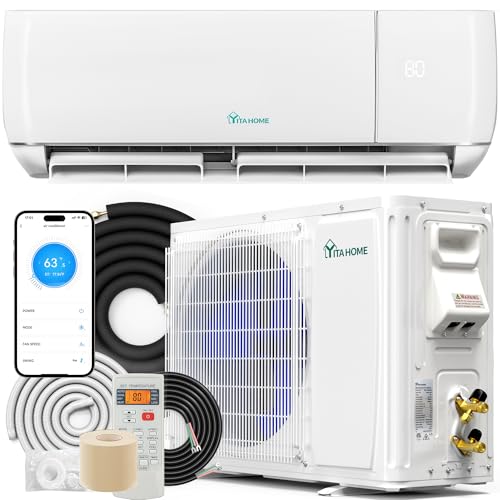
This mini-split emphasizes smart controls and quiet operation. It covers similar area to the COSTWAY unit and includes WiFi and Alexa compatibility for remote management.
Call 888-896-7031 for Free Local HVAC Quotes – Compare and Save Today!
- Energy Efficiency: Inverter compressor with claimed ~25% energy savings and ETL/AHRI certification.
- Five Modes & Health Features: Auto/cool/dry/heat/fan plus a “HEALTH” mode with negative ion and PM2.5 filtration functions.
- Silent Performance: Operates below 41 dB, automatic defrost, self-diagnosis and sleep/energy-saving modes.
This model suits garage owners who want a ductless permanent solution combined with smart-home integration and quieter operation for adjoining living spaces or offices above a garage.
Comfort Zone Ceiling Mount Garage Space Heater CZ230ER

This hard-wired, ceiling-mounted fan-forced heater is designed specifically for garages and workshops where floor space is at a premium.
- Space-Saving Design: Ceiling mount frees floor area while delivering widespread heat.
- Robust Construction: Heavy gauge steel housing for durability in poorly insulated or harsh environments.
- Airflow & Control: Adjustable louvers, variable mounting angle, digital thermostat, overheat protection and 12-hour timer.
Because it is hard-wired to 240V and intended for ceiling installation, this heater is best for users seeking permanent, high-output heat for larger garage footprints and who can accommodate professional installation.
Whynter 14,000 BTU Portable AC & Heater ARC-14SH

The Whynter ARC-14SH is a dual-hose portable unit with cooling and heating capability and a built-in dehumidifier. It is top-rated in portable AC categories for larger single-room applications.
Call 888-896-7031 for Free Local HVAC Quotes – Compare and Save Today!
- Coverage & Performance: Rated for up to 500 sq. ft. with 14,000 BTU capacity and 9,200 SACC cooling efficiency rating.
- Dual Hose & Dehumidifier: Dual-hose design improves efficiency and includes patented auto-drain and high dehumidification capacity.
- Noise & Build: Quiet operation at lower fan speeds; runs on CFC-free refrigerant and includes window kit.
Portable units like this provide flexibility for renters or garage owners who prefer no permanent installation. Dual-hose designs reduce negative pressure and can be more efficient in poorly sealed spaces.
SereneLife 12,000 BTU Portable AC With Dehumidifier

This SereneLife portable AC combines cooling, heating, and dehumidifying in a compact mobile package with caster wheels and an included window exhaust kit.
- Portable Convenience: Designed for easy movement between rooms and quick window installation via included kit.
- Four Operating Modes: Cooling, heating, dehumidifier, and fan with automatic swing for air circulation.
- Built-In Dehumidifier: Reduces moisture—useful in humid garages, basements or climate-sensitive storage areas.
As a plug-and-play option, this unit is suitable for users needing temporary climate control, or those who want to move a single device between garage and living areas seasonally.
Buying Guide: Choosing The Right Garage Heater Or AC
Selecting the best garage heating or cooling solution requires evaluating room size, insulation, power availability, installation preference, and usage patterns. Use the sections below to compare factors that affect performance, cost-effectiveness, and practicality.
1. Room Size And Heating/Cooling Capacity
Match capacity to square footage. Portable ACs and mini-splits list BTUs and suggested coverage. As a rough guide: 10,000–14,000 BTU units commonly cover 400–550 sq. ft., while mini-splits rated at 12,000 BTU commonly claim up to 750 sq. ft. Determine net usable volume if ceilings are high or insulation is poor.
2. Insulation And Garage Use
Insulation quality dramatically affects performance. A well-insulated garage reduces required capacity and operating cost. For intermittent workshop use, localized space heating or a portable AC may be efficient. For year-round comfort, consider a ductless mini-split or a hard-wired heater with higher sustained output.
3. Installation Type: Portable, Mini-Split, Or Hard-Wired
- Portable Units: No permanent install, easy to move, require window exhaust. Suitable for renters or intermittent use.
- Mini-Split Systems: Require wall penetration and professional or DIY installation. Offer higher efficiency, quieter operation, and both heating/cooling year-round.
- Hard-Wired Space Heaters: Ceiling- or wall-mounted heaters (240V) provide high-output heat for large areas and preserve floor space but require electrical work.
4. Power Requirements And Electrical Supply
Check whether your garage has the required circuits. Portable units typically run on standard 115V outlets; larger portable or hard-wired heaters require 240V circuits. Mini-splits usually need a dedicated circuit and professional wiring. Confirm breaker capacity before purchase.
5. Efficiency, Controls, And Features
Look for inverter compressors in mini-splits for variable-speed efficiency. Dual-hose portables reduce negative pressure and improve efficiency. Important controls include programmable timers, thermostats, remote/WiFi control, and modes like dehumidify or ECO to optimize energy use.
6. Noise Level And Placement
Noise matters for garages attached to living spaces. Mini-splits and some portables offer lower dB operation. Ceiling heaters may generate fan noise but can be mounted away from workstations. Check stated dB levels and plan placement accordingly.
7. Moisture Control And Dehumidification
Garages often suffer from humidity. Units with built-in dehumidifiers or drain/auto-evaporation features help protect tools and stored items. If moisture is a primary concern, prioritize models with strong dehumidifying capacity.
8. Durability, Maintenance, And Warranty
Garage environments can be dusty and subject to temperature swings. Choose units with accessible filters and durable housings. Evaluate warranty terms and availability of replacement parts. Professional installation can also affect warranty coverage for mini-splits and hard-wired heaters.
9. Safety Features
For heating devices, ensure certifications (ETL/UL) and features like overheat protection, tip-over switches for portable heaters, and automatic shutoff for condensate overflow. Hard-wired units should include thermal cutoffs and secure mounting options.
10. Cost Perspective: Upfront vs Operating Costs
Compare upfront costs (purchase + installation) with expected operating costs. Mini-splits generally have higher installation costs but deliver lower operating expenses versus portable units for year-round use. Hard-wired 240V heaters deliver strong output but can be costly to run depending on electricity rates.
Comparison Perspectives
- Best For Mobility: Portable ACs (SereneLife, Whynter) — no permanent changes, move as needed.
- Best For Year-Round Comfort: Mini-splits (COSTWAY, YITAHOME) — efficient heating + cooling, quieter operation.
- Best For Large, Open Garages: Hard-wired Ceiling Heater (Comfort Zone) — high-output, ceiling installation saves space.
- Best For Humidity Control: Units with strong dehumidifiers (Whynter, SereneLife, Uhome) — protect tools and materials.
When comparing models, cross-check official capacity ratings, installation requirements, electrical compatibility, and user scenarios (occasional workshop use vs full-time climate control). Prioritize the configuration that aligns with your garage layout, insulation, and whether you prefer temporary or permanent solutions.
Tips for Getting the Best HVAC Prices
- Prioritize Quality Over Cost
The most critical factor in any HVAC project is the quality of the installation. Don’t compromise on contractor expertise just to save money. - Check for Rebates
Always research current rebates and incentives — they can significantly reduce your overall cost. - Compare Multiple Quotes
Request at least three estimates before making your choice. You can click here to get three free quotes from local professionals. These quotes include available rebates and tax credits and automatically exclude unqualified contractors. - Negotiate Smartly
Once you've chosen a contractor, use the proven strategies from our guide — How Homeowners Can Negotiate with HVAC Dealers — to get the best possible final price.