
Searching For The Best Radiator Heater For Your Garage? This guide compares oil-filled radiator heaters and dedicated garage/ceiling heaters to help you choose the right option for different garage sizes, insulation levels, and installation preferences. Below is a quick summary of the five selected products covered in depth.
| Product | Type | Key Feature |
|---|---|---|
| Dreo Oil Filled Radiator | Portable Oil Radiator | Digital Thermostat, Remote, Quiet 1500W |
| PELONIS Basic Electric Oil Filled Radiator | Portable Oil Radiator | 3 Heat Modes, Quiet Operation |
| Comfort Zone Hard-Wired Ceiling Mount Heater | Hard-Wired Ceiling Fan-Forced | 7,500W, Ceiling Mount, 1250 sq. ft. Coverage |
| De’Longhi Oil Filled Radiator | Portable Oil Radiator | ComfortTemp Feature, Efficient Heat Flow |
| TEMPWARE Electric Garage Heater | Hard-Wired Ceiling Fan-Forced | 7,500W, Digital Controls, ECO Mode |
Dreo Oil Filled Radiator, Electric Radiant Heaters

This Dreo 1500W oil-filled radiator is designed for indoor rooms and provides quiet, even heat distribution through seven advanced fins. Its feature set emphasizes precise control and safety.
- Heating Output: 1500W with claims of fast, even heat dispersion across the fins.
- Controls & Modes: Digital thermostat, remote control, eco mode, and 24-hour timer for scheduling.
- Safety: Triple overheat protection, tip-over protection, burn-proof plug, and ETL listing.
- Use Case: Best suited for workbenches, small-to-medium heated garage spaces where portable radiant heat and quiet operation are priorities.
Oil-filled radiators like this one provide residual heat after shutoff and avoid blowing dust because they are fanless. For garages with moderate insulation and shorter run times, a 1500W unit offers supplemental heat rather than whole-garage heating.
PELONIS PHO15A2AGB Basic Electric Oil Filled Radiator

The PELONIS 1500W oil heater emphasizes energy flexibility with selectable wattage levels and a simple control layout. It is a common choice for portable indoor heating.
Call 888-896-7031 for Free Local HVAC Quotes – Compare and Save Today!
- Heating Modes: 600W/900W/1500W settings to scale output based on need and to reduce energy use.
- Quiet Operation: Fanless design prevents noise, beneficial when the garage is used as both workspace and storage.
- Design: Compact footprint and wheels for portability between garage zones or to move indoors when needed.
- Use Case: Effective for localized heating around workbenches, vehicle bays, or when you need quiet, indirect heat.
As with most oil radiators, expect gradual warm-up and longer-lasting warmth once powered down. These are not designed to replace high-output garage heaters in poorly insulated, large garages.
Comfort Zone Hard-Wired Ceiling Mount Garage Space Heater

The Comfort Zone 7,500W ceiling-mounted fan-forced heater is built for garages and workshops where floor space is limited and fast, forced-air heating is needed.
- Power & Coverage: Hard-wired 240V, 7,500W unit with up to 1,250 sq. ft. coverage under appropriate conditions.
- Installation: Ceiling-mounted, requires hard-wiring and secure mounting; saves floor space and protects the unit from shop hazards.
- Airflow Control: Adjustable louvers and variable mounting angle allow directional heating toward work areas.
- Durability: Heavy gauge steel construction designed for more rugged environments.
Fan-forced ceiling heaters deliver higher instantaneous heat output suitable for large, poorly insulated garages. They typically warm the air faster than oil radiators but may circulate dust and require professional installation.
De’Longhi Oil Filled Radiator Heater EW7707CM

The De’Longhi EW7707CM incorporates the brand’s ComfortTemp technology and a thermal slot design for efficient heat delivery with a lower surface temperature.
Call 888-896-7031 for Free Local HVAC Quotes – Compare and Save Today!
- Efficiency: ComfortTemp automatically maintains temperature and power levels to avoid wasteful cycling.
- Heat Flow: Thermal slot design helps move heat into the room while minimizing hot surfaces.
- Controls: Simple mechanical controls make operation straightforward for garage use.
- Use Case: Suitable for garages where low maintenance, efficiency, and safety are priorities over rapid large-space heating.
De’Longhi radiators are recognized for durability and steady radiant heating. They work well in somewhat insulated garages or as zone heaters for specific workspace areas.
TEMPWARE Electric Garage Heater, 7500-Watt Ceiling Mount
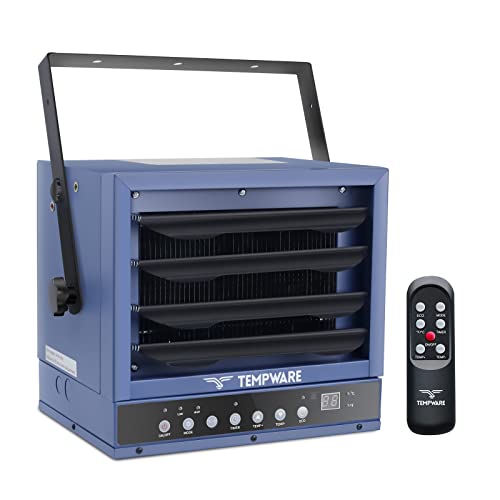
The TEMPWARE 7,500W ceiling-mounted shop heater is a digital, hard-wired alternative for garages that need fast warm-up and programmable control.
- Power & Modes: 6,250–7,500W two heat settings with adjustable louvers to direct output.
- Controls & Features: Digital thermostat, full-function remote, ECO mode, 1–12 hour timer, and overheat protection.
- Coverage: Rated to heat large areas—suitable for workshops and large two-car garages when properly installed.
- Use Case: Effective for whole-garage heating where rapid temperature changes and programmability are desired.
Compared with oil-filled radiators, ceiling-mounted fan heaters like this deliver higher BTU outputs and faster warm-up, making them preferred for larger, uninsulated garages or where continuous work requires quick heat recovery.
Buying Guide: How To Choose The Right Garage Radiator Heater
Choosing a heating solution for a garage depends on several factors including size, insulation, intended use, and installation constraints. Below are key considerations to compare radiator-style heaters and dedicated garage heaters.
1. Garage Size And Insulation
Small, Well-Insulated Garages: Portable oil-filled radiators (1500W) can provide comfortable localized warmth near workbenches or parked vehicles for short periods.
Large Or Poorly Insulated Garages: High-output ceiling-mounted fan-forced heaters (6,000–7,500W) are more effective for whole-space heating and faster temperature recovery.
2. Heat Delivery Type
Oil-Filled Radiators: Provide radiant and convective heat with slow warm-up and long-lasting residual heat after shutdown. Quiet and dust-free because they lack fans.
Fan-Forced Ceiling Heaters: Produce quick, forced-air heat, suitable for large volumes but may circulate dust and require more maintenance.
3. Installation & Power Requirements
Portable Units: Plug-in oil radiators need standard outlets and no permanent installation—easy to move and store.
Hard-Wired Units: Ceiling garage heaters typically require 240V hard-wiring and professional installation. Confirm electrical panel capacity and circuit requirements before purchase.
4. Thermostat & Controls
Digital thermostats, timers, and remote control provide convenience and energy savings. For garages used intermittently, programmable timers or ECO modes reduce runtime and operating costs.
5. Safety Features
Look for overheat protection, tip-over switches (for portable units), ETL/UL certification, and cool-touch surfaces where possible. Ceiling heaters should include thermal cutoffs and secure mounting hardware.
6. Noise And Air Quality
Oil-filled radiators operate silently and do not circulate air, ideal for dust-sensitive tasks. Fan-forced units provide more sound and may move particulates; consider filtration or cleaning schedules if air quality is a concern.
7. Portability And Zoning
Portable radiators are useful for zoning heat to a specific workstation. If you need whole-garage heating, ceiling-mounted units remove floor clutter and deliver broader coverage.
8. Efficiency And Runtime Cost
Compare wattage, thermostat accuracy, and ECO or comfort modes. Higher wattage units heat faster but consume more energy. Programmable controls and correct sizing reduce overall energy usage.
9. Durability And Environment
For garages with exposure to dust, chemical fumes, or occasional knocks, prefer heavy-duty metal housings and ceiling-mounted placement to reduce damage risk. Check IP ratings if condensation or moisture is possible.
10. Maintenance And Serviceability
Fan-forced heaters have motors and fans that may require periodic cleaning or lubrication. Oil-filled radiators are generally low-maintenance but inspect cords and casters regularly for wear.
Comparison Perspectives
Performance: Fan-forced ceiling heaters outperform oil radiators for speed and whole-room coverage. Oil radiators offer steady, residual heat and quieter operation.
Cost & Installation: Portable oil-filled units are lower cost and no-installation. Hard-wired garage heaters require upfront installation costs and electrical upgrades in some garages.
Safety & Use Case: Portable radiators are safer for enclosed, closely supervised work areas. Ceiling-mounted heaters are safer in busy garages where floor space must be kept clear.
Energy Use: Properly sized heaters with thermostats and timers will minimize energy waste; match output to garage size and use patterns for best results.
Tips for Getting the Best HVAC Prices
- Prioritize Quality Over Cost
The most critical factor in any HVAC project is the quality of the installation. Don’t compromise on contractor expertise just to save money. - Check for Rebates
Always research current rebates and incentives — they can significantly reduce your overall cost. - Compare Multiple Quotes
Request at least three estimates before making your choice. You can click here to get three free quotes from local professionals. These quotes include available rebates and tax credits and automatically exclude unqualified contractors. - Negotiate Smartly
Once you've chosen a contractor, use the proven strategies from our guide — How Homeowners Can Negotiate with HVAC Dealers — to get the best possible final price.